Roof Inspection for Insurance: What Inspectors Check and How to Pass
Quick answer
A roof inspection for insurance is a short, photo-based report that tells an insurer what your roof is made of, how old it is, how many years of life it has left and whether it shows damage or leaks. In Florida, if your roof is 15 years or older, your insurer must let you get one (at your cost) before requiring a new roof. If it shows at least 5 years of useful life left, the insurer may not refuse you solely because of the roof’s age.
A roof inspection for insurance is not the same as the full inspection you get when you buy a house. It answers a few narrow questions an underwriter needs before writing or renewing a policy: covering material, age, remaining useful life, visible damage and signs of leaks. Each answer has to be backed by photos and a licensed signature.
This guide walks through the roof inspection for insurance form that Florida inspectors fill in, line by line, the damage boxes that cause trouble, how Florida law counts your roof’s age, and what changed in Texas in September 2026. It ends with a worked example, the questions to ask your insurer and a week-before checklist. Every rule here was checked against its official source, as explained in how we verify our guides.
Table of Contents
Roof inspection for insurance at a glance
| Question | Short answer | Where it comes from |
|---|---|---|
| What is it? | A roof-only condition report with photos, used to decide if a home is insurable | Citizens sample Roof Inspection Form (RCF-1 03 25) |
| What does it record? | Covering material, roof age, remaining useful life, last permit and update dates, overall condition, damage, leaks | Citizens RCF-1 03 25 |
| Photos required | Each roof slope, plus every hazard or deficiency | Citizens RCF-1 03 25 |
| Who can sign it in Florida? | A licensed general, residential, building or roofing contractor, building code inspector or home inspector (for the Citizens form) | Citizens RCF-1 03 25 |
| Who pays? | You do, when it is the inspection Florida law lets you request for a roof 15+ years old | Fla. Stat. § 627.7011(5)(c) |
| Key Florida number | 5 years of remaining useful life | Fla. Stat. § 627.7011(5)(c) |
| Does a wind mitigation report count? | No. It verifies wind features, not roof condition | Note on Citizens RCF-1 03 25 |
What a roof inspection for insurance actually is
Think of a roof inspection for insurance as a one-page answer sheet for an underwriter. The inspector does not design repairs or quote a new roof. They record facts about the roof as it is today, take the required photos and sign that the statements are true. The insurer then decides whether the roof meets its rules.
Citizens Property Insurance Corporation, Florida’s state-created insurer, publishes a sample Roof Inspection Form that many inspectors use as a template. The form says it is not mandatory, but any other report must include at least the same level of detail. That makes it the clearest public checklist of what a roof inspection for insurance has to cover.
The form also draws a clear line between two documents that homeowners often mix up. It notes that it does not verify loss mitigation features, and points to the Uniform Mitigation Verification Inspection Form (OIR-B1-1802) for that. The reverse is also true: a wind mitigation report describes roof shape, deck nails and straps, not whether your shingles are worn out.
Roof inspection vs. 4-point vs. wind mitigation
| Report | What it covers | What it does not prove |
|---|---|---|
| Roof inspection | Roof covering, age, remaining useful life, condition, damage, leaks | Electrical, plumbing, HVAC, wind-resistance features |
| 4-point inspection | Roof, electrical, plumbing and HVAC: type, age and condition of each | Wind-resistance features such as roof-to-wall connections |
| Wind mitigation (OIR-B1-1802) | Building code, roof covering, deck attachment, roof-to-wall attachment, roof shape, secondary water resistance, opening protection | Roof condition or remaining life |
The Florida Chief Financial Officer’s four-point inspection guide describes the roof part of a 4-point the same way: type, age, condition and visible damage. It adds that an insurer may ask for documentation of at least five years of remaining useful life for roofs older than 15 years (shingles) or 20 years (tile or metal). So if your insurer asked for a 4-point, the roof section will face the same questions as a stand-alone roof inspection for insurance.
What inspectors check: the form, line by line
The Citizens form asks the same block of questions twice: once for the predominant roof and once for any secondary roof (a porch, an addition or a flat section). Here is what each line of a roof inspection for insurance means and what you can do before the visit.
| Line on the form | What the inspector records | What you can prepare |
|---|---|---|
| Covering material | Shingle, tile, metal, built-up, membrane or other | Your roofing contract or invoice naming the product |
| Roof age (years) | Years since the roof was installed or fully replaced | Permit records, closing documents, receipts |
| Remaining useful life (years) | The inspector’s estimate of how long the covering will keep working | Records of repairs and maintenance since installation |
| Date of last roofing permit | The permit date from your local building department | A printout or screenshot of the permit search |
| Date of last update | When the roof was last replaced, fully or partly | Invoices with dates |
| Full or partial replacement, % replaced | How much of the roof the update covered | The contract showing the scope of work |
| Overall condition | Satisfactory or unsatisfactory, with an explanation if unsatisfactory | Fix known problems before the visit and keep proof |
| Visible damage or deterioration | Eight checkboxes (see the next section) | A walk-around from the ground and photos of anything odd |
| Visible signs of leaks | Attic or underside of decking; interior ceilings. Since the 2025 update, any “yes” must be explained | Clear access to the attic hatch; look at ceilings near the roof edges |
Citizens updated this form in March 2025. Its agent bulletin says the roof form was changed to mirror the 4-point form, and that a “yes” on visible leaks must now be expanded in writing. Inspectors may still use their own template, so ask which one yours will use.
The 8 damage boxes that can sink a roof inspection for insurance
These are the checkboxes on the Citizens form under “Any visible signs of damage / deterioration?” A tick on any of them does not automatically mean you will be refused, but the inspector must explain it, and the insurer will read that explanation closely.
| Checkbox | What it usually looks like | Before the visit |
|---|---|---|
| Cracking | Splits in shingles or tiles | Ask a licensed roofer to repair and keep the invoice |
| Cupping / curling | Shingle edges lifting or bowing | Get an opinion on whether it is repairable or end-of-life |
| Excessive granule loss | Bald patches; granules piling up in gutters | Clean gutters so the inspector sees the real condition |
| Exposed asphalt | Dark, shiny areas where granules are gone | Usually a sign of age; ask a roofer about remaining life |
| Exposed felt | Underlayment visible through the covering | Repair before the inspection |
| Missing / loose / cracked tabs or tiles | Gaps after a storm, slipped tiles | Replace missing pieces and keep photos before and after |
| Soft spots in decking | Areas that give underfoot | Needs a roofer; often means water got into the deck |
| Visible hail damage | Dents or bruises on shingles, metal or vents | Check your policy and talk to your insurer before any claim |
Two leak questions follow: signs of leaks in the attic or on the underside of the decking, and signs on interior ceilings. An old stain can still read as a sign of a leak, so if the leak was fixed, keep the repair invoice ready to show the inspector.
Florida’s 15-year rule and the roof inspection for insurance
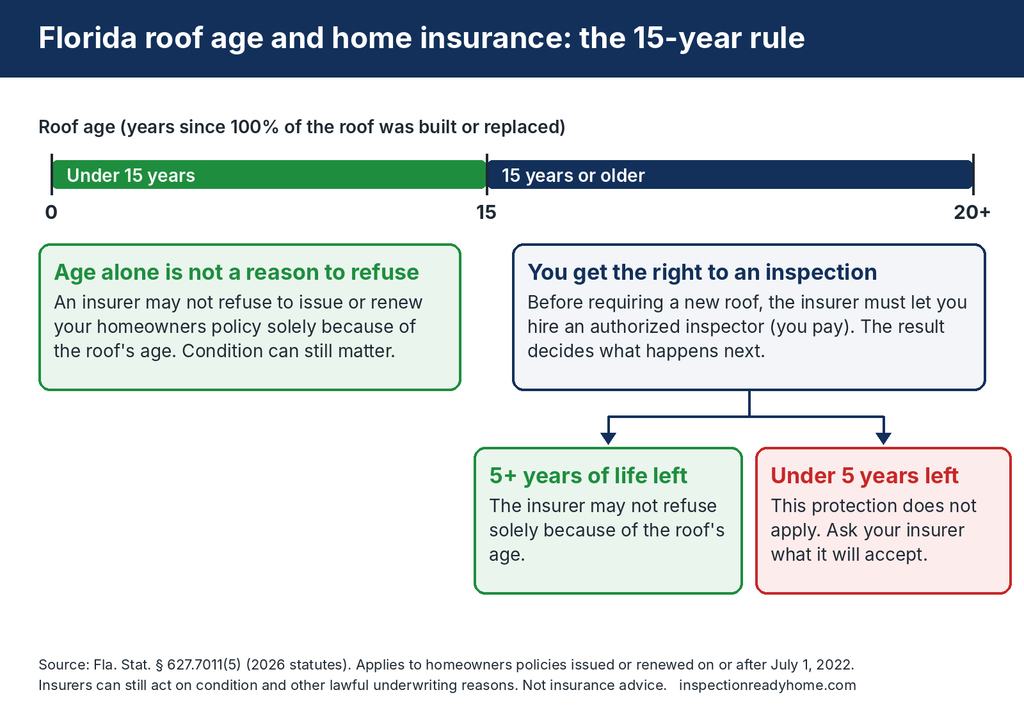
Florida is the state where a roof inspection for insurance carries the most legal weight. Section 627.7011(5) of the Florida Statutes sets three rules for homeowners policies issued or renewed on or after July 1, 2022:
- Under 15 years: an insurer may not refuse to issue or renew your homeowners policy solely because of the roof’s age.
- 15 years or older: before requiring a new roof as a condition of coverage, the insurer must let you have the roof inspected by an authorized inspector, at your expense.
- 5+ years of life left: if that inspection shows the roof has 5 years or more of useful life remaining, the insurer may not refuse to issue or renew solely because of roof age.
The same section lists who counts as an authorized inspector, as long as the insurer approves them: a licensed home inspector, a certified building code inspector, a licensed general, building, residential or roofing contractor, a licensed professional engineer or architect, or anyone else the insurer recognizes as qualified. The law also keeps the insurer free to act on other lawful reasons, such as the roof’s condition.
A 2026 bill, SB 808, proposed changes such as treating low-slope and steep-slope roofs differently. The 2026 edition of the statutes on the Florida Senate site still shows the wording above, which is what we describe here.
How Florida counts your roof’s age
Paragraph (d) of the statute says roof age runs from the last date when 100% of the roof’s surface was built or replaced under the building code in effect at that time. If the roof was replaced in stages, the clock starts at the first partial replacement in the series that ended up covering 100% of the surface. Finishing the job later does not reset the clock to the later date.
Worked example: three Florida homes, one renewal date
Assume each policy renews on December 1, 2026. The dates below are invented to show the math.
| Home | Roof history | Start date for roof age | Age at renewal | What the statute means here |
|---|---|---|---|---|
| A | Full shingle replacement, permit closed March 15, 2010 | March 15, 2010 | 16 years, 8 months | 15+: insurer must allow an inspection before requiring replacement |
| B | 60% replaced May 10, 2011; remaining 40% replaced in 2014 | May 10, 2011 (first partial replacement) | 15 years, 6 months | 15+: same as Home A, even though part of the roof is newer |
| C | Full replacement August 20, 2014 | August 20, 2014 | 12 years, 3 months | Under 15: no refusal solely because of age |
Home B is the one that surprises people. The newest section is only 12 years old, but under paragraph (d) the age counts from 2011. If Home A’s inspector writes “remaining useful life: 6 years”, the insurer may not refuse or non-renew on roof age alone. If the report says 3 years, the age protection does not apply and the insurer’s own rules decide.
The diagram above sums up how the 15-year rule shapes a roof inspection for insurance in Florida. Keep in mind that “solely because of roof age” is the key phrase: an insurer can still act on a roof in poor condition, or on other underwriting grounds, at any age.
Who pays, who signs and how to check the inspector
In Florida, the statute says the roof inspection for insurance you request for a roof 15 years or older is done at your expense. We have not found an official price range for a roof-only inspection, so we do not quote one. For a sense of scale, the CFO guide says a standalone four-point inspection, which covers the roof plus three other systems, typically costs $100 to $300.
The signature matters as much as the content. The Citizens form will not be accepted without the dated signature of a licensed general, residential, building or roofing contractor, a building code inspector or a Florida-licensed home inspector, along with the license number. Before you book, look up the license on the Florida Department of Business and Professional Regulation site, MyFloridaLicense.com, which the CFO guide recommends.
- Ask the inspector which form they will use and whether it matches what your insurer accepts.
- Confirm they will photograph every slope and every deficiency, as the form requires.
- Ask whether they will go into the attic: the form asks about leaks on the underside of the decking.
- Ask how soon you will get the signed report and in what format.
Ask your insurer before you book
- Which roof inspection form or report do you accept?
- How recent must the report be when I submit it?
- What roof age do you have on file for my home, and what document is it based on?
- How many years of remaining useful life do you require for my roof type?
- Will you accept a repair invoice plus a new report if the inspector finds damage?
- Do I need a separate 4-point or wind mitigation report as well?
Outside Florida: Texas and the aerial-photo problem
Florida is not the only state where roof age and condition are in the news. On September 29, 2026, the Texas Department of Insurance clarified its rule that insurers cannot decline or non-renew a home policy based on the age of the house or its roof. Insurers may still base decisions on the physical condition of the home and its parts, including the roof. In practice, that makes a clear, current roof inspection for insurance more useful in Texas, not less.
In many other states, the first “inspection” is a photo taken from a plane or drone, not a visit. The Connecticut Insurance Department, in a March 19, 2024 notice, said cosmetic issues such as natural discoloration and streaking do not support a non-renewal, and that aerial images alone showing only cosmetic issues may not be used for it. As an example of a safeguard, it pointed to a physical inspection, or a report from a licensed contractor or roofer submitted by the policyholder.
If you get a letter that cites your roof’s condition, ask for the specific reason and any images used, and consider a licensed roofer’s written report as your reply. Then contact your state’s insurance department if you believe the decision is wrong.
The week before your roof inspection for insurance: a 7-step checklist
- Find the permit date. Search your county or city building department records for the last roofing permit and note whether it covered the whole roof.
- Collect the paperwork. Roofing contract, invoices for repairs, and any earlier inspection reports.
- Walk around the house. From the ground, look for missing shingles or tiles, lifted edges and debris. Take dated photos.
- Check the ceilings. Look near exterior walls and in closets for stains. If you find one, know the story behind it.
- Open the way to the attic. Clear the hatch and the space under it so the inspector can see the underside of the decking.
- Clean the gutters. Clogged gutters hide granule loss and can make water stains worse.
- Fix what is fixable. Use a licensed roofer for repairs and keep the invoice to show the inspector and the insurer.
Frequently asked questions
How long does a roof inspection for insurance take?
We have not found an official figure for how long a roof inspection for insurance takes on its own. The Florida CFO guide says a four-point inspection, which covers the roof plus electrical, plumbing and HVAC, should generally take about an hour. Ask your inspector how long they expect for your home, especially if they need to enter the attic.
Is a roof inspection the same as a roof certification?
In everyday use, mostly yes: a roof certification and a roof inspection for insurance usually mean the same document. Citizens renamed its “Roof Condition Certification Form” to “Roof Inspection Form” in a 2018 update. Many insurers, agents and inspectors still call the document a roof certification.
Can my wind mitigation report prove my roof is in good shape?
No. The Citizens roof form states that it does not verify mitigation features and that those belong on form OIR-B1-1802. A wind mitigation report describes how the roof is built and attached, not how worn it is.
Can a Florida insurer drop me because my roof is 16 years old?
Not solely because of age, if an authorized inspector finds at least 5 years of useful life left. That protection comes from section 627.7011(5) and applies to homeowners policies issued or renewed on or after July 1, 2022. The insurer can still act on condition or other lawful reasons.
What if the report says less than 5 years of life left?
Then the age protection in the statute does not apply, and your insurer’s rules decide. Your options are usually repair and re-inspection, replacement, or shopping for other coverage. Ask your insurer exactly what it will accept before you spend money.
When to call a pro
- You see stains on ceilings or in the attic and do not know their cause.
- Shingles are curling, cracking or missing, or tiles have slipped.
- Any area of the roof feels soft or sags.
- Your insurer has sent a letter about your roof’s age or condition.
- You are buying a home with a roof close to 15 years old in Florida.
A licensed roofer can repair problems and give you a written condition report. A licensed home inspector or contractor can complete the roof inspection for insurance. For coverage questions, talk to your insurer or a licensed agent.
Sources
- Florida Statutes 2026, section 627.7011 (Florida Senate)
- Citizens Property Insurance Corporation, sample Roof Inspection Form RCF-1 03 25
- Citizens, “Roof and 4-Point Inspection Form Updates” (March 20, 2025)
- Citizens, “Roof and 4-Point Inspection Form Updates” (February 2018)
- Florida CFO, Insurance Consumer Advocate: What to Expect: Four-Point Inspection
- Florida Senate, SB 808 (2026): Roofing Requirements for Property Insurance
- Texas Department of Insurance news release, September 29, 2026
- Connecticut Insurance Department, notice on roof condition and aerial imagery (March 19, 2024)
- Florida Department of Business and Professional Regulation license search
This guide is general information about home insurance inspections, not insurance, legal or roofing advice. Daniel Aznar, who writes this site, is not a home inspector, a roofer or an insurance agent. Rules, forms and insurer requirements change: confirm what applies to your policy with your insurer, a licensed agent or a licensed inspector. Read our full disclaimer, and if you spot an error, our corrections page explains how we fix it. Information checked in October 2026.