These home insurance inspection tools help you get your house ready for the reports Florida insurers ask for: the 4 point inspection, the wind mitigation inspection and the roof inspection. Each tool runs in your browser, nothing you enter is sent to us, and every rule links to the official source it comes from.
Table of Contents
Home insurance inspection tools you can use now
Home insurance inspection checklist (4-Point Self-Check)
Walk through 24 checks across the roof, electrical, plumbing and water heater, and HVAC, plus access and timing. Mark each one OK, Not sure or Problem. You get a status for each system, a to-do list with problems first and a list of the paperwork to have ready, which you can print or save as a PDF.
- Best for: anyone whose agent asked for a 4 point inspection, and agents preparing a listing.
- Built from: the Citizens 4-Point Inspection Form (sample Insp4pt 03 25) and the Florida CFO’s consumer guide to the four-point inspection.
- Time: one walk around the house, with your invoices nearby.
Roof age and insurance checker (How long does a roof last?)
Pick your roof covering, the year it was put on and your state. You see the typical lifespan for that covering, your roof’s age as an insurer counts it, and which roof-age lines you have passed under Florida law, the Florida CFO guide, Citizens and the Texas Department of Insurance. You can download a calendar reminder for the next line.
- Best for: owners of roofs 12 years or older, and anyone whose insurer asked for a roof inspection.
- Built from: Fla. Stat. 627.7011(5), the Citizens inspections page, the CFO four-point guide, the TDI release of September 29, 2026 and the InterNACHI life expectancy chart.
- Time: under a minute, with your roof permit date if you have it.
Paperwork tracker (homeowners insurance declarations page)
Enter your renewal date from the declarations page and the date of each report: wind mitigation, 4-point, roof report, the Texas certificate of insurability or any document of your own. You see how long each one stays valid, which ones run out before your renewal, and you can download calendar reminders 60 and 30 days ahead.
- Best for: anyone with a renewal coming up, and anyone whose discount depends on a wind mitigation report.
- Built from: the Florida OIR wind mitigation page, the CFO four-point guide and the Texas Voluntary Inspection Program.
- Time: two minutes, with your declarations page and reports at hand.
More home insurance inspection tools are being built one at a time, and each one is checked against its official source before it goes live. Until then, the guides below cover the other inspections in detail.
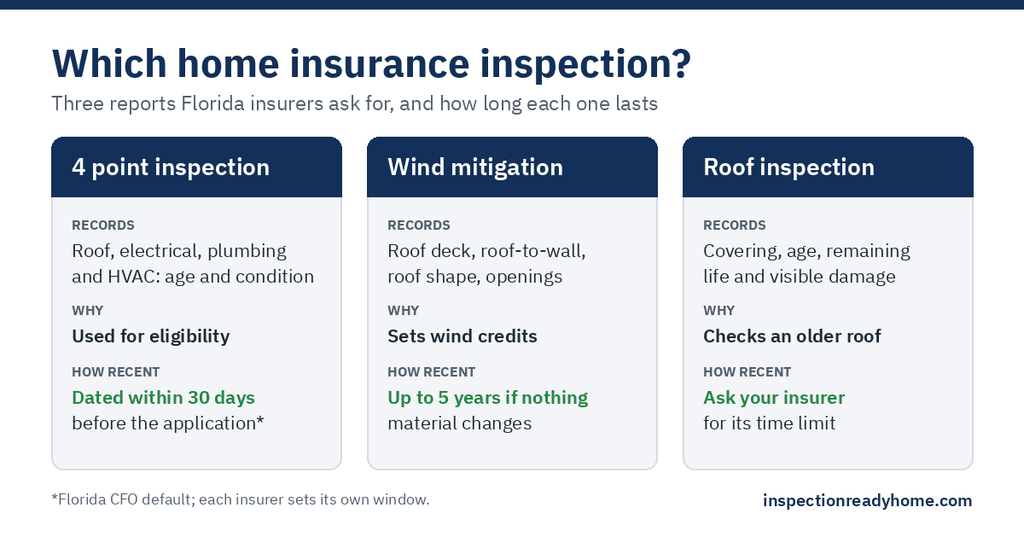
Which inspection is your insurer asking for?
Insurers use three different reports, and people often mix them up. Find the one your agent named, then use the matching tool or guide.
| 4 point inspection | Wind mitigation inspection | Roof inspection | |
|---|---|---|---|
| What it records | Age, type and condition of the roof, electrical, plumbing and HVAC | Wind-resistant features: roof deck, roof-to-wall connections, roof shape, opening protection | Roof covering, age, remaining useful life and visible damage |
| Why the insurer wants it | To decide whether the home is eligible | To apply wind mitigation credits to the premium | To check an older roof |
| When it is asked for | Commonly when a policy is issued or renewed; Citizens requires it for homes over 20 years old | When you want the credits on a Florida policy | At Citizens, shingle roofs over 25 years and hard roofs over 50 |
| How recent it must be | By default, dated within 30 days before the application | Up to 5 years, if nothing material changes | Ask your insurer (track it) |
| Our help | Checklist and guide | Inspection guide and form guide | Roof age checker and roof inspection guide |
Guides that go with our home insurance inspection tools
- 4 point inspection: what the inspector checks and the photos insurers want
- Roof inspection for insurance: what inspectors check and how to pass
- Wind mitigation inspection: what it checks and what changed in 2026
- Wind mitigation form explained, question by question
How our home insurance inspection tools work
- Private by design. Everything runs in your browser. Answers can be saved in your own browser so you can come back, and nothing is sent to us. Our privacy policy explains this.
- Sourced and dated. Every rule a tool uses links to the official document it comes from, with the date we last checked it.
- Printable. Results print cleanly, with the page address at the bottom, so you can hand them to a contractor or your agent.
- No predictions. A tool helps you prepare. The inspector fills in the form and the insurer makes the decision.
- No sales. No quote forms, no sign-ups and no insurer recommendations.
Frequently asked questions
Are these home insurance inspection tools free?
Yes. There is no account and no sign-up. The site is funded by advertising, as our privacy policy explains.
Do the tools work outside Florida?
The 4-Point Self-Check is built from a Florida form, the one Citizens uses; the roof age checker covers Florida and Texas rules and shows typical lifespans for any state; the paperwork tracker knows the Florida and Texas report rules and takes any document of your own, so it works with a declarations page from any state. Many of the checks, such as leaks or a breaker that keeps tripping, are worth reviewing before any insurance inspection. Ask your insurer which form it uses.
Can a tool replace the inspection?
No. The Florida CFO’s guide says the 4 point report must be completed by a verifiable Florida-licensed professional. Our tools only help you find and fix problems before that visit.
Sources
- Florida Department of Financial Services (CFO), Office of the Insurance Consumer Advocate, What to Expect: Four-Point Inspection
- Citizens Property Insurance Corporation, Inspections
- Citizens, 4-Point Inspection Form, sample Insp4pt 03 25
Our home insurance inspection tools are for preparation only, not insurance, legal or construction advice. They do not predict what an inspector or insurer will decide. Read our disclaimer and how we verify each rule. Information checked in October 2026.