Wind Mitigation Inspection: What It Checks and What Changed in 2026
Quick answer
A wind mitigation inspection is a visit by a qualified inspector who records how well your home is built to resist wind: roof shape, how the roof deck and the roof-to-wall connections are fastened, any sealed roof deck, and window and door protection. In Florida the findings go on form OIR-B1-1802, which grew to 9 questions on April 1, 2026. Your insurer uses the report to decide which wind mitigation credits you get.
A wind mitigation inspection does not judge whether your home is in good shape. It answers one narrow question for your insurer: which wind-resistant features does this house have, and can each one be proven? Every answer needs a photo or a document behind it, and a qualified inspector has to sign the form.
This guide covers what changed on the Florida form in 2026, the 9 things the inspector checks and where they look, the 6 mistakes that most often cost homeowners credits, what an inspection costs, and how long a report stays valid. Every rule was checked against its official source, as explained in how we verify our guides. If your insurer asked about the roof’s condition instead, our guide to the roof inspection for insurance covers that report.
Table of Contents
Already have a report? It is good for up to 5 years. Add its date and your renewal date from your homeowners insurance declarations page to our free tracker to get a reminder before it runs out.
Wind mitigation inspection at a glance
| Official form (Florida) | Uniform Mitigation Verification Inspection Form, OIR-B1-1802 (Rev. 04/26), 6 pages |
| Required for inspections from | April 1, 2026. Inspections before that date could use the Rev. 01/12 form |
| Number of questions | 9 (the 2012 form had 7) |
| Proof required | At least one photo or document for each attribute marked in questions 2 to 9 |
| Who can sign | Licensed home inspectors with hurricane mitigation training, certified building code inspectors, licensed general, building or residential contractors, professional engineers, architects, or others the insurer recognizes |
| How long it is valid | Up to 5 years, if no material changes are made to the structure and no inaccuracies are found |
| Typical price | No official figure. Consumer price guides cite about $75 to $150 |
| Is it mandatory? | No Florida statute we reviewed makes homeowners get one. The law requires insurers to offer credits for proven features |
What is a wind mitigation inspection?
A wind mitigation inspection is a fact-finding visit. The inspector does not test anything, design repairs or tell you whether the roof is worn out. They look at specific building features, photograph them, and mark one answer per question on a standard form. Your insurer then matches those answers to the mitigation credits in its rates.
The reason this matters in Florida is section 627.0629 of the Florida Statutes. It says rate filings for residential property insurance must include “actuarially reasonable” discounts, credits or other rate differentials for homes with features that reduce wind losses, such as roof strength and opening protection. The inspection is how you prove those features exist. Without it, the insurer has no verified record to apply them to.
People call the result different names: wind mit, wind mitigation report, wind mitigation certificate or uniform mitigation verification. In Florida they all point to the same document, form OIR-B1-1802. It is not the same as a 4-point inspection, which looks at the age and condition of the roof, electrical, plumbing and HVAC, and it does not replace a roof condition report.
What changed in 2026: from 7 questions to 9
Section 627.0629 requires the Florida Office of Insurance Regulation (OIR) to review mitigation features and their discounts by January 1, 2025, and every 5 years after that. Following a 2024 wind-loss study, OIR updated the form effective April 1, 2026. The Florida CFO says the new Rev. 04/26 form must be used for all inspections from that date, while inspections done before it could use the older Rev. 01/12 version.
| # | Rev. 01/12 form (2012) | Rev. 04/26 form (2026) | What is new for you |
|---|---|---|---|
| 1 | Building Code | Building Code | Same idea: which code was in force when the home was permitted |
| 2 | Roof Covering | Region | New. Your design wind speed zone, based on ASCE 7-22 |
| 3 | Roof Deck Attachment | Roof Slope | New. Steeper or flatter than a 6:12 pitch |
| 4 | Roof to Wall Attachment | Roof Covering | Moved down |
| 5 | Roof Geometry | Roof Deck Attachment | Same idea: how the roof sheathing is fastened. Includes a spray foam answer |
| 6 | Secondary Water Resistance | Roof to Wall Attachment | Adds minimum uplift capacities for each level |
| 7 | Opening Protection | Roof Geometry | Moved down |
| 8 | — | Sealed Roof Deck / Secondary Water Resistance | Renamed “sealed roof deck” |
| 9 | — | Opening Protection | Moved to the end |
Two other changes matter more than the numbering. First, the new form says at least one photo or document must accompany it to validate each attribute marked in questions 2 through 9. Second, a FORTIFIED Home Roof, Silver or Gold certificate may be used to validate questions 4 to 6 and 8 to 9, with a photocopy attached. If your home has one, give it to the inspector.
The 9 checks, in the order the inspector walks the house
The form is numbered by topic, but the visit itself moves through three places: paperwork, the attic and the outside of the house. Here is what the inspector looks at in each one. We explain every answer option in detail in our guide to the wind mitigation form.
At the desk: records and location
- Building code (question 1). Whether the original permit application fell under the 2001/2004 Florida Building Code, the 2007 code or later, or, in Miami-Dade and Broward, the 1994 South Florida Building Code. Permit records answer this.
- Region (question 2). The home’s design wind speed zone: the High-Velocity Hurricane Zone, Region 1 (140 mph or more), Region 2 (130 to 139 mph) or Region 3 (under 130 mph), looked up for your address.
- Roof covering (question 4). Each covering type, with its permit date or product approval number and the year it was installed. This is where a missing permit date hurts.
In the attic: how the roof is fastened
- Roof deck attachment (question 5). The weakest way the roof sheathing is fastened. Staples or 6d nails are the basic answer. 8d common nails at 12 inches or 6 inches in the field earn the stronger answers, as do systems tested to 103 or 182 psf of uplift.
- Roof-to-wall attachment (question 6). The weakest connection between the roof framing and the walls, from toenails up to double wraps or structural anchors. The next section shows the levels.
- Sealed roof deck (question 8). Whether there is a secondary barrier against water if shingles or tiles blow off, such as a fully adhered underlayment, taped deck seams, a double layer of felt or synthetic, or spray foam at the joints.
Outside: shape and openings
- Roof slope (question 3). Whether at least two-thirds of the main roof is steeper or flatter than a 6:12 pitch.
- Roof geometry (question 7). A hip roof counts only if other roof shapes make up no more than 10% of the total roof perimeter. A flat roof answer is for buildings with 5 or more units. Everything else is “other”.
- Opening protection (question 9). The weakest wind-borne debris protection on windows, doors, skylights and garage doors. Verified impact products rated for a 9 lb large missile score highest. Products that look rated but cannot be verified get a lower level.
Notice the word “weakest” in questions 5, 6 and 9. The form does not average your home. One under-nailed section of roof deck, one toenailed truss or one unprotected window can set the answer for the whole house.
Roof-to-wall connections: the attic check in detail
Question 6 is the part of the visit that homeowners can least see for themselves, because the connections sit where the roof trusses or rafters meet the top of the walls, often under insulation. The 2026 form now lists a minimum wind uplift capacity for each level, so a purpose-made connector or other documented method can qualify by its rated strength.
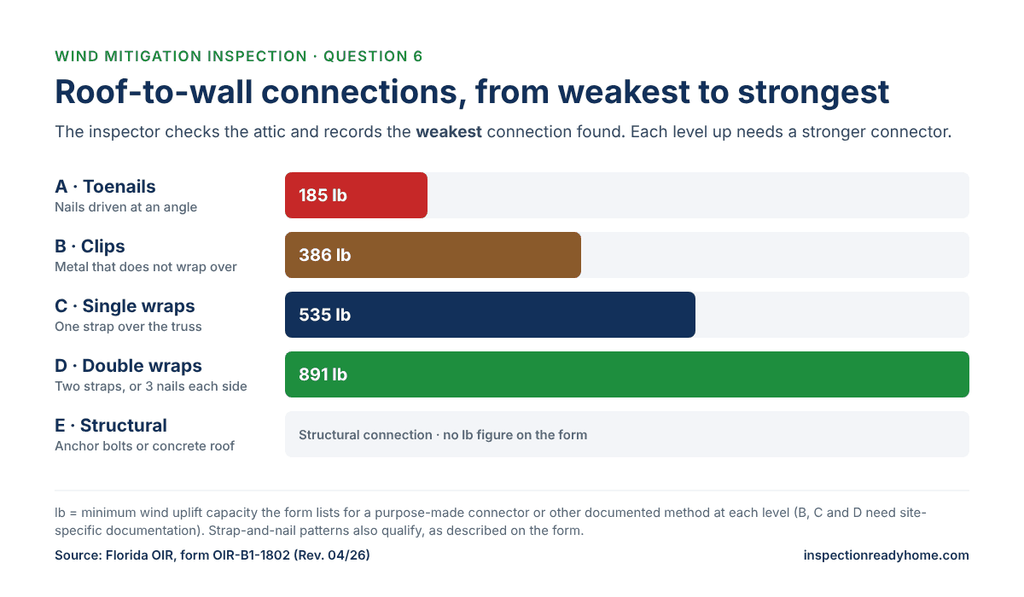
| Answer | What it looks like | Minimum rated capacity on the form |
|---|---|---|
| A. Toenails | Nails driven at an angle through the truss into the wall’s top plate, or connectors not installed as intended | 185 lb (other documented methods) |
| B. Clips | Metal connectors that do not wrap over the truss, or a strap with at least 3 nails that misses the wrap nail pattern | 386 lb |
| C. Single wraps | One strap over the truss, with at least 2 nails on one side and 1 on the other | 535 lb |
| D. Double wraps | Two straps, one on each side of the truss, or one strap with at least 3 nails on each side | 891 lb |
| E. Structural | Anchor bolts structurally connected, or a reinforced concrete roof | No lb figure |
For clips, single wraps and double wraps, the form also sets minimum conditions: metal connectors fastened with at least three nails, less than a ½-inch gap, and no visible severe corrosion. Connectors that are not installed as intended do not count as clips or wraps, and the form has a separate answer for them. If you are unsure what you have, ask the inspector to show you their attic photos after the visit.
6 costly mistakes that weaken a wind mitigation inspection
There is no pass or fail line on the form. But some situations push an answer down to its weakest option, or leave the inspector unable to verify a feature you paid for. These are the six we see written into the form itself.
| Mistake | What the form says | What to do instead |
|---|---|---|
| 1. No proof for a feature | At least one photo or document must validate each attribute in questions 2 to 9 | Gather permits, product approval numbers and invoices before the visit |
| 2. Shutters or windows you cannot verify | Products that appear to be rated but are not verified get level N, below A and B | Find labels, product approval numbers or the installer’s paperwork |
| 3. A damaged window or door | Answer Z applies when one or more openings need repair or replacement | Repair cracked glass, broken shutters or damaged garage doors first |
| 4. No way into the attic | Questions 5 and 6 have a “No attic access” answer | Clear the hatch, the closet below it and a path to the eaves |
| 5. An inspector who is not authorized | The insurer must accept forms from listed professionals; forms from others are optional for the insurer | Confirm the license type before you book |
| 6. Keeping an old report after a re-roof | Validity depends on no material changes to the structure | Get a new wind mitigation inspection after major roof work |
Mistake 6 can also work in your favor. A re-roof done to current code often changes several answers at once: roof covering, deck attachment and sealed roof deck. A fresh wind mitigation inspection is the only way those upgrades reach your policy.
Wind mitigation inspection cost, and the free option
No Florida agency publishes an official price for this inspection, and prices are set by each inspector. Two consumer price guides give a sense of the range: Angi lists a normal range of $85 to $125, with an average of $100 (updated July 2026), and Policygenius says around $75 to $150 (updated May 2024). Ask for a written quote, and ask whether a combined 4-point and wind mitigation visit costs less.
There is also a free route for some Florida homeowners. When we checked in October 2026, the My Safe Florida Home program’s website said free wind mitigation inspections were available. The program has its own eligibility rules, and our My Safe Florida Home guide turns them into a 9-point test, so check it before you pay for a private inspection.
One cost you should not pay twice: if your insurer wants to double-check a form signed by an authorized inspector, section 627.711 says it may require an independent verification “at the insurer’s expense”.
Wind mitigation inspection in Florida: what the law says
Florida is where this inspection is most formalized, because two statutes and an OIR rule shape it. Here is what each piece does for you as a homeowner.
- Credits must exist. Section 627.0629 requires residential property rate filings to include discounts, credits or other rate differentials, or deductible reductions, for homes with wind-loss mitigation features.
- Insurers must tell you. Since October 1, 2023, the same section requires insurers to post information about their hurricane mitigation discounts on their website. The Florida CFO adds that admitted insurers must send a Notice of Premium Discounts for Hurricane Loss Mitigation with each new policy and at each renewal.
- Insurers must accept the form. Section 627.711 says an insurer must accept as valid a uniform mitigation verification form signed by an authorized inspector. It may ask for independent verification at its own expense.
- Lying on it is a crime. Knowingly providing a false form to get a discount you are not entitled to is a first-degree misdemeanor under the same section.
Who can sign the form
Section 627.711(2)(a) lists who the insurer must accept: a home inspector licensed under s. 468.8314 who has completed at least 3 hours of approved hurricane mitigation training and a proficiency exam, a certified building code inspector, a licensed general, building or residential contractor, a professional engineer, a professional architect, or anyone else the insurer recognizes as qualified. Check any Florida license on MyFloridaLicense.com.
The signer must inspect the home personally. Only licensed contractors and engineers may send a direct employee, and they stay responsible for that employee’s work. At the end, you sign too: the homeowner section asks you to confirm the named inspector did the inspection and showed proof of identification.
If you are insured with Citizens, its wind mitigation page says to send the completed report to your agent, who submits it to Citizens.
How long a wind mitigation report stays valid
The form and the Florida CFO give the same rule: a completed form is valid for up to five years, as long as no material changes are made to the structure and no inaccuracies are found. “Up to” matters. Five years is the ceiling, not a promise that every insurer will keep using an older report.
Worked example: is your report still good on October 15, 2026?
Three hypothetical Florida homes, each with a wind mitigation report on file. The dates are invented to show the math.
| Home | Inspection date and form | Changes since | 5-year limit | Time left on Oct 15, 2026 | What it means |
|---|---|---|---|---|---|
| A | September 12, 2022, Rev. 01/12 | None | September 12, 2027 | 10 months, 28 days | Still within 5 years. Plan the next inspection for mid-2027 |
| B | February 3, 2023, Rev. 01/12 | Full re-roof in June 2025 | February 3, 2028 | 1 year, 3 months on paper | A re-roof is a material change. Get a new inspection on the Rev. 04/26 form |
| C | May 20, 2026, Rev. 04/26 | None | May 20, 2031 | 4 years, 7 months | Valid, already on the new form |
Home B is the trap. On paper the report has more than a year left, but the new roof changed what the inspector would see on several questions, which is exactly what the “no material changes” condition is about. Home B’s owner also has the most to gain from a new wind mitigation inspection, because a code-compliant re-roof can upgrade the roof covering, deck attachment and sealed roof deck answers.
Before your wind mitigation inspection: a 7-item document kit
Because every answer needs proof, the best preparation is paperwork, not cleaning. Put these in one folder, paper or digital, before the inspector arrives.
- Your policy details. The form asks for your insurance company and policy number.
- Building permits. The original permit and any re-roof permit, from your county or city records.
- Roofing contract and invoice. Ideally naming the product, its product approval number and the underlayment used.
- Window, door and shutter paperwork. Product approval numbers, labels or installer invoices for every protected opening, including the garage door.
- Any FORTIFIED certificate. Roof, Silver or Gold. The form lets it validate several answers.
- Your previous wind mitigation report. It shows the inspector what was found before.
- Clear access. To the attic hatch and to every window and door, including those behind furniture.
Frequently asked questions
Can you fail a wind mitigation inspection?
Not in the usual sense. A wind mitigation inspection records features; it has no pass or fail result. Weaker answers simply mean fewer or no credits, and your insurer decides how each answer is priced. The answers to watch are “unknown”, “no attic access” and the Z level for damaged openings.
Is a wind mitigation inspection required in Florida?
None of the Florida statutes we reviewed require homeowners to get one. Florida law instead requires insurers to offer credits for proven wind-resistant features. Without a report, there is nothing verified for your insurer to apply them to, so it is worth getting one when you buy, insure or re-roof a home.
How long is a wind mitigation inspection good for?
Up to five years, provided no material changes are made to the structure and no inaccuracies are found on the form. Major roof work or new windows are good reasons to get a new one sooner.
Is a wind mitigation certificate the same as the report?
Yes, in everyday use. “Wind mitigation certificate”, “wind mit report” and “wind mitigation inspection report” all usually mean the signed form OIR-B1-1802. A FORTIFIED certificate is different: it comes from a separate program and can be attached to the form as proof.
Does a wind mitigation inspection lower my insurance?
It can, if it verifies features that qualify for credits under your insurer’s rates. How much depends on your answers, your insurer and your policy, so we do not quote amounts. Ask your insurer or agent to show you the mitigation credits on your current declarations page before and after the new report. To see whether your premium is high to begin with, compare it with the official average cost of homeowners insurance in Florida for your county.
When to call a pro
- You are buying a home in Florida and want to know which credits it can earn.
- You replaced the roof, windows, doors or garage door since your last report.
- Your report is more than four years old, or was done on the 2012 form.
- Your report says “unknown” or “no attic access” on a question you think your home meets.
- Windows, doors or shutters are damaged after a storm.
An authorized inspector can complete a new wind mitigation inspection. A licensed contractor can repair or upgrade connections, roofing or openings. For questions about credits on your policy, talk to your insurer or a licensed agent.
Sources
- Florida OIR, Uniform Mitigation Verification Inspection Form OIR-B1-1802 (Rev. 04/26)
- Florida OIR, form OIR-B1-1802 (Rev. 01/12), prior version
- Florida OIR, Wind Mitigation Resources
- Florida Department of Financial Services (CFO), Mitigation Notices, Inspections and Forms
- Florida Statutes 2026, section 627.711 (Florida Senate)
- Florida Statutes 2026, section 627.0629 (Florida Senate)
- Citizens Property Insurance Corporation, Wind Mitigation Inspections
- My Safe Florida Home program
- Angi, wind mitigation inspection cost (updated July 2026)
- Policygenius, What is a wind mitigation inspection? (updated May 2024)
- Florida Department of Business and Professional Regulation license search
This guide is general information about home insurance inspections, not insurance, legal or construction advice. Daniel Aznar, who writes this site, is not a home inspector, a contractor or an insurance agent. Forms, rules and insurer requirements change: confirm what applies to your home and policy with your insurer, a licensed agent or an authorized inspector. Read our full disclaimer, and if you spot an error, our corrections page explains how we fix it. Information checked in October 2026.