Federal Pacific Electrical Panel: How to Spot One and What Home Insurers Do About It
Quick answer
A federal pacific electrical panel is a breaker box made by Federal Pacific Electric (FPE), usually installed from the 1950s to the 1980s. You can spot one by the FPE or Federal Pacific name on the door and the word Stab-Lok on the label inside. Many home insurers treat it as a red flag because some Stab-Lok breakers failed lab tests. If your 4 point inspection lists one, expect questions; a full panel replacement by a licensed electrician, with a permit, is the paperwork insurers accept most easily.
A federal pacific electrical panel can stop an insurance application cold, even when every light in the house works. In Florida, the inspector writes the panel brand on the 4 point inspection form and photographs the label, and the underwriter decides what to do with it. You do not need to open anything to find out whether you have one.
This guide gives you a five-step test to identify a federal pacific electrical panel from the outside, explains what regulators and a court actually said about Stab-Lok breakers, shows what the 4 point form records, and compares your three options with the documents each one gives your insurer. Every fact links to the source we read, as explained in how we verify our guides.
Table of Contents
Is it a federal pacific electrical panel? A 5-step test
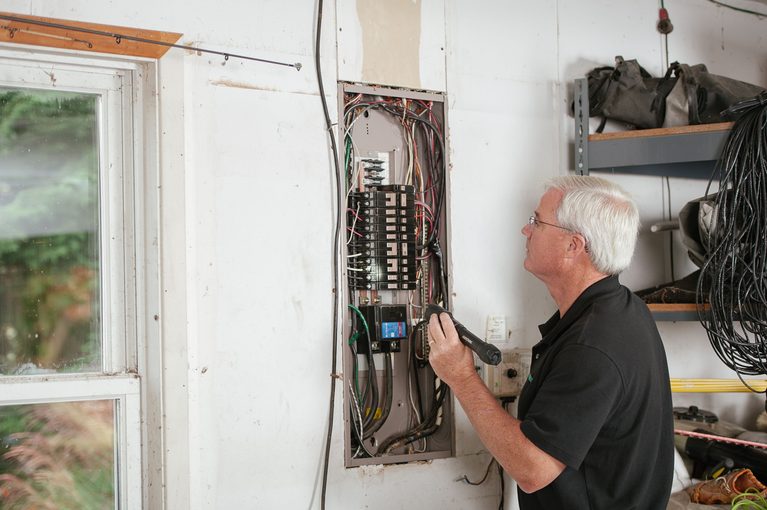
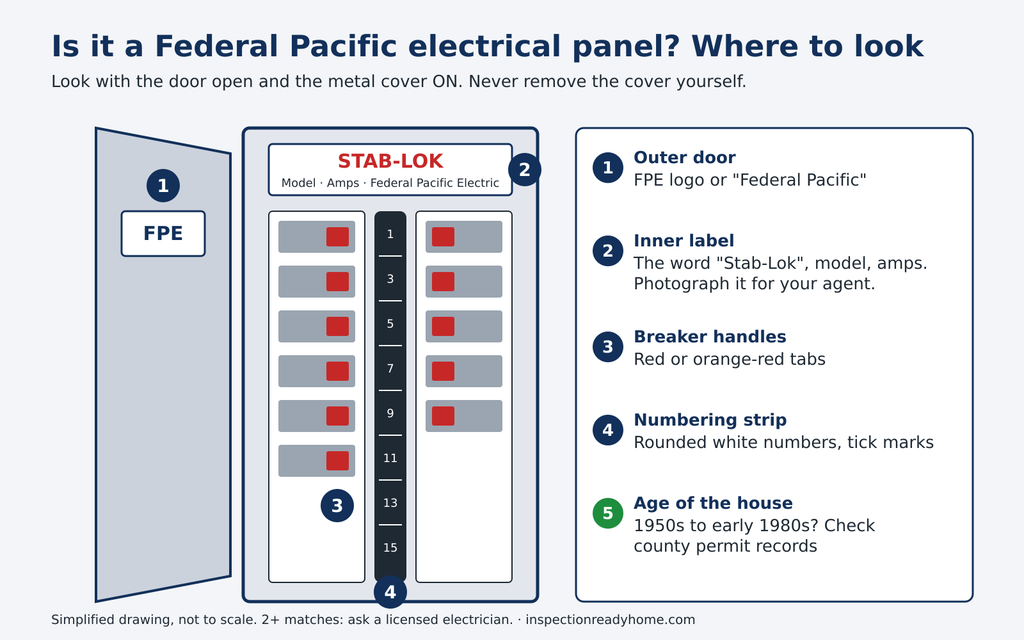
Start with the federal pacific electrical panel test below. Steps 1 to 4 need only your eyes and a flashlight, with the panel door open and the metal cover left on. Do not remove the cover or touch wires: that is a job for a licensed electrician. Cincinnati Insurance, in a loss-control guide on FPE panels, uses the same clues in the same order.
- Read the outer door. Look for the words Federal Pacific, Federal Pacific Electric or the FPE logo. A painted-over or replaced door can hide them, so keep going even if you see nothing.
- Read the label inside the door. FPE panels usually show the word Stab-Lok on the inner label or on the panel face, often near the top between the two rows of breakers. The panel model and amp rating are on the same label.
- Look at the breaker handles. Stab-Lok breakers typically have red or orange-red tabs on the handles.
- Check the numbering strip. Between the rows, FPE panels often have white-painted numbers with rounded corners and small tick marks, or white numbers on a black background on non-Stab-Lok models.
- Estimate the age. A home built or last rewired between the 1950s and the early 1980s is the most likely to have an original federal pacific electrical panel. Permit records from your county can confirm a later upgrade.
If two or more steps match, assume you have one until an electrician says otherwise. The table below turns each clue into what it means for your insurer.
| What you see | What it probably means | What to do next |
|---|---|---|
| FPE or Federal Pacific on the door | Likely FPE, unless the door was swapped | Check the inner label to confirm |
| Stab-Lok on the inner label | FPE Stab-Lok panel, the type this guide is about | Photograph the label for your agent |
| Red-tipped breakers, no FPE name visible | Possibly Stab-Lok or Stab-Lok-type replacement breakers | Ask an electrician to identify the panel |
| Another brand on door and label, house built after 1990 | Unlikely FPE | No action for this issue |
| Panel replaced, with permit and final inspection | Not an issue for the insurer | Keep the permit with your policy papers |
Why insurers worry about a federal pacific electrical panel
A breaker has one job: cut the power when a circuit draws more current than its wires can carry. The concern with a federal pacific electrical panel is that some Stab-Lok breakers did not reliably do that in testing. Here is what the public record says, in date order.
- June 1980. According to the Consumer Product Safety Commission, Reliance Electric, FPE’s parent company, reported that many FPE breakers, mostly two-pole residential models made before 1979, did not fully meet Underwriters Laboratories (UL) requirements. CPSC testing confirmed that some failed UL calibration tests.
- March 3, 1983. The CPSC closed its two-year investigation. It said the data did not show that the breakers posed a serious risk of injury, but also that its staff lacked the data to accept or refute Reliance’s position. Gathering that data would have cost several million dollars, against a budget of $34 million.
- February 18, 2011. The CPSC revised the 1983 release with a note telling electricians, homeowners, inspectors and real estate agents that it closed the matter without deciding whether FPE breakers are safe. There was never a recall.
- 2005. A class action notice from the Superior Court of New Jersey, Middlesex County, reported by the American Society of Home Inspectors, said the court found FPE had violated the New Jersey Consumer Fraud Act by cheating on the tests it used to obtain UL approval. Only a narrow group of original New Jersey owners could claim, with a deadline of April 20, 2005.
So the honest summary is this: no federal agency has declared a federal pacific electrical panel dangerous, and none has cleared it either. Cincinnati Insurance’s guide cites an independent peer-reviewed study in which 28% of tested breakers failed to trip, and recommends replacing the whole panel. That open question is why underwriters look twice when one shows up on a report.
What a 4 point inspection records about a federal pacific electrical panel
Florida insurers commonly ask for a 4 point inspection on older homes, and the Citizens sample 4-Point form (Insp4pt 03 25) shows what the inspector must write down. The form has no box that says federal pacific electrical panel. It does not need one: the brand goes on the form and the label goes in the photos.
| Form field or photo | What the inspector records | Why it matters for an FPE panel |
|---|---|---|
| Supplemental information: Brand/Model | The panel maker and model, for the main and any second panel | This is where FPE or Stab-Lok appears. The underwriter reads it |
| Panel age and Year last updated | When the panel went in or was last replaced | An old original panel reads very differently from a 2024 upgrade |
| Photo: main electrical service panel with interior door label | A close photo of the inner label | The Stab-Lok name is usually on this label |
| Photo: electrical box with panel off | The breakers and wiring behind the cover | Shows red-tipped breakers, scorching or double taps |
| Hazards present (12 listed, plus Other) | Double taps, scorching, tripping breakers, corrosion, improper breaker size and more | Any ticked box is a second problem on top of the brand |
| General condition: Satisfactory or Unsatisfactory | The inspector’s overall verdict | Unsatisfactory needs a written explanation |
The Florida CFO’s four-point inspection guide adds that insurers usually want a report dated within the last 30 days and that repairs may be required before a policy is issued. Citizens’ form also tells agents they may not submit applications for homes with electrical systems not in good working order or with existing hazards. If you want to see the whole electrical section before the visit, our free 4-point self-check walks through it. If the same report also ticks cloth wiring or active knob and tube, our guide to knob and tube wiring covers that question.
Stab-Lok breakers: why swapping breakers is usually not the fix
A Stab-Lok breaker clips onto the panel’s bus bar instead of bolting to it. Cincinnati Insurance notes that on Stab-Lok panels the breaker attachment points can wear, raising resistance and heat. That is one reason a breaker-only swap on a federal pacific electrical panel rarely satisfies an underwriter.
- The panel stays. New breakers do not change the bus bar or the label. The inspector still writes the same brand on the form.
- Replacement Stab-Lok-type breakers exist. They are sold for these panels by other makers. Whether an insurer accepts them is its own decision; ask before you buy.
- The paperwork is thinner. A breaker swap often has no permit, so you cannot show an inspected, dated upgrade.
Cincinnati Insurance also says to treat bolt-on FPE panels the same as Stab-Lok ones. If a seller or contractor tells you a federal pacific electrical panel is fine because it has new breakers, ask your insurer in writing before you rely on it.
Three options for a federal pacific electrical panel, and what each tells your insurer
Once a report lists a federal pacific electrical panel, owners usually end up on one of three paths. The pass and fail columns show how an underwriter is likely to read each one; your insurer’s written answer is what counts.
| Option | What you get | Likely insurer reading | Proof you can send |
|---|---|---|---|
| 1. Keep the panel and get it evaluated | An electrician’s written evaluation of condition | Varies by insurer: ask in writing whether an evaluation is enough | Signed evaluation on the electrician’s letterhead |
| 2. Replace the breakers only | New breakers in the old panel | Often not enough: brand and label unchanged | Invoice; usually no permit |
| 3. Replace the whole panel | A new panel and breakers, installed to current code | Usually resolves it | Permit, final inspection, invoice, photos of the new label |
Cost depends on the house, the panel size, the permit fees and how much wiring has to be corrected around the new panel, so we do not publish a single number. Get two or three written quotes from licensed electricians and make sure each one includes the permit and the final inspection. Our guide to the home insurance inspection explains what happens if the insurer finds the panel after your policy starts.
Worked example: same 1974 house, two outcomes
Picture a 1974 Florida home with its original federal pacific electrical panel. The owner switches insurers and needs a 4 point inspection. Two neighbors on the same street have identical houses. Here is how their files look a month later, using only the rules above; the details are an illustration with assumed facts.
| Step | Owner A: breakers swapped | Owner B: panel replaced |
|---|---|---|
| Work done before the inspection | New Stab-Lok-type breakers, no permit | New 200-amp panel, permit pulled, final inspection passed |
| Brand/Model on the 4 point form | Federal Pacific Stab-Lok | The new panel’s brand and model |
| Panel age / Year last updated | Original / breakers only | New / this year |
| Hazards ticked | None | None |
| What the agent can submit | Form plus an invoice | Form, permit, final inspection and invoice |
| Likely next step | Underwriter asks for replacement or declines | Application moves forward on the electrical point |
Owner A spent money and still has a federal pacific electrical panel on paper. Owner B’s permit and final inspection are the documents that close the question. The lesson: before you fix anything, ask the insurer which fix it accepts.
Paperwork to keep after you replace a federal pacific electrical panel
- The permit and the final inspection sign-off from your city or county.
- The electrician’s invoice with license number, date, address and the new panel’s brand, model and amp rating.
- Before and after photos of the panel with the door open and the inner label readable.
- A new 4 point inspection if the old one listed FPE, so the insurer’s file shows the current panel.
- The insurer’s written confirmation that the condition is cleared, if it had set one.
Keep these with your policy documents. Texas owners whose home is hard to insure can also look at the Texas Voluntary Inspection Program, which checks wiring among other standards.
Ask your insurer before you hire an electrician
- Do you accept a federal pacific electrical panel at all, or only after replacement?
- Would an electrician’s written evaluation be enough instead of a replacement?
- Do you accept replacement Stab-Lok-type breakers, or must the whole panel go?
- How long do I have to finish the work, and what proof do you need?
- Will you need a new 4 point inspection after the work, and dated within how many days?
Frequently asked questions
Is a Federal Pacific panel illegal?
We found no federal rule that makes owning one illegal, and the CPSC never ordered a recall. New electrical work must meet your local code and permit rules, and the real limit for most owners is whether their insurer will cover the home with the panel in place.
Should all Federal Pacific panels be replaced?
The CPSC says it never decided whether the breakers are safe, so there is no official answer. Many electricians, home inspectors and insurers recommend replacement, and Cincinnati Insurance’s guide recommends replacing the whole panel. Have a licensed electrician evaluate yours and ask your insurer what it requires.
How much does it cost to replace a Federal Pacific panel?
It depends on panel size, permit fees, local labor rates and any wiring that must be corrected, so we do not quote a national figure. Ask at least two licensed electricians for written quotes that include the permit and the final inspection, and check whether your insurer sets a deadline.
Can I sell a house with a federal pacific electrical panel?
Yes, but expect it to come up. A buyer’s home inspector will usually note it, and the buyer’s insurer may ask for a 4 point inspection or a replacement before it will write a policy. Disclosure rules vary by state, so ask your agent or a real estate attorney what you must disclose.
Does homeowners insurance cover a fire caused by a Federal Pacific panel?
Fire is a covered peril on standard homeowners policies, but your policy wording, any conditions the insurer set and what you told it on the application all matter. If the insurer asked you to replace the panel and you did not, read the letter carefully and ask the insurer in writing how it affects coverage. Our guide to what homeowners insurance pays for explains how covered causes work.
When to call a pro
- Now, not later: a warm or buzzing panel, a burning smell, scorch marks, or a breaker that will not stay on or will not trip. Call a licensed electrician; for smoke or sparks, call 911.
- Your 4 point inspection lists a federal pacific electrical panel: get an electrician’s written evaluation and quote, then ask your insurer which fix it accepts.
- You are buying a home with one: ask for an electrician’s quote during your inspection period and line up insurance before closing.
- Your insurer gave you a deadline: book the electrician and the permit early, because the final inspection date is what the insurer usually wants to see.
For coverage decisions, talk to your insurer or a licensed agent. For the panel itself, only a licensed electrician should open it.
Sources
- U.S. Consumer Product Safety Commission, Commission Closes Investigation of FPE Circuit Breakers (March 3, 1983; revised February 18, 2011)
- Citizens Property Insurance Corporation, 4-Point Inspection Form (sample)
- Florida Department of Financial Services, Insurance Consumer Advocate, What to Expect: Four-Point Inspection
- Cincinnati Insurance, FPE breaker panels: What’s the deal? (July 10, 2025)
- American Society of Home Inspectors, New Jersey finds Federal Pacific (FPE) guilty of consumer fraud (April 1, 2005)
- Texas Department of Insurance, Voluntary Inspection Program
This guide to the federal pacific electrical panel is general information, not insurance, legal or electrical advice. Daniel Aznar, who writes this site, is not an electrician, home inspector or insurance agent. Never open an electrical panel yourself: hire a licensed electrician, and confirm what your insurer requires with the insurer or a licensed agent. Read our full disclaimer, and if you spot an error, our corrections page explains how we fix it. Information checked in November 2026.