Does Homeowners Insurance Cover Roof Replacement? When It Pays and When It Doesn’t
Quick answer
Does homeowners insurance cover roof replacement? Only when a covered event, such as wind, hail or fire, damages the roof badly enough that repair is not enough. It does not pay to replace a roof that is simply old or worn out. Even when the claim is approved, your deductible, the age of the roof and whether the policy pays actual cash value or replacement cost decide how much you get.
Does homeowners insurance cover roof replacement? Sometimes, and the difference comes down to cause. Insurance pays for sudden damage from an event your policy covers. It does not pay for a roof that has reached the end of its life, because that is maintenance, and maintenance is your job.
This guide walks you through a five-question test to see where your roof stands, eight common situations and how insurers usually treat them, a worked example of what three roofs of different ages would actually collect, and the Florida and Texas rules that change the picture. Every legal point links to its official source, as we explain in how we verify our guides.
Table of Contents
Already know you need a new roof? Our roof replacement guide covers what it costs by home size, the Florida code work that adds to quotes and the paperwork to send your insurer afterward.
Before any claim, a roofer usually inspects the damage. Our roof inspection guide explains what gets checked, what it costs and how to spot a “free roof” pitch that Florida law prohibits.
Roof replacement and homeowners insurance at a glance
| Question | Short answer |
|---|---|
| Is a storm-damaged roof covered? | Usually, if the peril (wind, hail, fire, weight of ice or snow) is covered by your policy |
| Is an old, worn-out roof covered? | No. Wear, tear and lack of maintenance are not covered |
| Repair or full replacement? | The insurer pays for the damage. A full replacement is paid only when the damage justifies it |
| How much will I get? | Depends on your deductible and on actual cash value (ACV) versus replacement cost (RCV) settlement |
| Does roof age matter? | Yes. On an ACV policy, older roofs collect less, sometimes nothing |
| Florida claim deadline | Notice within 1 year of the date of loss; supplemental claims within 18 months |
| Can the insurer make me replace my roof? | It can make a new roof a condition of coverage, within state limits such as Florida’s 15-year rule |
Does homeowners insurance cover roof replacement in your case? A five-question test
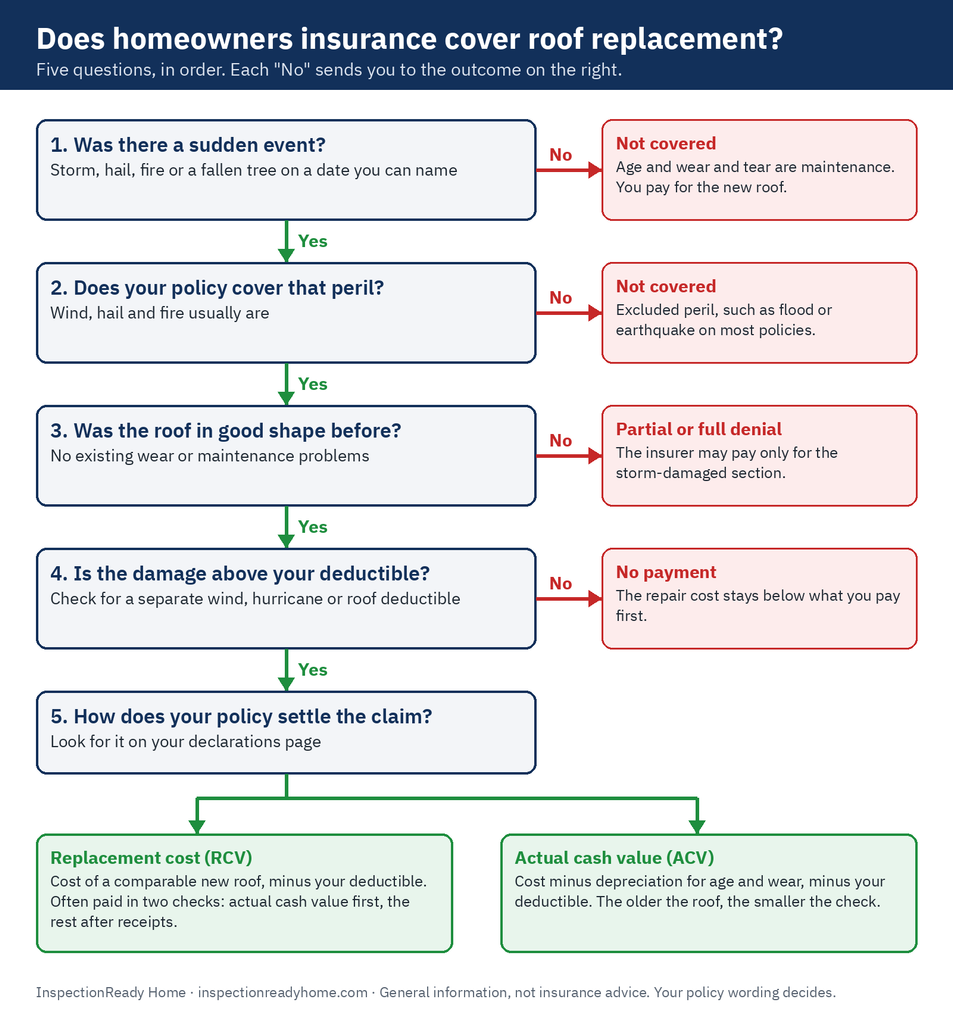
Insurers do not publish one shared rule, and each policy has its own wording. But almost every roof claim runs through the same five questions, in this order. Answer them honestly before you call anyone.
- Was there a sudden event? A storm, hail, a fallen tree or a fire on a date you can name. If the roof just got older and started leaking, the answer is no, and insurance will treat it as wear and tear.
- Is that event covered by your policy? Wind, hail and fire usually are. Flood and earthquake are usually excluded. Look for the list of perils and the exclusions in your policy.
- Was the roof in good condition before? If the roof already needed maintenance, the claim can be denied in part or in full, or paid only for the damaged section.
- Is the damage bigger than your deductible? Check whether you have a separate wind, hurricane or roof deductible. A percentage deductible on an expensive home can swallow a small claim.
- How does your policy settle roof claims? Replacement cost or actual cash value. This decides how much of the bill you carry.
Three yes answers and a damage bill above your deductible put you in a good position: in your case, the answer to “does homeowners insurance cover roof replacement?” is probably yes. A no to question 1 or 3 usually means the cost is yours, whatever a contractor at your door says.
8 roof situations and how insurers usually treat them
The same question gets very different answers depending on what happened to the roof. This table sorts the most common situations, from the ones most likely to be paid to the ones that almost never are.
| # | Situation | Usually covered? | Why | What to do |
|---|---|---|---|---|
| 1 | Hail cracks or bruises shingles on a roof in good shape | Yes, subject to deductible and settlement method | Hail is a typical covered peril | Photograph the damage, note the storm date, file a claim |
| 2 | Wind tears off shingles across several slopes | Yes, often | Wind is a typical covered peril; the scale of damage can justify a full roof | Cover the opening to prevent more damage, keep the receipts |
| 3 | Fire damages the roof | Yes | Fire is a typical covered peril | Call the insurer; keep the fire department report |
| 4 | Wind lifts a few shingles on one slope | Partly: usually repair, not replacement | The insurer pays for the damage, not for a new roof | Ask for the adjuster’s estimate in writing |
| 5 | A tree falls on the roof in a storm | Often, check your policy | Depends on the perils your policy lists | Have the tree removed by a pro; photograph before and after |
| 6 | Damage to a roof that already needed maintenance | Partly or no | Pre-existing wear can lead to a partial or full denial | Keep maintenance and repair records from before the storm |
| 7 | Old roof leaking from age, with no storm | No | Wear and tear is maintenance, not an insured loss | Budget for replacement; get quotes. See whether homeowners insurance covers roof leaks |
| 8 | Insurer requires a new roof to issue or renew the policy | No: this is not a claim | It is an underwriting condition, paid by you | See the Florida 15-year rule below; get a roof inspection |
Situation 8 is the one most people mean when they ask “does homeowners insurance cover roof replacement?” A letter that says “replace the roof or lose the policy” is not a claim at all. You pay for the new roof, and our guide to the roof inspection for insurance explains how a report on the roof’s remaining life can sometimes avoid it.
How much insurance pays: replacement cost vs actual cash value
Two policies can approve the same roof claim and pay very different amounts. The difference is the loss settlement method on your declarations page. The Tennessee Department of Commerce and Insurance gives a clear definition: actual cash value pays replacement cost minus depreciation, where depreciation reflects the roof’s age and wear.
- Replacement cost (RCV). Pays what a comparable new roof costs today, minus your deductible. Many insurers pay a first check for the actual cash value and the rest once the work is done and you send the receipts.
- Actual cash value (ACV). Pays the depreciated value of the roof, minus your deductible. The older the roof, the smaller the check.
The Texas Department of Insurance shows how sharp the drop can be. In its own example, with a $10,000 roof and a $4,000 deductible, replacement cost pays $6,000 at any roof age, while actual cash value pays $4,500 on a 5-year-old roof, $3,000 at 10 years and nothing at 20.
Worked example: three roofs, same storm
Three neighbors lose their roofs in the same hailstorm. Each roof would cost $16,000 to replace, each policy has a $2,000 deductible, and we assume the insurer depreciates the roof in a straight line over a 25-year life. Only the roof’s age changes.
| Roof age | Depreciation | ACV policy pays | RCV policy pays | Gap you cover on ACV |
|---|---|---|---|---|
| 4 years | $2,560 | $11,440 | $14,000 | $2,560 |
| 12 years | $7,680 | $6,320 | $14,000 | $7,680 |
| 20 years | $12,800 | $1,200 | $14,000 | $12,800 |
On a replacement cost policy, all three owners end up with a new roof for the price of their deductible. On an actual cash value policy, the owner of the 20-year-old roof collects about $1,200 toward a $16,000 job. Same storm, same deductible: the settlement method is worth more than any other line on the policy. So does homeowners insurance cover roof replacement on an older roof? It covers the storm damage, but on an ACV policy it may pay for only a small part of the new roof.
Florida rules on roof claims and roof replacement
Florida writes many of its roof rules into statute. Four sections matter most when you ask “does homeowners insurance cover roof replacement?” in Florida.
How a Florida insurer pays a roof claim
Under section 627.7011 of the Florida Statutes, a dwelling insurer must first pay at least the actual cash value of the loss, then the remaining amounts as repairs are performed. If your policy has a separate roof deductible, the insurer may limit the roof payment to actual cash value until you show reasonable proof that you paid that deductible. If the home is a total loss, replacement cost is paid without holding back depreciation.
The 15-year roof rule
The same section limits when roof age alone can cost you a policy:
- Under 15 years old. An insurer may not refuse to issue or renew a homeowners policy solely because of the roof’s age.
- 15 years or older. Before requiring a new roof, the insurer must let you get a roof inspection by an authorized inspector, at your expense.
- 5 years of life left. If that inspection shows at least 5 years of useful life remaining, the insurer may not refuse to issue or renew solely because of roof age.
That inspection is the same report covered in our roof inspection for insurance guide. Roof condition also appears on the Florida 4 point inspection, so a worn roof can cause trouble even when the age passes. To see which of these age lines your roof has already crossed, try our free roof age checker.
The 25 percent rule
Partial damage raises a building code question. Section 553.844 says that if a roof was built, repaired or replaced under the 2007 Florida Building Code or a later edition, and 25 percent or more of it is repaired or replaced, only the repaired part has to meet the current code. The statute’s exception does not mention older roofs, so if yours predates the 2007 code, ask your roofer and your local building department what the job requires, and ask your insurer whether your policy pays for code upgrades.
Claim deadlines
Under section 627.70132, notice of an initial or reopened property claim must reach the insurer within 1 year after the date of loss, and a supplemental claim within 18 months. Waiting to see whether a leak gets worse can cost you the claim.
Texas rules on roof age and roof claims
On September 29, 2026, the Texas Department of Insurance clarified its rule that insurance companies cannot decline or refuse to renew a home policy because of the age of the house or its roof. They can still base decisions on the physical condition of the home and its parts, including the roofing. In practice, an old roof in good condition should not cost a Texan coverage, while a worn one still can.
For claims, the Texas example above applies: check whether your declarations page says replacement cost or actual cash value for the roof, because that choice decides how much an older roof collects. So does homeowners insurance cover roof replacement in Texas? For storm damage, often. For age alone, no.
When your insurer wants you to replace your roof
This is the opposite of a claim, and it is common in Florida. A notice after a home insurance inspection or at renewal says the roof must be replaced for the policy to continue. Here the answer to “does homeowners insurance cover roof replacement?” is no: insurance will not pay for that roof. What you can do:
- Read the reason. Is it the roof’s age, its condition or both? The answer decides your options.
- In Florida, use the 15-year rule. If the notice is based on age and the roof is 15 or older, get an inspection by an authorized inspector. Five years of remaining life changes the outcome.
- In Texas, check the reason. Age alone is not allowed as a reason to decline or not renew; condition is.
- Fix what is fixable. A repair with invoices and photos sometimes answers a condition problem without a full replacement.
- Shop early. If replacement is unavoidable, get quotes and ask other insurers or a licensed agent about coverage before the deadline. If no private insurer will take the home, your state’s FAIR plan insurance may be the fallback.
Ask your insurer before you file a roof claim
- Does my policy settle roof claims at replacement cost or actual cash value?
- Do I have a separate wind, hurricane or roof deductible, and is it a flat amount or a percentage?
- If you pay actual cash value first, what do you need to release the rest, and by when?
- Does my policy pay for code upgrades if part of the roof is replaced?
- Will you send an adjuster, and can I get the estimate in writing?
How to file a roof claim without hurting it
- Stop further damage. Tarp the opening or have a roofer do it. Keep the receipts and ask your insurer how emergency repairs are reimbursed.
- Document everything. Date-stamped photos of each slope, the attic and any ceiling stains, plus the storm date from a local weather report.
- Give notice early. In Florida, within 1 year of the loss. Elsewhere, read the deadline in your policy.
- Describe facts, not guesses. Tell the adjuster what happened and when. Do not guess at the roof’s age or condition; show the permit or invoice instead.
- Be careful with door-to-door offers. The Maryland Insurance Administration warns that unsolicited “free roof” offers are often fraud, and that only a licensed public adjuster can negotiate a claim for you in that state.
- Keep the paper trail. Estimates, contracts, photos and every letter in one folder. On a replacement cost policy, the final receipts release the rest of the money.
If you are not sure your roof would pass a basic check before any of this happens, our free home insurance inspection checklist walks you through the roof and the other three systems insurers look at.

Frequently asked questions
Does homeowners insurance cover roof replacement due to age?
No. When a roof simply wears out, the answer to “does homeowners insurance cover roof replacement?” is no, because age is a maintenance cost. Insurance pays only when a covered event, such as wind, hail or fire, damages the roof. An old roof can still be covered for storm damage, but on an actual cash value policy the payout shrinks as the roof gets older.
Will insurance cover a 20-year-old roof?
For storm damage, often yes, but how much depends on the policy. In the Texas Department of Insurance example, an actual cash value policy pays nothing on a 20-year-old roof once the deductible is applied, while replacement cost pays the same as on a new roof. In Florida, a roof that old may also face the 15-year inspection rule at renewal.
How much does insurance pay for roof replacement?
The cost of the damage, minus your deductible, adjusted by your settlement method. Replacement cost pays the full cost of a comparable roof once it is replaced. Actual cash value subtracts depreciation for age and wear. Our worked example shows the gap can run from a few thousand dollars to most of the job.
Does a new roof lower your insurance?
It can. Insurers weigh roof age and construction when they price a policy, and in Florida the roof covering and roof deck attachment are recorded on the wind mitigation form. How much it changes your premium depends on the insurer, so ask for a quote before and after, and compare both with the official average cost of homeowners insurance in Florida for your county.
Can my insurer deny a roof claim because of wear and tear?
Yes, for the part of the damage caused by wear. If a covered storm hits a roof that already needed maintenance, the claim can be denied in part or in full, or paid only for the storm-damaged section. Repair records from before the storm help.
When to call a pro
- You see missing, cracked or lifted shingles or tiles after a storm.
- There is a new ceiling stain or water in the attic.
- You received a notice that your roof must be replaced to keep your policy.
- Your claim was denied or paid far less than the roofer’s estimate.
If you are still asking “does homeowners insurance cover roof replacement?” after the five-question test, start with facts: a licensed roofer can document storm damage and give you a written estimate. For disputes over a claim, talk to your insurer, a licensed agent, your state insurance department or, where allowed, a licensed public adjuster or attorney.
Sources
- Florida Statutes 2026, section 627.7011 (Florida Senate)
- Florida Statutes 2026, section 553.844 (Florida Senate)
- Florida Statutes 2026, section 627.70132 (Florida Senate)
- Texas Department of Insurance, Texas homeowners protected from being denied insurance based on roof age (September 29, 2026)
- Texas Department of Insurance, Home policies: replacement cost or actual cash value? (updated January 24, 2024)
- Tennessee Department of Commerce and Insurance, Actual cash value v. replacement cost
- Maryland Insurance Administration, Consumer advisory: roof replacement
- Maryland Insurance Administration, Consumer advisory: free roof offers
This guide to the question “does homeowners insurance cover roof replacement?” is general information, not insurance or legal advice. Daniel Aznar, who writes this site, is not a home inspector, a roofer or an insurance agent. Policy wording and state laws vary: confirm what applies to your home with your insurer, a licensed agent or your state insurance department. Read our full disclaimer, and if you spot an error, our corrections page explains how we fix it. Information checked in October 2026.