Roof Replacement: What It Costs, When You Need One and What to Send Your Insurer
Quick answer
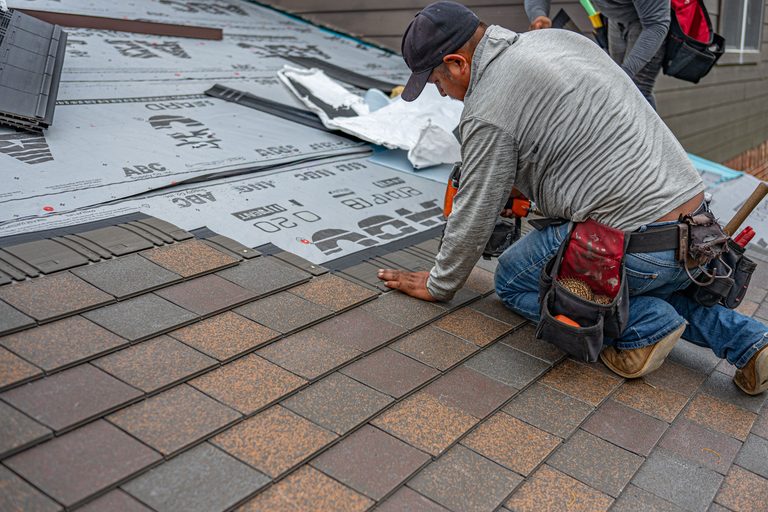
A roof replacement means tearing off the old covering down to the deck and installing a new roof under a building permit. Most cost about $5,866 to $13,209, with an average near $9,511 (Angi survey data). Insurance pays only when a covered event such as wind or hail ruined the roof. After the job, send your insurer the final permit and, in Florida, a new wind mitigation report.
A roof replacement is the biggest repair most owners ever pay for, and it touches your insurance twice: once when you decide who pays, and again when the new roof changes what your insurer sees. This guide covers what it costs, when repair is no longer enough, the steps of a permitted job, the Florida code work that surprises owners, and the paperwork to send your insurer afterward. If you want to know whether your policy pays for it, start with our guide to whether homeowners insurance covers roof replacement.
Table of Contents
Roof replacement cost at a glance
Angi, which surveyed more than 30,000 of its customers, puts the national average roof replacement at $9,511, with most jobs between $5,866 and $13,209 and an overall range of about $4 to $11 per square foot. Your roof is larger than your floor plan because of overhangs and pitch, so price it by roof area, not living area.
| Home size | Approximate roof area | Typical cost range |
|---|---|---|
| 1,000 sq ft | 1,120 sq ft | $4,900 to $12,300 |
| 1,600 sq ft | 1,790 sq ft | $7,800 to $19,700 |
| 2,000 sq ft | 2,235 sq ft | $9,700 to $24,600 |
| 2,400 sq ft | 2,685 sq ft | $11,700 to $29,500 |
| 3,000 sq ft | 3,355 sq ft | $14,600 to $36,900 |
Material moves the price as much as size. Angi gives installed ranges of $5,800 to $20,000 for asphalt shingles, $5,700 to $25,000 for metal, $8,500 to $26,400 for tile and $16,000 to $27,000 for wood shake. It adds $100 to $1,400 for the permit, depending on the city, and $1,000 to $3,000 for a steep roof.
Lifespan matters as much as the sticker price: a cheaper covering you replace sooner can cost more per year. Our roof age and insurance checker shows typical lifespans by covering and the age lines insurers use.
Repair or roof replacement? 6 signs that decide it
A leak or a few missing shingles does not mean you need a whole new roof. These six signs, each tied to a rule or a source, push the decision one way or the other.
| Sign | Usually means | Why |
|---|---|---|
| Repair would cost half or more of a new roof | Replace | Angi’s rule of thumb: at 50% or more, replace the whole roof |
| Two or more layers of roofing already on the deck | Replace (tear-off) | The Florida Existing Building Code requires removing all layers down to the deck before a new covering goes on (Section 706.3, as quoted by the Florida Roofing and Sheet Metal Contractors Association) |
| Existing roof is water soaked or too deteriorated to hold new roofing | Replace (tear-off) | Same code section: a soaked or deteriorated roof is not an adequate base |
| Shingle roof at or past 15 years and your insurer asks about it | Inspect first | In Florida, Fla. Stat. 627.7011(5) lets you show 5 or more years of remaining life with an inspection before an insurer can refuse coverage over age alone |
| Shingle roof over 25 years, or tile or metal over 50, insured with Citizens | Likely replace | Citizens asks for proof of at least 5 years of remaining life, or proof of replacement |
| Small, local damage on a younger roof | Repair | Repair is usually enough, but a covered storm loss may still be a claim worth checking |
If a storm caused the damage, find out what the cause means for payment before you sign anything: our guides to roof leaks and when insurance pays for a new roof walk through it. For an independent look at the roof itself, see our roof inspection guide.
The roof replacement process, step by step
A permitted job follows the same order almost everywhere. The details below are Florida-heavy because Florida adds the most rules; other states follow the same order with fewer inspections.
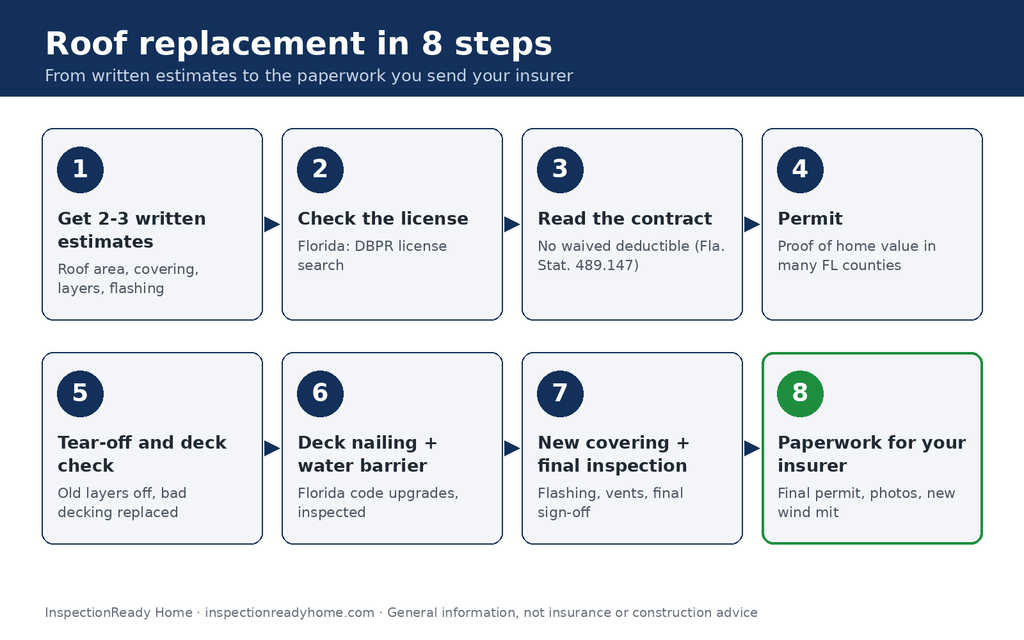
- Get two or three written estimates. Ask each roofer to measure the roof area, list the covering, underlayment, flashing and vents, and say how many layers come off.
- Check the license. In Florida, look up the roofer on the Department of Business and Professional Regulation (DBPR) license search. In other states, ask your city or county building department what license it requires.
- Read the contract before you sign. In Florida, a roofer may not offer gifts or a waived deductible in exchange for a claim or an inspection, and may not interpret your policy or adjust your claim without a public adjuster license (Fla. Stat. 489.147).
- Permit. The contractor pulls the reroof permit. Florida counties such as St. Johns ask for proof of the home’s insured or assessed value with the application, because it decides how much hurricane work the job must include.
- Tear-off and deck check. The old covering comes off down to the deck. Damaged decking gets replaced; check how your contract prices it.
- Deck nailing and water barrier. In Florida this is where code upgrades happen (next section), and the building department may inspect the deck nailing and the dry-in before the covering goes on.
- New covering and final inspection. The roofer installs the covering, flashing and vents, then calls for the final inspection.
- Paperwork. Keep the final permit, the product approvals and photos. Your insurer will ask for them.
Florida reroof rules that change your quote
Florida law (Fla. Stat. 553.844) and the Florida Existing Building Code add hurricane work to many reroofs. County guides, such as the 2026 St. Johns County re-roof worksheet and the City of Sebastian’s re-roof Q&A, describe it the same way. The rules apply to existing site-built single-family homes; Sebastian notes they cover homes built before the Florida Building Code took effect on March 1, 2002.
| Requirement | When it applies | What the roofer does |
|---|---|---|
| Stronger roof deck attachment | Every qualifying reroof, whatever the home’s value | Re-nails the deck where it uses staples or 6d nails, typically with 8d ring-shank nails at 6 inches on center |
| Secondary water barrier | Every qualifying reroof, whatever the home’s value | One of three methods: peel-and-stick underlayment over the whole roof; tape or strips over every deck joint plus underlayment; or two layers of qualifying underlayment |
| Roof-to-wall connections | Homes in the wind-borne debris region valued at $300,000 or more (insured value or just value for tax) | Adds straps or clips, spending up to 15% of the reroof cost; gable ends first |
| Who does the roof-to-wall work | Same homes | A residential, building or general contractor, not a roofing contractor alone |
| Inspections | Every qualifying reroof | Deck nailing, dry-in, in progress and final, plus a re-nailing affidavit in some cities |
This work costs money, but it is also what a wind mitigation inspector looks for. A permitted Florida reroof can change your answers on the wind mitigation form for roof covering, roof deck attachment and secondary water resistance. The inspector decides each answer from the permit, the photos and what they can see.
After the roof replacement: what to send your insurer
A new roof is a material change to your home, so the reports your insurer holds are now out of date. Use this list in the first weeks after the final inspection.
| Document | Why it matters | Where it goes |
|---|---|---|
| Final permit and invoice with the install date | Proves the roof’s new age; Florida’s 15-year roof rule and Citizens’ 25/50-year rule count from it | Your agent or insurer, and your own records |
| New wind mitigation report (Florida) | The Florida OIR says the form stays valid up to 5 years only if no material changes are made; a new roof is one | Your agent, who sends it to the insurer to update credits |
| New 4-point or roof report, if your insurer uses one | Shows the new covering, age and remaining life | Your agent, at the next renewal or when asked |
| Product approval numbers and photos | Back up the covering type and the deck and water barrier work | Kept with the reports; the inspector may ask |
| Next declarations page | Check that the roof year, deductibles and credits changed | Compare with the old one |
Our paperwork tracker keeps the dates of each report and reminds you before one runs out, and our guide to the wind mitigation inspection explains what the new report checks.
Worked example: one roof replacement in Florida
The home: a 2,000 sq ft single-family house built in 1998, about 2,235 sq ft of roof, asphalt shingles from 2007, in the wind-borne debris region. The insured value is $340,000. All prices are assumed for illustration and sit inside Angi’s ranges.
| Item | Before | After the roof replacement | Rule behind it |
|---|---|---|---|
| Roof age the insurer counts | 19 years | 0 years | Fla. Stat. 627.7011(5) |
| Quote for the reroof | — | $18,000 (assumed) | Angi range for this size: $9,700 to $24,600 |
| Deck re-nailing and water barrier | Not present | Required and inspected | Pre-2002 home: required whatever the value |
| Roof-to-wall connections | Toe nails (assumed) | Up to $2,700 of clips or straps | Value over $300,000: up to 15% of $18,000 |
| Wind mitigation report | 2022 report | New report ordered | No longer valid after a material change |
The result: the owner budgets $18,000 plus up to $2,700 for roof-to-wall work, keeps the permit and affidavit, and books a wind mitigation inspection the week after the final. The new roof resets the age clock and gives the insurer fresh evidence for credits.
Paying for a roof replacement
- An insurance claim, only for covered damage. Insurers pay for storm, hail or fire damage, not for a roof that is simply old. The Texas Department of Insurance says replacement cost policies usually pay in two parts, the rest after repairs start; see our coverage guide.
- Your deductible is yours. Texas law requires you to pay it and lets the insurer ask for proof (Insurance Code Chapter 707), and TDI warns that a contractor offering to waive it is breaking the law. Florida bans offering a waived deductible to get a claim or inspection (Fla. Stat. 489.147).
- My Safe Florida Home. Since the 2026 changes, replacing the roof covering can be part of the grant’s roof improvements for eligible owners; see our guide to My Safe Florida Home.
- PACE financing (Florida). Residential PACE is repaid through an assessment on your property tax bill, recorded against the home as a lien; read the disclosure and ask your mortgage servicer before you sign.
- “Free roof replacement” offers. A free roof usually means someone plans to bill your insurer for it. In Florida, a roofer may not offer anything of value for letting them inspect your roof or file a claim.
Ask your roofer before you sign
- How many layers come off, and what do you charge per sheet of replaced decking?
- Is the deck re-nailing and secondary water barrier included, and which method do you use?
- Who pulls the permit, and which inspections will the building department do?
- Will you give me the final permit, product approval numbers and photos of each stage?
- If my home needs roof-to-wall work, who does it and is it in this price?
Frequently asked questions
Is $30,000 too much for a roof replacement?
Not always. On a 3,000 sq ft home, Angi’s range runs from $14,600 to $36,900, and tile, metal or a steep roof push it higher. On a small, simple shingle roof, $30,000 is high: ask for an itemized quote and compare it with two others.
Can I get a new roof for $5,000?
Only on a small, simple roof. Angi starts its range at $4,900 for a 1,000 sq ft home with about 1,120 sq ft of roof. Most homes cost more, and a Florida reroof adds deck nailing and a water barrier.
Does a roof replacement lower my home insurance?
It can. In Florida, a new wind mitigation report after a roof replacement may show stronger answers that earn credits, and an insurer cannot refuse coverage over the roof’s age alone while it is under 15 years. TDI says a Texas insurer might give a discount for roofing materials less likely to be damaged by wind, hail or fire. Ask your insurer which credits apply; our wind mitigation form guide explains each question.
Do I need a permit for a roof replacement?
In most places, yes. Angi puts permit fees at $100 to $1,400 depending on the city. In Florida, the permit is also how the building department checks the deck nailing, water barrier and any roof-to-wall work, and it is the date your insurer uses for the roof’s age.
Will my insurer pay for a new roof?
Only when a covered event damaged the roof badly enough that repair is not enough. Wear and tear are not covered. Our coverage guide has a 5-question test, and our roof inspection for insurance guide explains the report your insurer may want.
When to call a pro
Call a licensed roofer for estimates and the permit, a licensed inspector for the wind mitigation or 4-point report after the job, and your agent before you file a claim. If a claim is disputed, a licensed public adjuster or an attorney can review it.
Sources
- Angi, How much does roof replacement cost? (customer survey data)
- St. Johns County, Re-Roof Mitigation Worksheet (2026)
- City of Sebastian, Re-Roof Mitigation Q&A
- FRSA, When reroofing, the choice to recover or replace may not be yours (Florida Existing Building Code 706.3)
- Florida Statutes 627.7011, homeowners policies (2026)
- Florida Statutes 489.147, prohibited property contractor practices (2026)
- Florida Statutes 553.844, windstorm loss mitigation
- Citizens Property Insurance Corporation, Inspections
- Florida Office of Insurance Regulation, Wind Mitigation Resources
- Texas Department of Insurance, What to know about replacing your roof (updated April 1, 2026)
- Texas Department of Insurance, Is it OK for a contractor to waive my deductible?
- Texas Department of Insurance, Roofing and insurance: know the law
- Florida Senate, bill analysis of SB 770 (2024), residential PACE
This roof replacement guide is general information, not insurance, legal or construction advice. Daniel Aznar is not a roofer, inspector or insurance agent. Check your policy with your insurer and your project with a licensed contractor and your building department. Read our disclaimer, how we verify each source and about the author. Spot an error? Tell us through our corrections page. Information checked in November 2026.