Roof Inspection: What Gets Checked, What It Costs and Which One You Need
Quick answer
A roof inspection is a check of your roof covering, flashing, gutters, vents and attic by a roofer or inspector, who reports damage, leaks and how much life the roof has left. Most cost about $125 to $357 (Angi survey data). Which one you need depends on who is asking: your insurer, your lender, a buyer or a storm.
A roof inspection sounds like one thing, but it is really five or six different jobs. The visit your insurer wants is not the one a buyer’s home inspector does, and neither is the free check a storm chaser offers at your door. This guide shows which type fits your situation, what gets checked, what it costs, what Florida law says about “free” offers and the mistakes that cost owners money. If your insurer has already asked for a report, go straight to our guide to the roof inspection for insurance.
Table of Contents
If the inspector says repair is no longer enough, our roof replacement guide explains the cost, the steps of a permitted job and what to send your insurer when it is done.
Which roof inspection do you need?
Start with the person asking for it. The table matches the most common situations with the type of inspection that answers them.
| Your situation | Type of inspection | Usually done by | What you get |
|---|---|---|---|
| Florida insurer asks about an older roof | Insurer’s roof form or the roof section of a 4-point | Florida-licensed inspector or contractor | Form with roof age, material, condition and remaining useful life, plus photos |
| You are buying a home | Roof section of a general home inspection | Home inspector | Description of the roof covering and visible defects; no life estimate required |
| Lender or appraiser flags the roof | Roof certification letter | Licensed roofing contractor | Written statement of condition and remaining life |
| Wind, hail or a fallen tree hit the roof | Storm damage inspection | Roofer, then the insurer’s adjuster | Photos and notes of new damage for a claim |
| You want a wind discount | Wind mitigation inspection | Qualified wind mitigation inspector | The official mitigation form for your insurer |
| Nothing is wrong yet | Maintenance check | Roofer, or you from the ground | Early warning on small problems |
Two of these have their own guides: the wind mitigation inspection for the wind discount and the 4-point inspection, which covers the roof plus the electrical, plumbing and heating systems.
How a roof inspection works, step by step
- Paperwork first. The inspector asks for the roof’s age. Have the permit, the final inspection or the roofing invoice ready. Without them, the age is an estimate and insurers may treat it as older.
- From the ground. The inspector walks around the house and looks at the roof lines, sagging, missing pieces, gutters and downspouts.
- On or above the roof. Depending on pitch, height and weather, the inspector climbs a ladder to the eaves, walks the roof or flies a drone. Each method is noted in the report.
- Edges and openings. Flashing, vents, pipe boots, skylights and the chimney are where most leaks start, so they get a close look.
- In the attic. Stains, daylight, damp insulation and rot on the underside of the roof deck show problems that are invisible from outside.
- The report. You get photos of each slope and of every problem, the type of covering and, on insurance and certification forms, an estimate of remaining life.
Home inspectors follow written standards that limit what they must do. InterNACHI’s standards, for example, require inspecting the roof from ground level or the eaves and do not require walking on the roof or predicting its service life. That is why a buyer’s home inspection rarely satisfies an insurer or lender that wants a report with a remaining-life figure.
What a roof inspection checks: 12 points
Use this as a reading guide for any report. Each row shows what a sound roof looks like and the red flag an inspector writes down.
| Check | Looks fine | Red flag |
|---|---|---|
| 1. Roof covering | Flat, complete shingles or tiles | Missing, cracked, curled or lifted pieces |
| 2. Granules (asphalt) | Even color and texture | Bald patches, heavy granules in gutters |
| 3. Roof line | Straight ridge and slopes | Sagging or dips in the deck |
| 4. Flashing | Sealed metal at walls, valleys and chimney | Loose, rusted or missing flashing |
| 5. Pipe boots and vents | Tight seals around each opening | Cracked boots, gaps, exposed nails |
| 6. Skylights | Clean seals, no stains below | Fogging, gaps or water marks |
| 7. Chimney | Solid mortar and cap | Cracks, leaning, missing cap |
| 8. Gutters and downspouts | Attached, clear, draining away | Pulled loose, clogged, overflowing |
| 9. Fascia and soffit | Solid wood, no gaps | Rot, holes, animal entry |
| 10. Attic underside | Dry decking, no light through | Stains, mold, daylight, wet insulation |
| 11. Ventilation | Clear intake and exhaust vents | Blocked vents, heavy heat or moisture |
| 12. Past repairs | Matching, permitted work | Patches of mismatched material, unpermitted work |
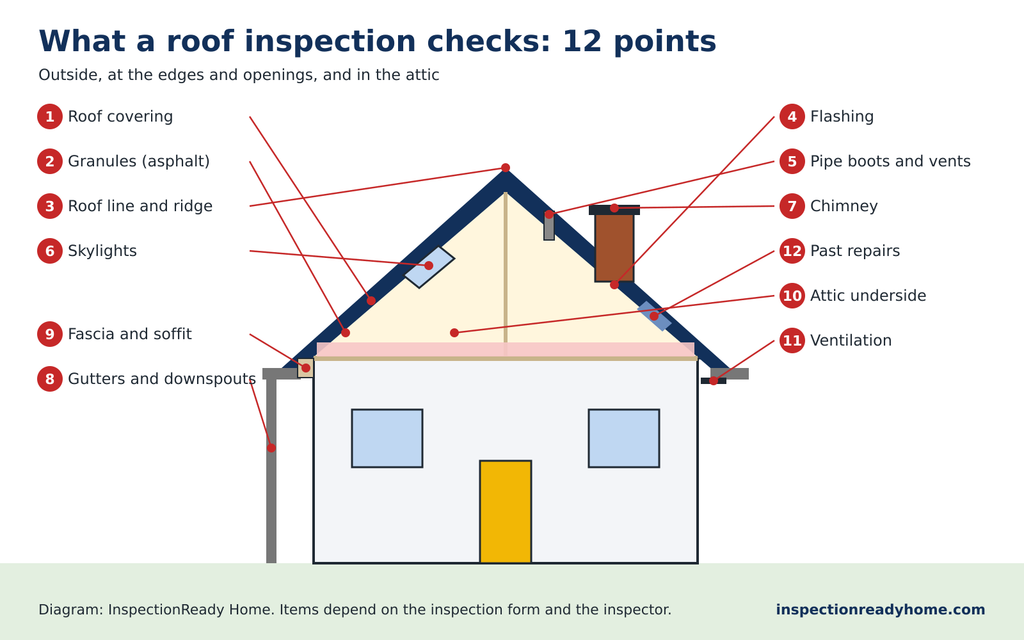
A red flag is not automatically a failed inspection. One cracked pipe boot is a small repair. A sagging deck or an active leak is a different story: Citizens’ 4-point form asks the inspector to report visible leaks, and agents may not submit an application while hazards like that remain. If the report shows water damage, read whether homeowners insurance covers roof leaks before you call the insurer.
Roof inspection cost
No government agency publishes these prices, so the figures below come from Angi’s survey of its customers. Treat them as a starting range and ask for a written quote.
| Type of inspection | Typical price |
|---|---|
| Physical (on the roof or from a ladder) | $75 to $200 |
| Drone | $150 to $400 |
| Infrared (finds trapped moisture) | $400 to $600 |
| Roof certification | $75 to $200 |
| National average | $236 (typical range $125 to $357) |
Size and pitch move the price most: Angi lists $75 to $210 for a 1,000 sq ft roof and $265 to $735 for 3,500 sq ft. In Florida, the state’s Chief Financial Officer puts a 4-point inspection at $100 to $300, and that visit covers the roof plus three other systems. If you need both a roof and a wind mitigation report, ask for one visit; many inspectors do them together.
Who pays? Usually you. Florida law lets an insurer require an inspection of a roof that is 15 years old or more before it asks for a replacement, and that inspection is at the owner’s expense. If your insurer sends its own inspector, it pays for that visit.
Free roof inspection offers: what Florida law says
A free roof inspection is not illegal in itself. What Florida law targets is the sales pitch around it. Under section 489.147 of the Florida Statutes, a contractor may not:
- offer you a rebate, gift, gift card, cash, coupon, a waived deductible or anything else of value for letting them inspect your roof or for filing a claim;
- solicit you with ads that push a roof claim without stating, in readable type, that you pay the deductible and that waiving it or filing false claims is insurance fraud;
- interpret your policy or adjust your claim unless they hold a public adjuster license.
Each violation can cost the contractor up to $10,000. A roofing contract must state that the contractor cannot offer those incentives; if it does not, you can void the contract within 10 days. After a declared state of emergency, you can also cancel a roof contract signed within 180 days of the event within 10 days or by the official start date, whichever comes first.
There is a genuinely free option in Florida: the state’s My Safe Florida Home program offers a free wind mitigation inspection to eligible owners. It is not a general roof check, but it records how your roof is attached, which matters for your premium.
Roof certification vs. roof inspection
A roof certification is a roof inspection with a promise attached: a roofer states in writing that the roof is in a certain condition and should last a stated number of years. It is not a warranty unless the document says so. Three groups ask for one:
- Lenders. HUD’s appraisal reference guide for FHA loans says the roof should have at least two years of remaining physical life, and the appraiser must report a roof with less. The same guide says a person the lender considers qualified should certify the roof’s condition, which is why lenders often ask for a roofer’s letter.
- Insurers. Citizens Property Insurance in Florida requires documents showing at least five years of remaining useful life on roofs older than 25 years (shingle and other soft coverings) or 50 years (tile, slate, clay, concrete or metal). Its sample form must be signed by a Florida-licensed professional and sent with photos of each slope.
- Buyers and sellers. A certification can calm a buyer worried about an older roof. Read the limits: what was inspected, how, and what is excluded.
Want to know how many years your roof has before it hits these thresholds? Our free roof age and insurance checker compares your roof’s age with typical lifespans and the common insurance rules.
How often should you get a roof inspection?
The National Roofing Contractors Association (NRCA) recommends scheduled roof system inspections at least twice a year, preferably in spring and fall, and an extra one after severe weather such as a hailstorm or hurricane. Most owners do the spring and fall checks from the ground and call a pro when something looks wrong.
In practice, plan a professional visit at these moments:
- after any storm with high wind or hail, before you decide on a claim;
- about a year before your Florida roof turns 15, so you have time to repair or plan a replacement;
- before you list or buy a home with a roof older than about 15 years;
- when your insurer, lender or a buyer asks for one, in the format they name.
Worked example: one roof, three inspections in a year
Example with assumed facts. A Florida homeowner has a 19-year-old asphalt shingle roof with permit records. Here is what each visit did for them:
| Moment | Who asked | Inspection | Result and next step |
|---|---|---|---|
| January, renewal | Insurer | Insurer’s roof form at the owner’s cost | Roof over 15 years old but showing more than 5 years of life left, so the insurer cannot refuse on age alone. Policy renewed |
| June, after a hailstorm | Owner | Storm damage inspection by a roofer | Bruised shingles on two slopes. Photos and notes sent with the claim |
| October, before a sale | Buyer’s lender | Roof certification letter | Roofer certifies the repaired roof and gives its remaining life; loan condition cleared |
The same roof needed three different documents, each for a different reader. Keep every report: the next visit goes faster when the inspector can see the last one, and our free insurance paperwork tracker reminds you before each one runs out. If the hail claim is approved, our guide on whether homeowners insurance covers roof replacement explains how the payout is calculated.
5 costly roof inspection mistakes
- Booking the wrong inspection. A home inspection report rarely satisfies an insurer that wants a remaining-life figure. Ask which form they accept before you pay.
- No proof of the roof’s age. Without a permit or invoice, the inspector estimates the age, and the estimate may be older than the real roof.
- Waiting for the renewal notice. In Florida, an insurer must give 120 days’ notice of non-renewal on a home. An inspection a few months earlier leaves time to repair.
- Signing on the spot after a storm. Read any contract before you sign, check the contractor’s license and remember the cancellation rights above.
- Fixing nothing before the visit. Clear gutters, trim branches off the roof and repair obvious damage first. Small items can still appear in the report.
Ask before you book
- Which form do you accept, and does it need a remaining-life estimate?
- Which licenses can sign it?
- How recent must the inspection be?
- Do you need photos of every slope, and of the attic?
- If a repair is needed, how long do I have and what proof do you want?

Frequently asked questions
How long does a roof inspection take?
It depends on the roof’s size, pitch and attic access. Florida’s Chief Financial Officer says a 4-point inspection, which includes the roof, takes about 60 minutes. A roof-only visit on a simple house is often shorter; a steep or large roof, or one with an infrared scan, takes longer.
How do they do roof inspections?
The inspector looks from the ground, from a ladder at the eaves, on the roof surface or with a drone, then checks the attic. The report states which methods were used and includes photos of each slope and of every defect.
What is the 25% rule for roofing?
In Florida, if a roof was built, repaired or replaced under the 2007 Florida Building Code or later, and 25% or more of it needs repair, only the repaired part must meet the current code. This exception is in section 553.844(5) of the Florida Statutes. It does not say what happens to roofs built before the 2007 code.
Does homeowners insurance pay for a roof inspection?
Usually not. Policies pay for covered damage, not for a routine check you order. When the insurer sends its own inspector or adjuster, it pays for that visit. In Florida, the inspection an insurer can require on a roof 15 years or older is at the owner’s expense.
Is a free roof inspection worth it?
It can be, as long as there is no pressure to file a claim. In Florida, a contractor cannot offer you anything of value or waive your deductible in exchange for the inspection. If the free check turns into a pitch for a “free roof”, get a second opinion before you sign.
When to call a pro
Call a licensed roofing contractor if you see daylight in the attic, stains on ceilings, sagging or missing pieces after a storm. If an insurer or lender asked for the report, confirm the form and the license they accept first. Before the visit, our free 4-point self-check helps you spot problems the inspector will note.
Sources
- Florida Statutes, section 489.147, Prohibited property insurance practices; contract requirements (2026 edition).
- Florida Statutes, section 627.7011(5) (2026 edition), roof age and inspections.
- Florida Statutes, section 553.844(5) (2026 edition), roof repairs and the 25% rule.
- Florida Statutes, section 627.4133 (2026 edition), notice of non-renewal.
- Citizens Property Insurance Corporation, Inspections, roof remaining useful life rules.
- Citizens Property Insurance Corporation, sample Roof Inspection Form (RCF-1).
- U.S. Department of Housing and Urban Development, HOC Reference Guide, Roofs and Attics (archived page).
- Professional Roofing (NRCA), “A new resource for consumers”, November 2020.
- InterNACHI, Home Inspection Standards of Practice, section 3.1 Roof (last revised October 2022).
- Florida Department of Financial Services, Insurance Consumer Advocate, What to Expect: Four-Point Inspection.
- Angi, How much does a roof inspection cost? (private source, customer survey data).
This guide is general information, not insurance or legal advice. Daniel Aznar is not an insurance agent, a roofer or a home inspector. Ask your insurer, a licensed roofing contractor or a licensed inspector about your own home. Read our full disclaimer and how we verify our guides. Information checked in November 2026.