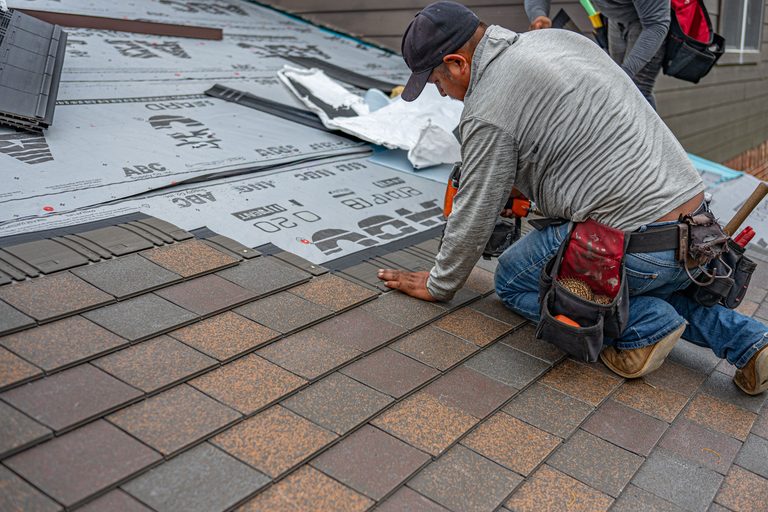
Does Homeowners Insurance Cover Roof Leaks? The Cause Decides What Gets Paid
Quick answer
Does homeowners insurance cover roof leaks? Usually yes when a sudden, covered event such as wind, hail or a falling tree opens the roof and water gets in. Usually no when the roof leaks because it is old, worn or poorly maintained. Even on a covered leak, the policy often pays for the water damage inside more readily than for fixing the roof itself, and your deductible comes off the top.
Does homeowners insurance cover roof leaks? The honest answer is that it depends on why the water came in, not on the fact that it did. A leak is a symptom. Your insurer looks for the cause behind it, and the cause decides whether the claim is paid, paid in part or denied.
This guide splits a leak into the separate bills it creates, ranks nine common causes from most to least likely to be covered, and follows one hypothetical Florida leak from the first drip to the insurer’s decision, with every deadline that applies. Each rule links to its official source, as explained in how we verify our guides.
Table of Contents
One leak, five bills: what gets paid
When people ask “does homeowners insurance cover roof leaks?”, most picture one claim. In practice a leak creates several costs, and a policy can treat each one differently. Before you call anyone, sort your costs into these lines.
| Part of the bill | Usually paid when | Usually not paid when | Proof that helps |
|---|---|---|---|
| Damage inside the home (ceilings, walls, insulation, floors) | The water came in because of a sudden, covered event | The water came in slowly, over weeks or months | Dated photos, the storm date, the date you first saw the stain |
| Repairing the roof | A covered event damaged the roof itself | The roof failed from age, wear or poor installation | Roofer’s written report on the cause |
| Emergency tarp or temporary repair | It was reasonable and done to stop more damage after a covered loss | It covers a leak the policy does not cover | Receipts and before-and-after photos |
| Mold | It grew from a covered water loss | It grew from a gradual leak or a flood | Prompt report, a professional’s findings |
| Your belongings | Water from a covered event soaked them | The leak itself is not covered | A list with descriptions and photos |
The first two lines are where most disputes start. An insurer can accept that a storm damaged your ceiling and still argue that the roof needed replacing anyway. When that happens, the question shifts to whether homeowners insurance covers roof replacement, which has its own rules for age and depreciation.
Does homeowners insurance cover roof leaks? 9 causes ranked
Here are the usual reasons a roof starts leaking, sorted from the ones insurers most often pay to the ones they rarely do. Find yours, then read the column on what to check.
| # | Cause of the leak | Usually covered? | What to check |
|---|---|---|---|
| 1 | Wind tears off shingles or tiles in a storm and rain gets in | Yes, often | The storm date; whether a separate wind or hurricane deductible applies |
| 2 | Hail cracks or punctures the roof | Yes, often | Photos of dents on shingles, vents and gutters |
| 3 | A tree or large limb falls on the roof | Often | The perils your policy lists; photos before the tree is removed |
| 4 | Ice dam backs meltwater under the shingles | Often for the inside damage | Whether the roof had known damage before; prompt notice |
| 5 | Hurricane: wind opens the roof, then rain follows | Often, under wind | Hurricane deductible; flood and storm surge need a separate flood policy |
| 6 | Heavy rain finds a gap, with no storm damage | Often not | Policy wording on rain; what the roofer says caused the gap |
| 7 | Failed flashing or sealant around a chimney, vent or skylight | Usually not | Workmanship or product warranty from the installer |
| 8 | Worn-out shingles leak slowly over months | No | Budget for repair; a gradual leak is treated as maintenance |
| 9 | Damage you knew about and left unrepaired | No, or only in part | Repair records from before the loss |
So does homeowners insurance cover roof leaks in your case? Notice the pattern. Rows 1 to 5 start with an event you can put a date on. Rows 6 to 9 describe a roof that was already failing. The Texas Department of Insurance puts the line in plain terms: most home policies cover sudden and accidental water damage, but not gradual leaks or seepage, or the mold that comes from them.
The Maryland Insurance Administration adds the other half of the rule. Insurance is not meant to pay for maintenance or wear and tear, and if a roof already needed maintenance when the storm hit, the claim can be denied in full, in part, or paid only for the damaged section.
The rain clause: why heavy rain alone is not enough
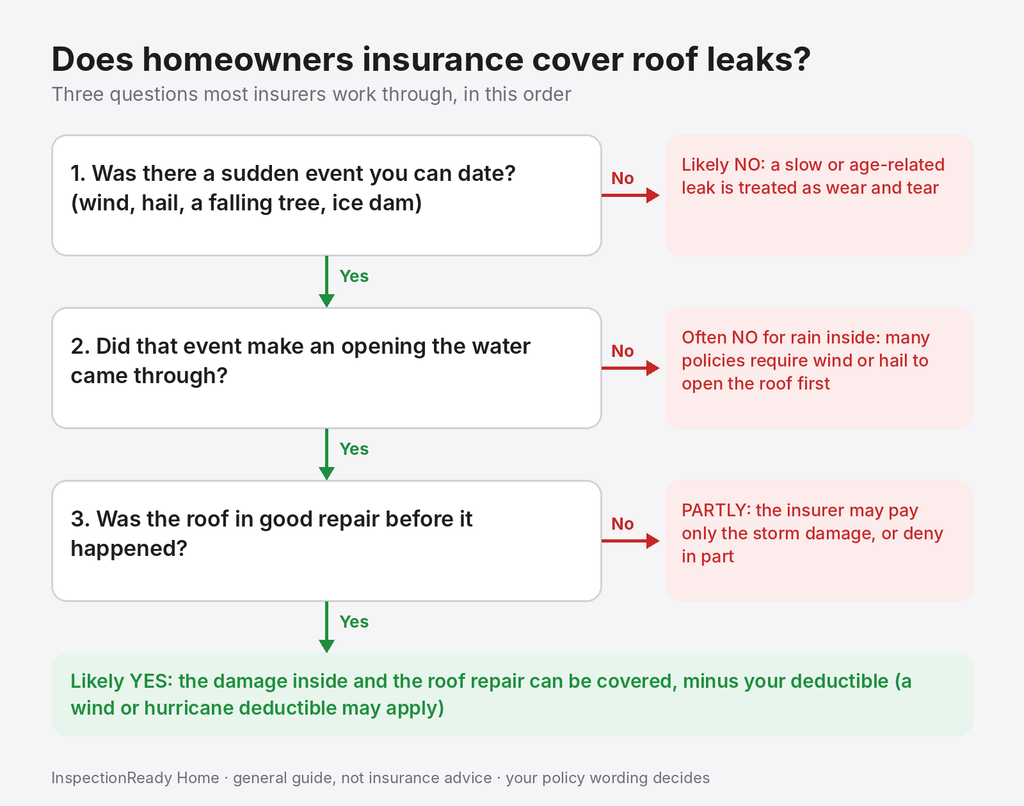
Row 6 trips up many homeowners. It feels like the storm caused the leak, but the policy may not see it that way. Many policies tie rain damage inside the house to a condition: wind or hail must first make the opening the rain came through.
A 2009 New York decision, Nooney v. Tower Group Companies, quotes one homeowners policy that excludes rain damage to the inside of a building unless the direct force of wind or hail damages it and causes an opening in a roof or wall. That is one insurer’s form, not a national rule, but the same idea appears in many policies. Look for it in the windstorm section of yours.
- Find the windstorm or hail peril in your policy and read the sentence about rain.
- Look for the opening. Missing shingles, a lifted ridge cap or a puncture is evidence that wind or hail made one.
- Get the cause in writing. A licensed roofer’s report that names storm damage carries more weight than your own guess.
- Write down the weather. Note the date, and keep a local weather report showing wind or hail that day.
If you cannot point to an opening, the leak may be read as wear, and the answer to “does homeowners insurance cover roof leaks?” in your case leans toward no.
Old roof, new storm: how age changes the answer
Does homeowners insurance cover roof leaks on an old roof? It can: an old roof is not automatically excluded. If a storm damages a 20-year-old roof, the storm damage can still be covered. Age matters in two other ways. First, it makes it easier for an insurer to argue that wear, not the storm, caused the leak. Second, on an actual cash value policy, depreciation shrinks what you collect for the roof itself.
Age can also cause trouble before any leak. In Florida, roofs 15 years or older face the inspection rule in section 627.7011(5) at renewal, and both the Citizens roof form and the roof part of the 4 point inspection ask whether the inspector sees signs of leaks in the attic or on ceilings. To see which roof-age lines yours has passed, use our free roof age checker.
Worked example: one Florida leak, from first drip to decision
A tropical storm passes over a Florida home on a Saturday. That evening, the owner sees a brown stain spreading on the bedroom ceiling. The dates and dollar amounts below are invented to show how the deadlines and the bill fit together; the deadlines themselves come from Florida law and the CFO claim guide.
| When | What happens | The rule behind it |
|---|---|---|
| Day 0 | Owner photographs the stain and the roof from the ground, moves furniture, places buckets | CFO guide: photograph damage before and after repairs |
| Day 1 | A roofer tarps the damaged slope and writes that wind lifted a row of shingles; owner keeps the receipt | CFO guide: make emergency repairs to prevent further damage |
| Day 1 | Owner reports the claim to the insurer | Fla. Stat. 627.70132: notice within 1 year of the date of loss |
| By day 8 | Insurer acknowledges the claim | Fla. Stat. 627.70131: within 7 calendar days of the claim communication |
| Weeks 1 to 4 | Adjuster inspects, in person or by drone, and asks for the tarp receipt | CFO guide: follow up if no adjuster calls within a week |
| By day 61 | Insurer pays or denies the claim, or the undisputed part | Fla. Stat. 627.70131: within 60 days after notice |
| Up to 18 months | A second stain appears in the closet: owner files a supplemental claim | Fla. Stat. 627.70132: supplemental claim within 18 months |
Now the bill, with assumed figures: tarp $600, ceiling and insulation $3,400, roof repair $2,500, and a policy with a $2,000 hurricane deductible. If the adjuster agrees that wind made the opening, the covered total is $6,500 and the check is $4,500 after the deductible. If the adjuster finds the shingles were worn and the storm only exposed it, the roof repair can drop out, and the owner may be left arguing over the ceiling. The roofer’s note on day 1 is what decides whether, for this owner, the answer to “does homeowners insurance cover roof leaks?” is yes.
Ice dams and snow: the northern version of the same question
In cold states, the leak often comes from an ice dam: snow melts on a warm roof, refreezes at the colder edge and backs water under the shingles. United Policyholders, a nonprofit consumer group, says the inside damage from an ice dam is generally covered if you give timely notice and the leak was not caused only by known, pre-existing roof damage. So does homeowners insurance cover roof leaks from ice dams? Often, for the damage inside.
The same group warns that disputes tend to be about the repair, not the leak: how much of the roof must be redone, whether the policy pays actual cash value, and whether new shingles must match the old ones. It also advises against chipping ice with shovels, snow blowers or torches, which can turn a covered leak into self-inflicted roof damage.
Does homeowners insurance cover roof leaks in Florida?
The basic rule is the same as everywhere: covered cause, covered leak. Florida adds four things that change how a roof leak claim plays out.
- Deadlines are in statute. Notice of an initial or reopened claim within 1 year after the date of loss, and a supplemental claim within 18 months, under section 627.70132. The insurer must acknowledge within 7 days and pay or deny within 60 days under section 627.70131.
- The 25 percent rule. Under section 553.844, if a roof built or replaced under the 2007 Florida Building Code or later has 25 percent or more repaired or replaced, only the repaired part must meet the current code. If your roof predates the 2007 code, ask your roofer and building department what a large repair requires.
- Hurricane deductibles. A leak after a named storm may fall under a separate hurricane deductible, which can be a percentage of your dwelling coverage. Check your declarations page.
- Free mediation. The CFO claim guide says the final decision must tell you about Residential Property Mediation through the Department of Financial Services, at no cost, if you disagree.
One more Florida point: an old ceiling stain can come back to bite you at renewal. If an inspector ticks the leak boxes on a 4-point or roof form, the insurer will want to know the story, so keep the repair invoice. Our free home insurance inspection checklist includes the leak checks inspectors make.
What to say, and not say, to the adjuster
The adjuster’s job is to find the cause and the cost. Yours is to give facts that hold up. A few habits make a difference.
| Say this | Avoid this | Why |
|---|---|---|
| “I first saw the stain on the evening of the storm, here is the photo.” | “It’s probably been leaking for a while.” | A guess about a slow leak describes a gradual loss, which is usually excluded |
| “The roof was replaced in 2014; here is the permit.” | “The roof is pretty old, I think.” | A permit date is a fact; an estimate invites a wear argument |
| “My roofer found lifted shingles on the north slope.” | “I don’t know what happened.” | A named cause gives the adjuster something to verify |
| “Here are the tarp receipt and before-and-after photos.” | Throwing out wet drywall before anyone sees it | The CFO guide says to dispose of damaged items only if they are a health risk |
Ask your insurer before you hire a roofer
- Does my policy cover rain damage inside the house only if wind or hail made an opening?
- Which deductible applies to this leak: the regular one, a wind deductible or a hurricane deductible?
- How do you reimburse emergency repairs such as a tarp, and what receipts do you need?
- Do I have to use a preferred contractor or a managed repair program?
- Does my policy include any coverage for mold cleanup or testing?

Frequently asked questions
Does homeowners insurance cover roof leak repair, or only the water damage?
Both can be covered when a covered event damaged the roof. When the roof simply wore out, the repair is usually yours to pay, and the inside damage may be denied too if the leak was gradual. So does homeowners insurance cover roof leaks and the repair? Only when the cause is covered.
Is it normal for a roof to leak in heavy rain?
No. A sound roof should shed heavy rain. A leak in a downpour points to a weak spot, such as worn shingles, failed flashing or storm damage you have not noticed. Have it looked at before the next storm, because a leak you know about and leave alone is the kind insurers deny.
What is the 25% rule for roofing?
It is a Florida building code rule, not an insurance rule. Section 553.844 says that if 25 percent or more of a roof built under the 2007 Florida Building Code or later is repaired or replaced, only the repaired part must meet the current code. Ask your insurer whether your policy pays for any code upgrades the repair requires.
Will insurance pay for mold from a roof leak?
Often, if the mold grew from a covered water loss and you reported it quickly. The Texas Department of Insurance says mold from gradual leaks or from a flood is not covered, and that most standard policies do not pay for mold cleanup and testing unless you added that coverage.
How fast do I have to report a roof leak?
As soon as you can. TDI says hidden water damage usually has to be reported within days after you first see it. In Florida the outside limit is 1 year after the date of loss for the initial claim, but waiting lets the damage grow and gives the insurer room to call it gradual. That is the practical answer to “does homeowners insurance cover roof leaks?” months later: it gets harder every week.
When to call a pro
- Water is dripping now or a ceiling is sagging: call a licensed roofer for a tarp, and keep clear of the sagging area.
- You need the cause in writing before you file.
- The adjuster’s estimate is far below your roofer’s, or the claim was denied as wear and tear.
- You smell mustiness or see spots after a leak: a licensed mold professional can assess it.
For coverage questions, talk to your insurer or a licensed agent. In Florida, check a contractor’s license with the Department of Business and Professional Regulation before you sign, as the CFO guide advises, and read any contract that takes a share of your insurance money.
Sources
- Texas Department of Insurance, When are water damage and mold covered by insurance?
- Florida Department of Financial Services, What to Expect After Filing a Homeowners Claim (June 2025)
- Florida Statutes 2026, section 627.70131 (Florida Senate)
- Florida Statutes 2026, section 627.70132 (Florida Senate)
- Florida Statutes 2026, section 553.844 (Florida Senate)
- Florida Statutes 2026, section 627.7011 (Florida Senate)
- Maryland Insurance Administration, Consumer advisory: roof replacement
- United Policyholders, Ice Dams and Insurance (updated March 2026)
- Supreme Court of New York, Queens County, Nooney v. Tower Group Companies, 2009 NY Slip Op 33229(U)
This guide to the question “does homeowners insurance cover roof leaks?” is general information, not insurance, legal or roofing advice. Daniel Aznar, who writes this site, is not a roofer, a home inspector or an insurance agent. Policy wording and state laws vary: confirm what applies to your home with your insurer, a licensed agent or your state insurance department. Read our full disclaimer, and if you spot an error, our corrections page explains how we fix it. Information checked in October 2026.