Knob and Tube Wiring: How to Spot It, Why Insurers Balk and What a Rewire Costs
Quick answer
Knob and tube wiring is the open-air electrical system used in many U.S. homes from about 1880 to the 1940s: single wires run on porcelain knobs and pass through porcelain tubes, with no ground wire. It is not dangerous by itself, but age, amateur splices and insulation packed over the wires create real risks. Many home insurers will not write a policy while it is active, so the fix that clears an application is usually a permitted rewire by a licensed electrician.
Knob and tube wiring is still hiding in the walls and attics of a lot of older houses, and it tends to surface at the worst moment: during a home inspection, a 4 point inspection or an insurance application. The lights may work fine. The problem is that many underwriters will not take the risk while it is live.
This guide shows you where to look for it, what home inspectors and electrical codes actually say about the danger, how a Florida 4 point report flags it, and what your options cost, with the papers each option gives your insurer. Every fact links to the source we read, as explained in how we verify our guides.
Table of Contents
Knob and tube wiring at a glance
| Question | Short answer |
|---|---|
| When was it installed? | Roughly 1880 to the 1940s; ASHI says a few homes got it as late as the early 1970s |
| How does it work? | Separate hot and neutral wires held off the wood by porcelain knobs, with tubes where they pass through framing |
| Is there a ground wire? | Usually no, so three-prong outlets on it are not grounded |
| Is it dangerous? | Not by itself; age, modifications, overloading and insulation contact are the problems |
| Is it illegal? | No national rule forces removal, but new installations need special permission |
| Will insurers accept it? | Many will not while it is active; some accept an electrician’s evaluation |
| What does replacing it cost? | $12,000 to $36,600 for most homes, average $24,300 (Angi, 2026 data) |
How to spot knob and tube wiring: 6 places to look
You can usually confirm knob and tube wiring without touching anything. Take a flashlight, stay on walkways or framing in the attic, and never pull on a wire. If a space has loose insulation, look but do not dig: older insulation and the wire’s own coating may contain asbestos, as ASHI warns.
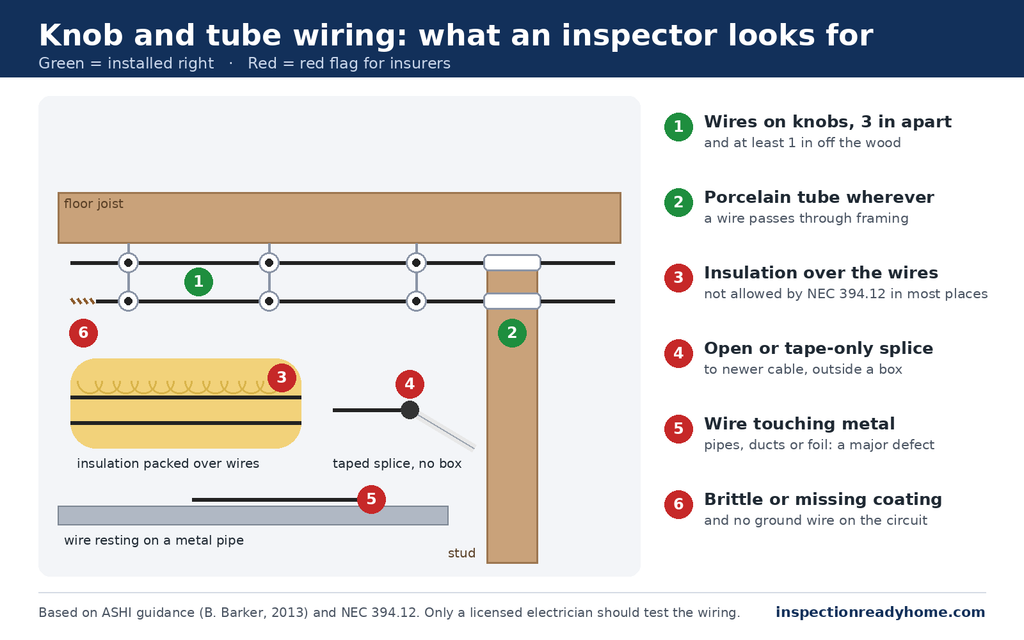
- Basement or crawlspace ceiling. Look along the floor joists for single black or cloth-covered wires running a few inches apart on small white porcelain knobs.
- Where wires cross a joist or stud. A white porcelain tube through the wood, with one wire inside it, is the tube half of the name.
- The attic. Same knobs on the rafters or ceiling joists, often half buried in insulation. Do not step on or move the wires.
- Outlets. Two-slot outlets with no ground hole throughout the house are a strong hint. Three-slot outlets on an old circuit can be a cover-up, not proof of new wiring.
- The panel or fuse box. Screw-in fuses, or a newer panel with old cloth-covered single wires coming into it, point to original circuits still in use.
- The house’s age and records. A home built before the 1950s with no permit for a full rewire on file with your city or county most likely still has some.
Finding the knobs proves the system was installed. It does not prove the wiring is still live. Old runs are often cut off and left in place, so only an electrician can tell you what is active, and ASHI advises inspectors to report both active and inactive K&T.
Is knob and tube wiring dangerous? What inspectors actually say
The honest answer is: it depends on what has happened to it since 1925. InterNACHI’s guide to knob-and-tube wiring says the system is not inherently dangerous and that the risk comes from its age, improper modifications and building insulation that surrounds the wires. Bruce Barker, writing for the American Society of Home Inspectors (ASHI) in 2013, puts it the same way, then adds that there are too many ifs for some insurers.
Barker lists four reasons he still treats it as a reportable condition: the system is at the end of its service life, it usually has no equipment grounding conductor, each circuit is a 15-amp circuit that may feed more lights and outlets than is safe, and its insulation may contain asbestos. The table turns his checklist of a correct installation into a pass or fail view.
| What to check | Installed right | Red flag |
|---|---|---|
| Clearance from wood | At least 1 inch from walls, floors and framing | Wire pushed against wood by insulation or later work |
| Spacing between wires | At least 3 inches apart | Wires bundled or tied together |
| Support | Knobs no more than 4½ feet apart; wires on the sides of joists | Sagging runs or wires laid across the top of joists |
| Through framing | A porcelain tube at every hole | Bare wire through a drilled hole |
| Splices to newer wiring | Inside a covered junction box | Open splice or tape-only joint to modern cable |
| Metal nearby | No contact with pipes, ducts or foil | Touching metal: ASHI calls this a major deficiency |
| Insulation over the wires | Open air around the conductors | Buried in insulation, which the NEC does not allow in most places |
| Wire coating | Intact rubber and cloth | Brittle, cracked or missing insulation |
Insulation over old wiring: the code rule
Insulation is where many houses with knob and tube wiring get into trouble, often during an energy upgrade. Knob and tube was designed to shed heat into open air. ASHI notes that, under normal use, covered wiring should not overheat more than other methods, but insulation work can damage the wires or push them against wood. Either way, most jurisdictions treat insulation over live K&T as a defect.
| Where | Rule | What it takes to insulate |
|---|---|---|
| National Electrical Code, Article 394.12 | Concealed knob and tube may not be used in hollow walls, ceilings or attics insulated with loose, rolled or foamed-in-place material that surrounds the wires | Remove or replace the circuit first, unless your state or city adopted an exception |
| Washington, WAC 296-46B-394 | Allows loose or rolled insulation over existing knob and tube if three conditions are met | A licensed electrical contractor certifies the wiring in writing; Class I insulation with a flame spread of 25 or less, never foam; overcurrent protection sized to the 60°C column of NEC Table 310.16 |
| California (as applied by Menlo Park) | New knob and tube is not allowed without special permission; insulation is allowed under an exception | Electrician survey and certification, a copy to the owner, bilingual caution notices at access points, noncombustible and non-conductive insulation, and a certification form approved before work starts |
If an insulation contractor plans to blow insulation into an older attic, ask for an electrician’s survey first. A rewire before insulating also avoids paying twice for the attic work.
Knob and tube wiring and insurance: why underwriters say no
An underwriter cannot see inside your walls, so it prices the worst case. InterNACHI says many insurance companies refuse to insure houses with knob and tube wiring because of the fire risk, and that exceptions are sometimes made when an electrical contractor has deemed the system safe. ASHI tells inspectors to advise clients to call their insurer right away, because the company may require a costly rewire before it issues a policy.
- Refusal while it is active. Many insurers give this answer for a new policy. Inactive, disconnected runs left in the walls are a different case; ask.
- Acceptance with an electrician’s letter. Some insurers want a licensed electrician’s written evaluation of condition, load and splices.
- A deadline to replace it. An insurer may write the policy on condition that the wiring is replaced within a set time.
- A residual market. If standard insurers all decline, a state FAIR plan or similar program may be the fallback while you plan the rewire.
In Texas, homes that struggle to find coverage can apply to the Voluntary Inspection Program, whose standards include the wiring. Whatever your state, get the insurer’s position in writing before you pay for any work.
What a 4 point inspection asks about knob and tube
In Florida, the question about knob and tube wiring usually comes up on a 4 point inspection, which Citizens requires on homes more than 20 years old. The Citizens sample 4-Point form (Insp4pt 03 25) does not leave room for doubt: the wiring type list includes cloth (knob and tube), and a separate question asks whether there is active knob and tube. The same form tells agents they may not submit applications for homes with existing electrical hazards.
The rest of the electrical section, from panel brand to the 12 listed hazards, works the same way as for an old panel. Our guide to the Federal Pacific electrical panel walks through every field, and our free 4-point self-check lets you run through the section before the inspector arrives. The Florida CFO guide adds that insurers usually want the report dated within 30 days and may require repairs before a policy is issued.
Your options, from cheapest to cleanest
Every fix for knob and tube wiring below starts with a licensed electrician. What changes is how much of the old system stays live and how much paper you end up with for the underwriter.
- Keep it and get a written evaluation. The electrician checks condition, splices, fuse sizes and insulation contact. Papers: a signed evaluation on letterhead. Insurer reading: enough for some, refused by many.
- Disconnect what is no longer used. Dead runs are cut off at both ends and marked. Papers: invoice and, where required, a permit. Insurer reading: helps only if no old circuit stays active.
- Partial rewire. New circuits for the kitchen, bathrooms and other heavy loads, with the rest left in place. Papers: permit and final inspection for the new work. Insurer reading: the 4 point form still says active knob and tube if any circuit remains.
- Full rewire. Every active circuit of knob and tube wiring replaced with modern grounded cable, often with a panel upgrade. Papers: permit, final inspection, invoice and photos. Insurer reading: usually closes the question.
Angi’s guide to finding and fixing knob-and-tube wiring calls a complete rewire the recommended choice and says a partial one may be better than leaving the old wiring as it is. For insurance, the useful test is simpler: after the work, can the inspector answer no to the question about active knob and tube?
Knob and tube wiring replacement cost
Angi’s knob and tube replacement cost guide (2026 data) puts the average at $24,300, with most owners paying $12,000 to $36,600, or about $10 to $20 per square foot. Its range by home size is below. Treat it as a budget band, not a quote: plaster walls, attic access and local labor rates move the number a lot.
| Home size | Estimated cost to replace |
|---|---|
| 800 sq ft | $8,000 to $16,000 |
| 1,000 sq ft | $10,000 to $20,000 |
| 1,300 sq ft | $13,000 to $26,000 |
| 1,600 sq ft | $16,000 to $32,000 |
| 2,000 sq ft | $20,000 to $40,000 |
| 2,500 sq ft | $25,000 to $50,000 |
| 3,000 sq ft | $30,000 to $60,000 |
The same guide breaks out the pieces that quotes often list separately:
- Labor: $50 to $100 an hour per electrician, or about $100 to $350 or more per outlet, switch or fixture.
- Permits and inspections: permits from $10 to $500, often $100 to $125 each; inspections about $100 to $150.
- Wall repair: drywall patches from $60 to $900; lath and plaster about $80 to $200 per square foot.
- Painting: about $1,960 on average for interior painting afterward.
- Panel upgrade: $600 to $4,000 if the old fuse box or panel has to go too.
Worked example: one 1925 bungalow, three quotes
Picture a 1,300 sq ft Florida bungalow built in 1925, with original knob and tube wiring on most circuits and a newer breaker panel. The buyer’s insurer asks for a 4 point inspection. Three electricians quote. The dollar figures are assumptions inside Angi’s ranges, not real bids.
| Quote | Scope | Active knob and tube after | Likely insurer reading |
|---|---|---|---|
| A: $3,500 (assumed) | Evaluation, disconnect two dead runs, fix two open splices | Yes, on six circuits | Many insurers still decline |
| B: $9,000 (assumed) | New kitchen, bath and laundry circuits only | Yes, on bedrooms and lighting | Form still answers yes; ask before you sign |
| C: $19,500 (assumed) | Full rewire, permit, plaster patching, labeled panel | None | Usually clears the electrical point |
Quote A is the cheapest and the least useful for insurance, because the answer on the form does not change. Quote C costs the most but is the only one that turns the wiring into a closed question. The lesson: show your insurer the scope of each quote before you choose.
Ask your insurer before you sign a rewire contract
- Do you insure homes with any active knob and tube wiring, or only after full replacement?
- Is a licensed electrician’s written evaluation enough, and what must it say?
- If I disconnect unused runs, do you treat the remaining old wiring as active?
- How long do I have to finish the work, and do you need a permit and final inspection?
- Will you need a new 4 point inspection afterward, and dated within how many days?
Keep the permit, the final inspection and the electrician’s invoice with your policy papers; our paperwork tracker can remind you before the next renewal. The same steps apply to other old systems insurers ask about, such as polybutylene pipes.
Frequently asked questions
Is knob and tube wiring still legal?
Yes, in the sense that no national rule makes you tear out existing wiring. ASHI notes it may still be installed today as an extension of existing knob and tube, or with permission from the local building department. New installations are generally not allowed, and the NEC bars it in insulated hollow spaces. Your city or county applies the code, so ask them before remodeling.
Is it okay to buy a house with knob and tube wiring?
It can be, if you plan for it. Get an electrician’s evaluation and quote during your inspection period, and ask at least two insurers whether they will cover the home before you close. Lenders usually want proof of homeowners insurance before closing. Our guide to the home insurance inspection explains what the insurer may check after you buy.
How much does it cost to rewire a house with knob and tube?
Angi’s 2026 data puts most jobs between $12,000 and $36,600, with an average of $24,300, or about $10 to $20 per square foot. Plaster walls, a panel upgrade and painting can push the total higher. Ask for written quotes that include the permit and final inspection.
Can you sell a house that has knob and tube wiring?
Yes. Expect the buyer’s inspector to note it and the buyer’s insurer to ask about it, which can slow the sale or become a price negotiation. Disclosure rules vary by state, so ask your real estate agent or an attorney what you must disclose.
Does homeowners insurance pay to replace knob and tube?
Usually not. A homeowners policy pays for sudden damage from a covered cause, such as a fire, not for upgrading a system because it is old. Check your policy’s wear and tear exclusion, and plan the rewire as a home improvement.
When to call a pro
- Now, not later: a burning smell, warm outlets or switch plates, flickering lights, fuses that keep blowing or scorch marks. Call a licensed electrician; for smoke or sparks, call 911.
- Your 4 point report or home inspection lists active knob and tube: get an electrician’s evaluation and quote, then ask your insurer which fix it accepts.
- You plan to add insulation to an older attic or walls: get an electrician’s survey before the insulation contractor starts.
- Your insurer set a deadline: book the electrician and the permit early, because the final inspection date is what the insurer usually wants to see.
For coverage decisions, talk to your insurer or a licensed agent. For the wiring itself, only a licensed electrician should open boxes or test circuits.
Sources
- American Society of Home Inspectors, Old Wiring Methods, by Bruce Barker (November 1, 2013)
- InterNACHI, Knob-and-Tube Wiring, by Nick Gromicko and Kenton Shepard
- Washington Administrative Code, WAC 296-46B-394, Concealed knob-and-tube wiring
- City of Menlo Park, Knob and Tube Safety Wiring Requirements
- Angi, How Much Does It Cost to Replace Knob and Tube Wiring? (2026 data)
- Angi, How to Replace Knob-and-Tube Wiring in Your Home
- Citizens Property Insurance Corporation, 4-Point Inspection Form (sample, Insp4pt 03 25)
- Florida Department of Financial Services, Insurance Consumer Advocate, What to Expect: Four-Point Inspection
- Texas Department of Insurance, Voluntary Inspection Program
This guide to knob and tube wiring is general information, not insurance, legal or electrical advice. Daniel Aznar, who writes this site, is not an electrician, home inspector or insurance agent. Do not handle old wiring yourself: hire a licensed electrician, and confirm what your insurer requires with the insurer or a licensed agent. Read our full disclaimer, and if you spot an error, our corrections page explains how we fix it. Information checked in November 2026.