FAIR Plan Insurance: Who Qualifies, What It Covers and How It Differs by State
Quick answer
FAIR plan insurance is basic property coverage sold by a state-created pool when regular insurers will not cover your home. Nearly three dozen states and Washington, D.C. have one. Most plans cover the structure against fire and a short list of named perils, pay actual cash value, and leave out liability, flood and often theft. You usually need proof of two or three declined applications, and most people apply through a licensed agent.
FAIR plan insurance is what many homeowners are offered after a non-renewal letter and a few declined applications. The name sounds like one national program, but it is not. Each state that has a FAIR plan sets its own rules, its own limits and its own list of covered perils, and the differences decide whether you end up with a usable policy or a fire policy with holes in it.
This guide to FAIR plan insurance compares six states side by side, explains the three tests that decide whether you qualify, lists the gaps you need to fill, and runs one house through three states in a worked example. Every rule links to a state insurance regulator, the plan itself or the national bodies that track these plans, as explained in how we verify our guides.
Table of Contents
FAIR plan insurance at a glance: six states compared
FAIR stands for Fair Access to Insurance Requirements. The NAIC, the national association of state insurance regulators, says the first plans were set up in 26 states and the District of Columbia under the Urban Property Insurance Protection and Reinsurance Act of 1968. Triple-I now counts nearly three dozen states plus D.C. (Georgia’s, for example, is the Georgia Underwriting Association). Below are six that show how far apart the rules can be.
| State and plan | Who qualifies | Top residential limit | What stands out |
|---|---|---|---|
| California: California FAIR Plan | Owners who cannot get coverage from a regular insurer | $3 million | Fire policy with options; no theft, water damage or liability. See our California FAIR Plan guide |
| New York: NYPIUA | Owners who cannot buy basic property insurance in the voluntary market | ACV basis; ask NYPIUA | Basic or Broad Form; no liability, flood or theft. Coastal owners can try C-MAP first |
| Massachusetts: MPIUA | You certify a reasonable effort to find coverage elsewhere | Ask MPIUA | Closest to a homeowners policy: includes theft and limited liability. You can apply directly |
| Texas: Texas FAIR Plan Association | Declined by at least two licensed insurers; no current policy or offer | $1 million dwelling | Homeowners, dwelling, tenant and condo forms; no wind or hail where TWIA covers it. See our Texas homeowners insurance guide, and our Texas windstorm insurance guide for TWIA |
| Colorado: Colorado FAIR Plan | Three declinations from standard insurers | $750,000 home and contents combined | Newest plan (homeowners policies from April 10, 2025); actual cash value only |
| Florida: Citizens Property Insurance | No private offer, or private offers more than 20% above Citizens | Set by Citizens rules | Not called a FAIR plan, but plays the same last-resort role statewide |
Two patterns in FAIR plan insurance jump out. The test to get in ranges from proving you made a reasonable effort to showing three written declinations. And the product ranges from a bare fire policy to something close to a full homeowners form. Knowing your state’s version is the first step.
What is FAIR plan insurance, and who runs it?
A FAIR plan is not a government insurer in most states. The NAIC explains that each plan is set up at the state level, but the private insurers licensed in that state back it financially and share its profits, losses and expenses in proportion to their market share. Massachusetts says the same about its own plan: created by state law, not a state agency and not funded by the state.
The plans exist for owners the market has turned away. The NAIC lists natural disasters, building code changes and rising costs among the reasons insurers pull back (compare the average cost of homeowners insurance by state). Triple-I adds older buildings with outdated systems, high crime areas and a history of several claims. That is why FAIR plan insurance usually costs more than a regular policy for less coverage: it carries the risks no one else wanted.
Coastal states add a second layer to FAIR plan insurance. Triple-I notes that some states run separate beach, wind or Citizens plans for hurricane-exposed areas. In Texas, the Texas Windstorm Insurance Association (TWIA) covers wind and hail along the coast, so a coastal owner may need both a TWIA policy and a Texas FAIR Plan policy for the same house.
Do you qualify for FAIR plan insurance? The three tests
Every state words it differently, but almost every plan checks the same three things before it sells FAIR plan insurance.
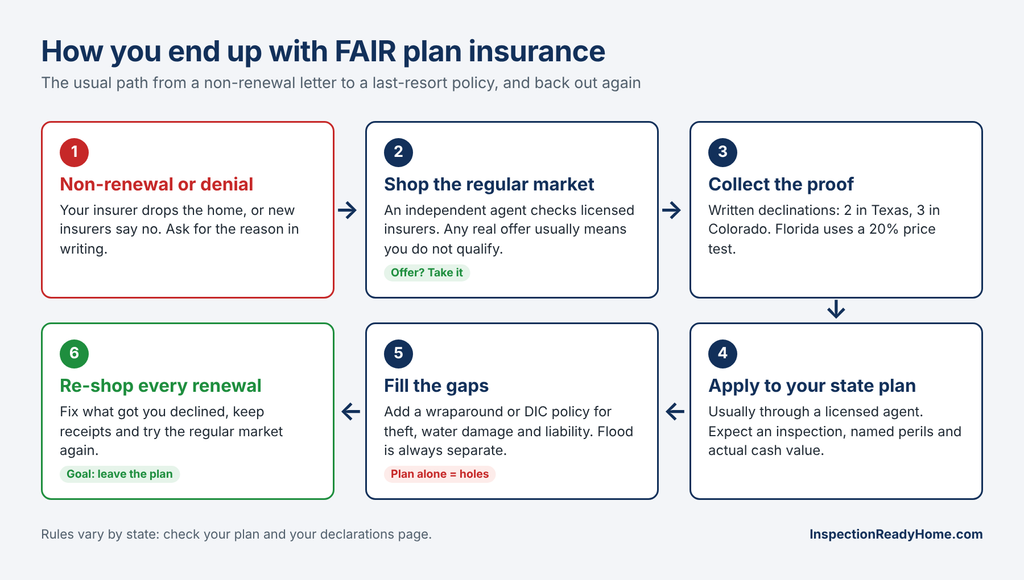
- You tried the regular market and failed. Texas wants proof of two declinations from licensed insurers that actively write homes. Colorado wants three. Massachusetts asks you to certify a reasonable effort. Florida uses a price test: Citizens is open to you if no private insurer will write the home, or if every private offer is more than 20% above the Citizens premium for comparable coverage.
- You do not already hold an offer. Texas says you are not eligible if you have a current policy, a renewal offer or a valid offer of comparable coverage. A high quote is still an offer in many states, so a non-renewal letter alone may not be enough.
- The house passes underwriting. Triple-I says the property usually must be free of liens and penalties and meet local building, housing and sanitation codes. The Texas plan lists reasons for denial such as a home in disrepair, a vacant property, an unfenced pool or more than eight paid claims in three years.
The third test is where an inspection comes in. New York’s plan sends an outside inspector to check insurability, usually within about 10 business days. If your home is older, read our guide to the home insurance inspection before the visit; Florida owners should also know what a 4 point inspection records, because Citizens asks for one on older homes.
What FAIR plan insurance usually covers, and the gaps to fill
The NAIC says FAIR plans are mainly meant for catastrophic events and that dwelling coverage is the minimum in most states. Personal belongings and other structures are often optional add-ons, and loss of use and personal liability are generally not offered. Here is how a typical plan compares with a standard homeowners policy.
| Coverage | Typical FAIR plan | Typical homeowners policy |
|---|---|---|
| The house itself | Yes, against named perils such as fire and lightning | Yes, usually against all risks not excluded |
| Wind and hail | Varies: optional in California, included in New York’s basic form, excluded in TWIA areas of Texas | Yes, often with a separate deductible |
| Personal property | Often optional or limited | Yes |
| Theft | Usually no (New York and California); yes in Massachusetts and on Texas homeowners forms | Yes |
| Water damage from inside the home | Usually no; Texas sells it as an endorsement | Yes when sudden and accidental |
| Liability to others | Usually no; limited liability in Massachusetts | Yes |
| Loss of use (living elsewhere) | Usually no | Yes |
| How losses are paid | Actual cash value by default; replacement cost only as an option in some states | Often replacement cost |
| Flood and earthquake | No | No: separate policies |
Actual cash value deserves a second look. It means the plan subtracts depreciation, so an older roof or kitchen is worth far less than the cost to rebuild it. Our guide on whether homeowners insurance covers roof replacement shows how much that can cut a claim, and our free roof age checker tells you how far along your roof is before an insurer asks.
How owners fill the gaps
The usual fix for the gaps in FAIR plan insurance is a second policy from a private insurer. California calls it a difference in conditions (DIC) policy. New York’s regulator describes a wraparound policy that adds liability, personal property and theft on top of the plan’s Basic or Broad Form, and says replacement cost for the building is possible with an approved wraparound endorsement. Flood needs its own policy in every state, and New York’s plan may ask for proof of flood insurance in high-risk flood zones.
Worked example: one house, three states
Picture the same single-family home, owner-occupied and in good repair, with a rebuild cost of $900,000 and an older roof. The owner gets a non-renewal and cannot find a regular policy. Here is roughly what FAIR plan insurance would look like in three states, using each plan’s published rules.
| Question | Texas | Colorado | New York |
|---|---|---|---|
| Proof needed to apply | Two declinations | Three declinations | Unable to buy basic coverage in the voluntary market |
| Can the house be insured to $900,000? | Yes: dwelling limit up to $1 million | No: $750,000 cap for home and contents together | Ask the plan; it insures on an actual cash value basis |
| Older roof damaged by a covered peril | Actual cash value, unless a replacement cost endorsement is added | Actual cash value only | Actual cash value, unless a wraparound policy adds replacement cost |
| Burglary | Covered on the homeowners form | Not in the plan: buy a separate policy | Not covered: needs a wraparound policy |
| Guest hurt on the stairs | Ask your agent what the form includes | Not covered: no liability section | Not covered |
| How to apply | Through an authorized Texas agent | Through a licensed agent | Directly by web, mail, email or fax, or through a broker |
The same house gets three very different FAIR plan insurance products. In Colorado the owner is underinsured by $150,000 before any claim. In New York the owner needs a second policy for theft and liability. In Texas the limit fits, but the payout on an older roof still depends on that replacement cost endorsement.
How to apply for FAIR plan insurance, step by step
The steps below put the plans’ own rules in a practical order. Skipping the first two can leave you without the proof the plan asks for.
- Shop the regular market with an independent agent. Ask for written declinations, not phone answers. Texas has a proof-of-declination form for this.
- Check excess and surplus lines. Triple-I and New York’s regulator both mention these insurers as another route. New York requires three declinations from licensed insurers first, and warns that these policies are not backed by the state guaranty fund.
- Find out how your state’s plan takes applications. Texas and Colorado sell only through licensed agents. New York and Massachusetts also accept applications directly. California works through brokers or a call to the plan.
- Prepare the house for the inspection. Fix visible hazards, clear debris, fence the pool and have repair receipts ready.
- Choose limits and options. Ask for replacement cost, wind and hail, personal property and water damage where the plan offers them.
- Buy the gap policy at the same time, so theft, liability and water damage are covered from day one.
- Put a re-shop date on the calendar. Texas makes policyholders reapply in the voluntary market every two years; even where no rule says so, a yearly check is worth it.
Ask the plan or your agent before you sign
- Which perils are on my declarations page, and is wind or hail one of them?
- Are losses paid at actual cash value, and can I add replacement cost?
- Does the policy include theft, water damage, personal property or liability?
- What is the maximum limit, and is it combined for the home and contents?
- When must I re-shop the regular market, and what happens if I get an offer?
How to get off FAIR plan insurance
FAIR plan insurance is built as a bridge, not a home. Moving back to a regular insurer usually takes three things.
- Fix what got you declined. Ask the insurer that dropped you, in writing, for the reason. Roof age, wiring and plumbing are common ones.
- Keep proof of the work. Permits, invoices and dated photos help an underwriter say yes.
- Re-shop on a schedule. Florida runs a clearinghouse that checks private offers against the Citizens premium, so a cheaper private policy can replace a Citizens one; our guide to homeowners insurance Florida rules lists the other doors, from FMAP to surplus lines. To judge any offer, compare it with the official average cost of homeowners insurance in Florida for your county.

Frequently asked questions
What does FAIR plan mean in insurance?
FAIR stands for Fair Access to Insurance Requirements. A FAIR plan is a state-mandated pool that sells basic property coverage to owners who cannot get it in the regular market. FAIR plan insurance is backed by the private insurers licensed in the state, not by a single company.
What does FAIR plan insurance not cover?
In most states, FAIR plan insurance leaves out personal liability and loss of use, and Triple-I lists theft, flood, earthquake, hail and vandalism among the coverages plans often do not offer. Some states differ: Massachusetts includes theft and limited liability. Flood always needs a separate policy.
Is FAIR plan insurance good?
It does one job well: it keeps a home insured against major losses such as fire when no one else will. It is rarely a full replacement for a homeowners policy, and it usually costs more for less. Treat it as a bridge and keep shopping.
How much does FAIR plan insurance cost?
There is no national average you can rely on. Each plan files its own rates with the state regulator; New York’s plan says it bases its rates on loss costs from the Insurance Services Office. Triple-I says premiums can be higher than regular insurance and that the usual discounts are often missing. Only a quote tells you your number.
Does every state have a FAIR plan?
No. Triple-I counts nearly three dozen states plus D.C. Colorado only started selling homeowners policies in April 2025. If your state has no plan, Triple-I suggests asking your agent whether fixing the risk could restore regular coverage, and calling your state insurance department.
When to call a pro
- You received a non-renewal: call an independent agent who places FAIR plan insurance and also sells wraparound or DIC policies.
- You are buying a home in a high-risk area: get quotes before your inspection contingency ends.
- Your FAIR plan application was declined: New York’s plan accepts written appeals, and your state insurance department takes complaints.
- You plan roof, wiring or plumbing work to win back regular coverage: ask an agent which fixes matter most before you hire a contractor.
For coverage decisions, talk to a licensed agent or broker. For a rule you do not understand, call your state insurance department.
Sources
- NAIC, Fair Access to Insurance Requirements Plans (updated December 13, 2024)
- Triple-I, What are FAIR plans and how might they provide insurance coverage?
- California Department of Insurance, California FAIR Plan
- New York Department of Financial Services, Problems Obtaining Insurance
- New York Property Insurance Underwriting Association, FAQ
- Massachusetts Division of Insurance, Massachusetts Property Insurance Underwriting Association
- Texas FAIR Plan Association, Coverage and Eligibility
- Texas FAIR Plan Association, Fact Book (data as of Q2 2026)
- Colorado Division of Insurance, FAIR Plan
- Colorado Division of Real Estate, HOA Center Advisory on the FAIR Plan (February 13, 2025)
- PropertyCasualty360, Colorado FAIR Plan contract analysis, part 1 (January 5, 2026)
- Colorado Revised Statutes 10-4-1808 (FAIR plan sold through licensed producers)
- Citizens Property Insurance Corporation, Clearinghouse eligibility
This guide to FAIR plan insurance is general information, not insurance or legal advice. Daniel Aznar, who writes this site, is not an insurance agent, broker or home inspector. Each state’s plan sets its own rules: confirm what applies to your home with a licensed agent, the plan itself or your state insurance department. Read our full disclaimer, and if you spot an error, our corrections page explains how we fix it. Information checked in October 2026.