Louisiana Homeowners Insurance: Costs, the 3-Year Rule, Louisiana Citizens and the 2027 FORTIFIED Discounts
Quick answer
Louisiana homeowners insurance is the most expensive in the country: $3,027 a year for a standard HO-3 policy (NAIC, 2023 data), $1,290 above the national average. Policies issued after August 1, 2024 no longer get the old 3-year renewal protection. Since July 1, 2026, insurers must give 60 days’ notice before canceling or not renewing. Louisiana Citizens is the last resort, and from January 1, 2027 every insurer must apply set discounts for FORTIFIED homes.
Louisiana homeowners insurance has been rewritten more in the last three years than in the twenty before. The state dropped the 3-year rule for new policies, doubled the notice period for cancellations, opened a grant lottery for stronger roofs and ordered insurers to apply discounts from a state table. Most quote pages still describe the old rules.
This guide puts the changes in order, shows what Louisiana homeowners insurance costs by official data, works through a hurricane deductible across two storms in one year, and explains Louisiana Citizens, the Fortify Homes grants and the new FORTIFIED discount table. Each rule links to the statute, regulation or agency page we read, as described in how we verify our guides.
Table of Contents
Louisiana homeowners insurance rules: what changed and when
If you read about Louisiana homeowners insurance before 2024, several things you learned are no longer true. This is the order in which the rules changed, with the date each one took effect. The sections below explain each step:
- January 1, 2023: a new policy with a hurricane, named storm or wind and hail deductible must come with a separate state form showing that deductible, which you are asked to sign (R.S. 22:1337).
- May 7, 2024: Act 9 of 2024 takes effect for one key line: the 3-year renewal protection does not apply to any policy issued after August 1, 2024 (R.S. 22:1265).
- January 1, 2025: the rest of Act 9 applies. For older policies still under the 3-year rule, an insurer that files a plan with the commissioner may decline to renew up to 5% of them each calendar year, for any reason.
- July 1, 2026: Act 182 of 2025 raises the written notice before a cancellation or nonrenewal to 60 days, from 20 or 30, and requires a nonrenewal notice to state the cause.
- January 1, 2027: insurers must apply the FORTIFIED discounts set by Regulation 136, and new Louisiana Citizens rates start for new and renewal policies.
- April 1, 2027: planned assumption date for Louisiana Citizens’ 25th depopulation round, when private companies can take over selected policies.
- December 31, 2027: end of the period in which the Citizens 10% markup is suspended in parishes ruled noncompetitive, unless the law changes again.
What Louisiana homeowners insurance costs
The latest regulator-compiled figure is in the NAIC’s homeowners report with 2023 data, published in July 2026. It puts the average Louisiana HO-3 premium at $3,027 a year, about $252 a month. That is the highest of the 50 states plus Washington, D.C., and $1,290 above the national HO-3 average of $1,737. Across all policy forms, the Louisiana average is $2,860.
Louisiana homeowners insurance costs more than in any Gulf neighbor on this measure. The NAIC averages are $2,864 in Texas, $2,779 in Florida, $2,029 in Mississippi and $1,906 in Alabama. Our average cost of homeowners insurance ranking lists every state.
Quote websites often show a higher Louisiana number, sometimes above $3,500. They usually price one sample house at a fixed dwelling limit in 2025 or 2026, while the NAIC figure is what policyholders actually paid across every home size. Both are useful, but only quotes on your own house tell you what you will pay. The Louisiana Department of Insurance (LDI) homeowners page links to its company and agent search tools.
Why is homeowners insurance so high in Louisiana?
Hurricanes are most of the answer. A large share of every Louisiana homeowners insurance premium pays for wind risk, and the state’s own FORTIFIED discount table, explained below, assumes the risk is far higher near the coast than in the north. Insurers also buy reinsurance on world markets to cover a bad season, and that cost is passed into premiums. Your own bill then moves with distance from the coast, the age and fastening of your roof, the cost to rebuild and your claims history.
Hurricane deductibles: one per calendar year
Many Louisiana homeowners insurance policies carry a separate deductible for hurricanes or named storms, usually a percentage of the dwelling limit. R.S. 22:1337 sets the rules that matter most when you claim:
- What triggers it: a storm the National Hurricane Center has declared a hurricane or a named storm. A name given only by the media does not count.
- It replaces the normal deductible: for a hurricane or named storm loss, the separate deductible applies in place of your all-perils deductible, not on top of it.
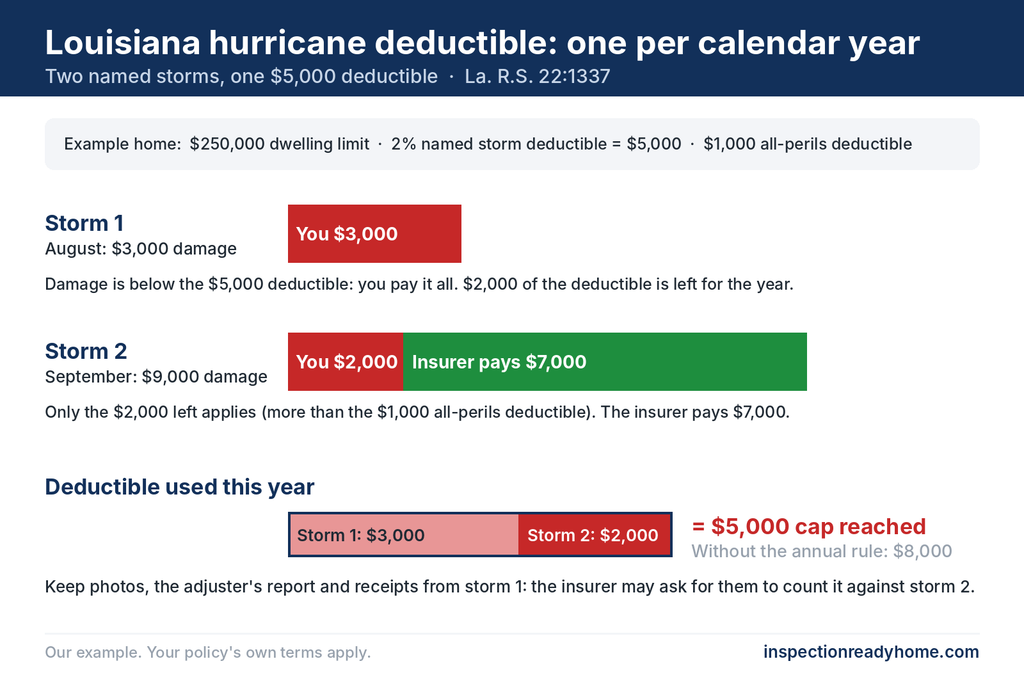
- It applies once a year: the separate deductible is applied on an annual basis to all hurricane and named storm losses in a calendar year. For a second storm, the insurer can apply only what is left of it, or the all-perils deductible if that is greater.
- Keep receipts: the insurer may ask you to keep records of the first loss so it can count it against the second.
- The state form: since January 1, 2023, a new policy comes with a separate deductible form prescribed by the LDI (Bulletin 2022-04). You get a new one if the insurer changes the deductible amount or percentage.
Separately, R.S. 22:1265(G) says a homeowners policy may not apply more than one deductible to a loss from any single incident. A policy term that tries to is void.
Worked example: two named storms in one season
Take a house with a $250,000 dwelling limit, a 2% named storm deductible ($5,000) and a $1,000 all-perils deductible. Two named storms hit in the same year:
| Event | Damage | Deductible applied | You pay | Insurer pays |
|---|---|---|---|---|
| First named storm, August | $3,000 | $5,000 (the full storm deductible) | $3,000 | $0 |
| Second named storm, September | $9,000 | $2,000 (the $5,000 minus the $3,000 already absorbed; greater than $1,000) | $2,000 | $7,000 |
| Year total | $12,000 | Capped at $5,000 for the year | $5,000 | $7,000 |
Without the annual rule, the second storm would carry a fresh $5,000 deductible and you would pay $8,000 for the year instead of $5,000. Keep photos, the first adjuster’s report and repair receipts. They are how you prove the first $3,000 when the second claim comes in.
Before you renew Louisiana homeowners insurance, multiply your own dwelling limit by your storm percentage. A 5% deductible on a $300,000 limit is $15,000. If that is more than you could pay after a storm, ask what a lower percentage would cost.
What is the 3-year rule in Louisiana?
The 3-year rule, in R.S. 22:1265(D), protects a homeowners policy that has been in force and renewed for more than three years. Once a policy reaches that point, the insurer may cancel it or refuse to renew it only for one of these reasons:
- nonpayment of premium;
- fraud by the insured;
- a material change in the risk being insured;
- two or more claims within a continuous three-year period in the five years before the renewal date;
- continuing the policy would endanger the insurer’s solvency.
Two details help you. A loss caused only by forces of nature, which the statute calls an Act of God, does not count toward the two claims. And reporting damage or asking a coverage question is not a claim unless you demand payment under the policy. The rule never stopped an insurer from changing deductibles or coverage at renewal, and an insurer that leaves the Louisiana homeowners insurance market entirely cannot write homeowners policies in the state for five years.
Act 9 of 2024 split policies into two groups. Find your policy’s original issue date on your declarations page and read the matching column:
| Question | Policy in force 3+ years on or before August 1, 2024 | Policy issued after August 1, 2024 |
|---|---|---|
| Does the 3-year rule apply? | Yes, with the reasons listed above | No (R.S. 22:1265(K)) |
| Can the insurer nonrenew for other reasons? | Only within a 5% yearly cap, after filing a plan with the commissioner, who may approve more | Yes, with proper notice and the cause stated |
| Notice before nonrenewal | 60 days since July 1, 2026 | 60 days since July 1, 2026 |
| Can deductibles change at renewal? | Yes; the rule never limited that | Yes |
The practical point: switching companies to save money ends your old protection, because the new policy is issued after August 1, 2024. That may still be the right move, but weigh it before you change Louisiana homeowners insurance carriers on an older policy.
Cancellation and nonrenewal notices: 60 days since July 1, 2026
Act 182 of 2025 (House Bill 345) changed the notice rules for Louisiana homeowners insurance from July 1, 2026. An insurer must now mail or deliver written notice at least 60 days before a cancellation or nonrenewal takes effect, up from 30 days in the policyholder bill of rights and 20 days in parts of the code. A homeowners nonrenewal notice must also state the cause. Cancellation for nonpayment of premium keeps a shorter notice period.
If you get a cancellation or nonrenewal and want the reasons in writing, R.S. 22:1265(A) lets you ask. Send a written request within six months after the policy ends, and the insurer must answer in writing. Then use the 60 days:
- Check the date on the letter against the policy’s end date. Fewer than 60 days, for a reason other than nonpayment, is worth raising with the LDI.
- Check your issue date. If the policy was in force for more than three years on or before August 1, 2024, the reason has to fit the 3-year rule or the insurer’s 5% plan.
- If the reason is the roof or another condition, get a roofer’s report or run our 4-point self-check and send the evidence.
- Ask an agent for new Louisiana homeowners insurance quotes at once, and ask about Louisiana Citizens only if private companies decline.
Louisiana Citizens insurance: the insurer of last resort
Louisiana Citizens Property Insurance Corporation is a nonprofit created by the state for property owners who are, in its words, in good faith entitled to insurance but unable to get it from the voluntary market. Its company overview says plainly that it is the insurer of last resort and is required by the state to cost more than private companies. The LDI tells homeowners to ask their agent about it when they cannot get coverage in the private market.
Citizens writes under two plans, the Coastal Plan and the FAIR Plan. By law (R.S. 22:2303), their rates must be at least 10% above the higher of an actuarially justified rate or the highest rates charged by the main private insurers in the parish. Until December 31, 2027, that markup is suspended in any market the commissioner rules noncompetitive, where Citizens rates may not exceed that higher figure. Three things to know if you have a Louisiana Citizens insurance policy or may need one:
- 2027 rates: the LDI approved changes for policies effective on or after January 1, 2027: +1.0% for the FAIR Plan, +8.3% for the Coastal Plan and +1.4% statewide on average (Citizens rate notice of October 30, 2026). Your change depends on your parish and policy type.
- Depopulation: since 2008, Citizens has transferred selected policies to private insurers in rounds. Round 25 is being planned with an assumption date of April 1, 2027 (depopulation page). If your policy is offered to a private company, read the letter carefully and compare the coverage, deductibles and premium before the transfer date.
- Coverage gaps: like any Louisiana homeowners insurance policy, it does not cover flood. Check the dwelling limit and the storm deductible on the declarations page as you would with a private quote.
Florida runs a separate program with the same name and different rules; our guide to Florida Citizens insurance covers that one, and our FAIR plan insurance guide compares last-resort pools across states.
FORTIFIED roofs: the grant lottery and the 2027 discount table
A FORTIFIED roof is built to a voluntary standard from the Insurance Institute for Business & Home Safety (IBHS) that goes beyond the building code: stronger roof deck fastening, a sealed deck and better edges, verified by an evaluator. Louisiana now ties two things to it.
Louisiana Fortify Homes Program grants
The Louisiana Fortify Homes Program, run by the LDI, pays up to $10,000 toward replacing a roof to the FORTIFIED Roof standard. Grants go to eligible applicants chosen by a random lottery in registration rounds, and you must register again for each round. The LDI program page sets these conditions:
- Who qualifies: you own the home and live in it as your main residence, keep an active Louisiana homeowners insurance policy, carry flood insurance if the home is in a FEMA Special Flood Hazard Area, and the house is in good repair. The home must be in an eligible parish, shown on the program’s map.
- Usually not eligible: condos, duplexes, apartments, manufactured and mobile homes, rentals and second homes.
- Order of steps: grant approval, then an approved evaluator, then bids from approved contractors. Starting work before the award can make the project ineligible, so a roof already replaced does not qualify.
- What you pay: anything above the grant and the evaluator’s fee. The grant is paid to the contractor after the IBHS certificate is issued, and it cannot pay an insurance deductible, though it can be combined with a roof claim.
- After the work: the designation generally lasts five years and can be renewed, and the certificate usually stays with the home if you sell.
Funding grew in 2026: lawmakers added $30 million in the state budget and another $50 million from a Louisiana Citizens surplus (Louisiana Illuminator, May 2026), and a June 2026 round offered 3,000 grants with more parishes eligible. Rounds open on dates the LDI announces, so check the program page or contact fortify@ldi.la.gov or (225) 342-0111. Alabama runs a similar program, covered in our Alabama homeowners insurance guide.
Regulation 136: the FORTIFIED discount table from 2027
Louisiana law has required FORTIFIED discounts since 2023, but each company set its own. Under Regulation 136, announced in LDI Bulletin 2026-04, every property insurer must apply discounts on Louisiana homeowners insurance from a state benchmark table no later than January 1, 2027. The discounts apply to the hurricane portion of the premium, not the whole bill. The LDI publishes the table on its FORTIFIED benchmarks page:
| Zone | FORTIFIED Roof | FORTIFIED Silver | FORTIFIED Gold |
|---|---|---|---|
| North | 16% | 20% | 24% |
| Central | 27% | 35% | 42% |
| South (Louisiana Coastal Zone parishes) | 29% | 43% | 49% |
The LDI built the table with two hurricane catastrophe models, run by the NAIC on typical Louisiana single-family homes, and drew the South zone from the statutory Louisiana Coastal Zone. Silver adds protection for openings and other weak points, and Gold ties the whole structure together. Because the discount comes off the hurricane part only, ask your insurer how much of your Louisiana homeowners insurance premium is hurricane premium before you estimate a saving. Other wind mitigation features can earn credits too; our wind mitigation inspection guide explains what inspectors record.
Cheapest homeowners insurance Louisiana: how to compare quotes
We do not rank insurers. Lists of the best or cheapest homeowners insurance Louisiana companies offer price a sample house, often in one city, and a low premium can hide a 5% storm deductible or an actual cash value roof. In New Orleans, Baton Rouge, Lafayette or Lake Charles, compare quotes for the same dwelling limit and ask each company or agent the same questions:
Ask your insurer or agent
- What is the hurricane or named storm deductible in dollars, and may I see the state deductible form?
- Is the dwelling limit based on a current rebuild estimate, and is the roof paid at replacement cost or actual cash value?
- How much of the premium is hurricane premium, and what would a FORTIFIED Roof, Silver or Gold certificate take off it from 2027?
- If I switch, do I lose protection under the 3-year rule on my current policy?
- Is the company admitted in Louisiana, or a surplus lines insurer outside the state guaranty fund?
The roof question matters most. Our guide to whether homeowners insurance covers roof replacement explains depreciated roof payments, and our roof age checker shows when insurers start asking about yours. Keep every quote, inspection and renewal date for your Louisiana homeowners insurance in our free renewal paperwork tracker.
Claims, flood and complaints
Most homeowners policies do not cover flood, the LDI reminds consumers; that takes a separate policy, usually through the National Flood Insurance Program, which generally starts 30 days after you buy it (our flood insurance guide explains the limits). After a storm, report the claim quickly, stop further damage, photograph everything and keep the receipts you will need for the deductible rule above.
If a dispute over Louisiana homeowners insurance goes nowhere, the LDI’s Office of Consumer Services takes complaints online and helps with policy questions. The consumer hotline is 1-800-259-5300, and the Office of Property and Casualty is at (225) 342-1258. Send copies of your policy, claim number and letters, never the originals.
Frequently asked questions
How much is homeowners insurance in Louisiana?
The NAIC’s latest regulator-compiled average is $3,027 a year for a standard HO-3 policy (2023 data), about $252 a month and the highest in the country. Coastal homes and homes with older roofs usually pay more for Louisiana homeowners insurance.
Does the 3-year rule still protect me?
Only if your policy was in force and renewed for more than three years on or before August 1, 2024, and even then the insurer may nonrenew within a 5% yearly cap after filing a plan. Policies issued after August 1, 2024 are not covered.
Is Louisiana Citizens more expensive than private insurance?
By design, yes: state law sets its rates at least 10% above private benchmarks, though that markup is suspended in parishes ruled noncompetitive until December 31, 2027. Get private quotes first and compare the full coverage, not just the price.
Can I get a Fortify Homes grant for a roof I already replaced?
No. You must be selected and approved before choosing a contractor and starting work. A roof already certified FORTIFIED can still qualify for the insurance discount.
Does Louisiana homeowners insurance cover hurricane flooding?
No. Wind damage from a hurricane can be covered, but flood and storm surge need a separate flood policy.
When to call a pro
- Licensed Louisiana agent: you need quotes, or private companies have declined and you need a Louisiana Citizens application.
- FORTIFIED evaluator and approved roofer: your roof is due for replacement and you want the grant or the 2027 discount.
- LDI Office of Consumer Services: a notice came with fewer than 60 days, the reason does not fit the 3-year rule, or a claim was underpaid.
- Attorney: a large storm claim is denied and talks with the insurer have stalled.
This site does not sell Louisiana homeowners insurance or recommend insurers. Confirm details with your agent, your insurer or the LDI.
Sources
- NAIC, Homeowners insurance report: Data for 2023 (July 2026)
- Louisiana Department of Insurance, Homeowners Insurance
- Louisiana Revised Statutes, R.S. 22:1265: cancellation and nonrenewal, the 3-year rule
- Louisiana Revised Statutes, R.S. 22:1337: named storm, hurricane and wind and hail deductibles
- Louisiana Revised Statutes, R.S. 22:2303: Louisiana Citizens rates
- Act 9 of the 2024 Regular Session (HB 611), enrolled
- Act 182 of the 2025 Regular Session (HB 345), résumé digest
- LDI Bulletin 2022-04: prescribed deductible notice form
- Louisiana Citizens Property Insurance Corporation, Company Overview
- Louisiana Citizens, Rate Level Changes (personal lines, effective January 1, 2027)
- Louisiana Citizens, Depopulation
- LDI, Louisiana Fortify Homes Program
- LDI, FORTIFIED Benchmarks (Regulation 136)
- Louisiana Illuminator, Louisiana adds money to expand its fortified roof program (May 27, 2026)
This guide to Louisiana homeowners insurance is general information, not insurance or legal advice. Daniel Aznar, who writes this site, is not an insurance agent or inspector and does not recommend any insurer. Laws, grant rounds and rates change: confirm with the LDI, Louisiana Citizens, your agent or your insurer. Read our full disclaimer, and if you spot an error, our corrections page explains how we fix it. Information checked in November 2026.