Flood Insurance: What It Covers, Who Needs It and How the 30-Day Wait Works
Quick answer
Flood insurance is a separate policy that pays for flood damage your homeowners policy excludes: rising water, storm surge and heavy-rain runoff. Through the federal NFIP it covers up to $250,000 for the building and $100,000 for belongings, usually starts 30 days after you buy, and is required for homes in high-risk zones with a federally backed mortgage. Private insurers can offer higher limits.
Flood insurance is the policy most homeowners only think about after the water is already inside. FEMA’s FloodSmart site puts it plainly: most homeowners insurance does not cover flood damage, and it does not meet mortgage or disaster-aid requirements for flood coverage either.
This guide explains what counts as a flood, what a policy pays for and what it never does, who must buy it, how the price is set, and how the federal program compares with private coverage. Every rule links to the FEMA, state or congressional page we read, as explained in how we verify our guides.
Table of Contents
Homeowners policy or flood insurance? 7 kinds of water
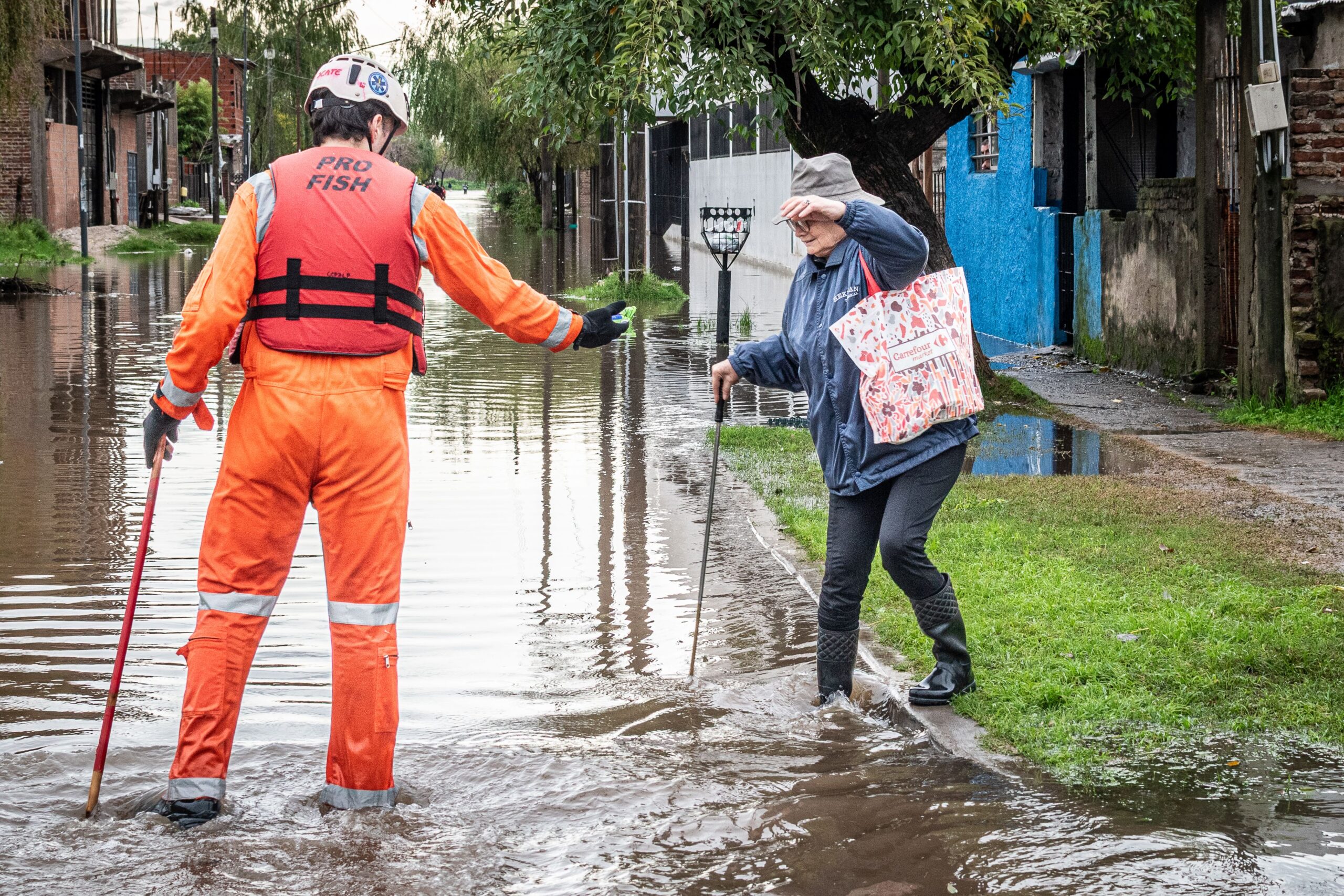
The cause of the water decides which policy pays. FEMA defines a flood as a general and temporary condition where water covers two or more acres of normally dry land, or two or more properties, one of them yours, from overflowing inland or tidal waters, unusual and rapid runoff of surface water, mudflow, or shoreline collapse caused by waves (FloodSmart policy FAQ). Here is how that plays out:
| Where the water came from | Usually paid by | Why |
|---|---|---|
| A river, lake or the ocean overflows into your street | Flood policy | Overflow of inland or tidal waters |
| Hurricane storm surge pushes seawater inside | Flood policy | Tidal water inundating normally dry land |
| Heavy rain runs off and pours in at ground level | Flood policy | Rapid accumulation or runoff of surface water |
| The sewer backs up because the street is flooded | Flood policy | FEMA covers backup only when it results directly from flooding |
| The sewer backs up because your own pipe is clogged | Neither by default | Not a flood; some homeowners policies sell a backup endorsement |
| A pipe bursts inside the wall | Homeowners policy | Sudden and accidental water damage, not a flood |
| Wind tears off shingles and rain gets in | Homeowners policy | The wind opening comes first; it is a wind claim |
For the burst-pipe side of that table, our guide to polybutylene pipes explains how home insurers treat sudden versus gradual leaks, and our roof leaks guide covers wind-driven rain.
What flood insurance covers
An NFIP policy for a homeowner has two parts, bought separately and each with its own deductible. FEMA’s buying guide lists the limits and the main items:
| Building coverage (up to $250,000) | Contents coverage (up to $100,000) |
|---|---|
| Electrical and plumbing systems | Clothing, furniture and electronics |
| Furnaces and water heaters | Curtains and portable or window air conditioners |
| Refrigerators, stoves and built-in appliances such as dishwashers | Clothes washer and dryer, microwave |
| Permanently installed carpeting, cabinets, paneling and bookcases | Carpet installed over wood floors |
| Foundation walls, anchorage systems and staircases | Valuables such as original artwork and furs, up to $2,500 |
| Detached garages, fuel tanks, well water tanks and pumps, solar equipment | — |
Renters can buy contents coverage alone, up to $100,000. If your home would cost more than $250,000 to rebuild, the NFIP cannot cover the difference: the Congressional Research Service notes that the program does not sell excess coverage above its standard limits, so that part has to come from the private market.
What it never covers
Whatever caused the flood, FEMA lists these as outside an NFIP policy:
- Currency, precious metals, stock certificates and other valuable papers.
- Cars and most self-propelled vehicles, including their parts.
- Personal property kept in basements.
- Property outside the insured building: landscaping, septic systems, decks and patios, fences and swimming pools.
- Temporary housing and additional living expenses while the home is repaired.
- Financial losses from business interruption.
Two of those catch homeowners off guard. A finished basement full of furniture is mostly uninsured under the NFIP, and there is no hotel money while the house dries out; your homeowners policy will not step in for a flood loss either.
Who needs flood insurance: zones and lenders
FEMA maps every community into flood zones. The zone decides whether a lender must require coverage; it does not decide whether you can flood. FEMA’s flood risk page says almost one-third of NFIP claims over the past 10 years came from outside the high-risk zones.
| Zone | Risk | Required? |
|---|---|---|
| A, AE, AH, AO, AR, A99 | High (at least a 1% chance of flooding each year) | Yes, with a government-backed mortgage in a participating community |
| V, VE | High, coastal, with storm waves | Yes, with a government-backed mortgage |
| B and X (shaded) | Moderate, usually between the 100-year and 500-year flood limits | No, but recommended; some lenders still require it |
| C and X (unshaded) | Low, above the 500-year flood level | No, but recommended |
| D | Undetermined: no flood hazard analysis done | No, but recommended; rates reflect the uncertainty |
Two more rules can make a policy mandatory even outside a high-risk zone. If your property has ever received federal disaster assistance, it must keep flood coverage to qualify again, and the rule follows the property, so it binds you even if a previous owner got the aid (FloodSmart eligibility). And in Florida, Citizens requires most of its wind policyholders to carry it, regardless of zone, by January 1, 2027; our guide to homeowners insurance Florida rules explains the phase-in.
The 30-day waiting period and its 4 exceptions
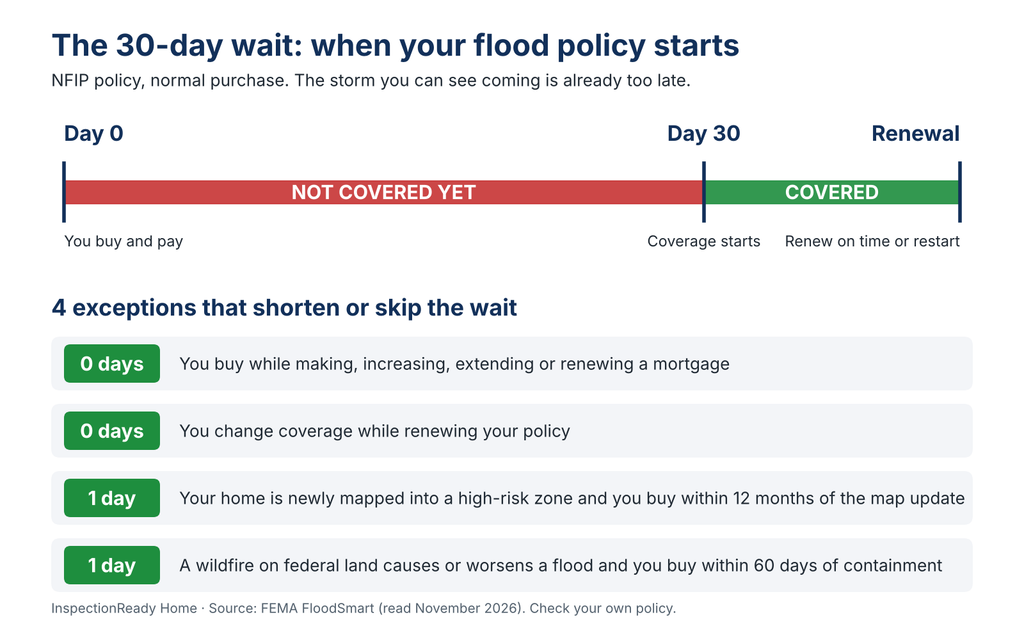
An NFIP policy normally takes effect 30 days after you buy it, so a policy bought when a storm appears on the forecast will not cover that storm. FEMA lists four exceptions:
- No wait if you buy while making, increasing, extending or renewing a mortgage.
- No wait if you change coverage while renewing your policy.
- One day if your property is newly mapped into a high-risk zone and you buy within 12 months of the map update.
- One day if a flood is caused or worsened by a wildfire on federal land and you buy within 60 days of the containment date.
Policies also do not renew on their own. FEMA’s renewal page says you must renew every year; coverage stays in effect for 30 days after expiry if you renew and pay in full within that grace period. Let it lapse and you start over with a new 30-day wait, and you may lose discounts tied to continuous coverage.
What decides the price of a flood policy
There is no single national price. FEMA’s premium page says your NFIP premium is unique to the property and built from three groups of variables. Under the pricing approach FEMA calls Risk Rating 2.0, premiums follow each property’s own risk rather than only its zone, according to the Congressional Research Service.
| Group | What FEMA looks at | What lowers it |
|---|---|---|
| Where it is built | Distance to the coast, rivers and lakes; ground elevation; the community and its Community Rating System (CRS) class | Living in one of the roughly 1,500 CRS communities |
| How it is built | Occupancy, foundation type, first-floor height, number of floors, construction type, flood openings, machinery and equipment | A higher first floor, flood openings, utilities raised above the first floor |
| What is covered | Replacement cost value, building and contents limits, deductibles | Higher deductibles (more out of pocket after a flood) |
One detail matters when you shop: FEMA says every insurer that sells NFIP policies uses the same pricing, so the same NFIP policy costs the same from any of them. Private flood prices can differ. FEMA’s homeowner checklist adds that, in high-risk zones, homes with basements may pay 20% more, and its discount tool estimates savings for foundation type, first-floor height, raised equipment and flood openings. An elevation certificate is not required but can help you pay less.
To see a real number for your address, use the quote tool on FloodSmart, where you can now buy an NFIP policy online, or ask an agent. Any figure you see in an article is someone else’s average, not your premium.
NFIP or private flood insurance?
Florida’s Office of Insurance Regulation says most flood coverage is written through the NFIP, often by private companies under the Write Your Own program, while a growing private market writes primary or excess flood coverage outside it, either as a stand-alone policy or as an endorsement on a homeowners policy.
| Question | NFIP | Private flood |
|---|---|---|
| Building limit | $250,000 | Set by the insurer; can be higher |
| Contents limit | $100,000 | Set by the insurer |
| Price | Same from every NFIP seller | Varies by company |
| Waiting period | 30 days, with 4 exceptions | Set by the policy |
| Accepted by lenders? | Yes | Yes if at least as broad as the standard NFIP policy; ask your lender |
| Depends on Congress? | Yes: needs reauthorization | No |
The December 11, 2026 deadline
Congress has kept the NFIP running with short-term extensions; it is currently authorized until December 11, 2026. If it lapses, the Congressional Research Service says policies already in force keep running to the end of their one-year term, but FEMA loses the authority to issue new contracts and claims may have to wait for premium income if funds run short. If you are buying a home or your policy renews around that date, ask your agent now how a lapse would affect you.
Worked example: a home that costs $400,000 to rebuild
Say a single-family home would cost $400,000 to rebuild and holds about $120,000 of belongings, some of it in a finished basement. The amounts are assumptions to show how the limits work, not a quote.
| Item | Need | NFIP alone | Gap |
|---|---|---|---|
| Building | $400,000 | Up to $250,000 | $150,000: private excess or primary coverage |
| Contents | $120,000 | Up to $100,000 | $20,000, plus anything kept in the basement |
| Living elsewhere during repairs | Several months | Not covered | Savings or a private policy that includes it |
| Deductibles | One per coverage | Separate building and contents deductibles | Choose them knowing both may apply |
The lesson: before you compare prices, write down what you would need to rebuild and replace, then check which parts each option actually reaches.
How to buy a flood policy in 5 steps
- Find your zone and risk. Use FEMA’s flood map tools on FloodSmart, and remember that a low-risk zone is not a no-risk zone.
- Confirm your community participates. NFIP coverage is only available where the town or county follows FEMA’s floodplain rules; most do.
- Get a quote. Buy online on FloodSmart, through an NFIP agent, or ask your agent for a private quote as well.
- Set limits from rebuilding cost. Building and contents separately, and decide whether you need excess coverage above $250,000.
- Buy early and keep it renewed. Count the 30 days, put the renewal date on your calendar, and keep the declarations page with your other insurance papers.
Our paperwork tracker can hold the flood policy’s renewal date next to your homeowners policy and inspection reports. If your home insurer also asks for a wind mitigation inspection or a 4 point inspection, keep those reports in the same place.
Frequently asked questions
How much should I expect to pay for flood insurance?
It depends on where and how your home is built and how much coverage you choose; FEMA prices each property individually. NFIP rates are identical across sellers, so one NFIP quote tells you the NFIP price. Get it on FloodSmart and compare it with a private quote.
Does homeowners insurance cover flood damage?
No. Most homeowners and renters policies exclude flood, and FEMA says they do not satisfy mortgage or disaster-aid flood requirements. Water from a burst pipe is different: that is usually a homeowners claim.
Is flood insurance worth it outside a flood zone?
FEMA reports that almost one-third of NFIP claims in the past decade came from outside high-risk zones, and federal disaster aid needs a presidential declaration that most floods never get. Policies in lower-risk areas are priced for that lower risk.
Is a flood policy required?
Yes if your home is in a high-risk zone (A or V) and has a government-backed mortgage, if your property received federal disaster aid before, or if your lender or insurer requires it. Otherwise it is optional.
Can I buy flood insurance when a hurricane is coming?
You can buy it, but an NFIP policy usually starts 30 days later, so it will not cover a storm that is already forecast. The no-wait exception applies mainly when you are closing or changing a mortgage.
When to call a pro
- Licensed insurance agent: you need a quote, excess coverage above NFIP limits, or a private policy your lender will accept.
- Licensed surveyor: you want an elevation certificate to document your home’s height.
- Your local floodplain manager: you want to know your community’s CRS class or upcoming map changes.
- Your state insurance department: you have a dispute about a flood claim or a private flood policy.
This site does not sell insurance or recommend insurers. Confirm coverage details with your agent or FEMA.
Sources
- FEMA FloodSmart, What you need to know about buying flood insurance
- FEMA FloodSmart, Who’s eligible for NFIP flood insurance?
- FEMA FloodSmart, Premium Costs
- FEMA FloodSmart, What are Flood Zones and Maps?
- FEMA FloodSmart, What is a flood?
- FEMA FloodSmart, How to renew your flood insurance policy
- FEMA FloodSmart, Flood insurance policy checklist for homeowners
- FEMA FloodSmart, Flood Insurance Mitigation Discount Tool
- Florida Office of Insurance Regulation, Flood Insurance
- Citizens Property Insurance Corporation, Flood
- Congressional Research Service, Introduction to the National Flood Insurance Program (October 5, 2026)
- Congressional Research Service, What Happens If the NFIP Lapses? (September 11, 2026)
This guide to flood insurance is general information, not insurance or legal advice. Daniel Aznar, who writes this site, is not an insurance agent and does not recommend any insurer. Limits, rules and the NFIP’s authorization can change: confirm with FEMA, your agent or your insurer. Read our full disclaimer, and if you spot an error, our corrections page explains how we fix it. Information checked in November 2026.