Arkansas Homeowners Insurance: Costs, Hail Deductibles, the 365-Day Claim Window and the 2026 FORTIFIED Rules
Quick answer
Arkansas homeowners insurance averages $1,870 a year for a standard HO-3 policy (NAIC, 2023 data), 13th highest in the country and $133 above the national average. Hail and wind drive the price. Since 2023, insurers may require a separate wind and hail deductible and pay older roofs on a schedule. A cancellation after 60 days needs one of the reasons in state law and 20 days’ notice, and a storm claim alone cannot be the reason.
Arkansas homeowners insurance is priced around one problem: roofs. Hail falls across the state every spring, tornadoes follow the same storms, and insurers have been paying out more than they expected. The state’s answer has been a mix of looser rules for insurers and new protections for owners, and most people only learn them after a storm.
This guide reads the Arkansas Insurance Department (AID)’s own bulletins and the Arkansas Code. You get a timeline for reporting hail damage, a table of what your insurer can and cannot do, and the new FORTIFIED rules that started on July 1, 2026. Every rule links to its source, as explained in how we verify our guides.
Table of Contents
What Arkansas homeowners insurance costs
The latest regulator-compiled numbers come from the NAIC’s homeowners report with data for 2023, published in July 2026. The average Arkansas homeowners insurance premium for an HO-3 policy was $1,870 a year, about $156 a month. That is $133, or 7.7%, above the national average of $1,737 and puts Arkansas 13th of 51 (the 50 states plus Washington, D.C.). Counting every policy form, the state average was $1,868.
Arkansas sits between two price zones. To the south and west, Louisiana ($3,027), Texas ($2,864), Oklahoma ($2,486) and Mississippi ($2,029) all cost more. To the north and east, Tennessee ($1,649) and Missouri ($1,589) cost less. The full 51-state ranking is in our guide to the average cost of homeowners insurance.
Quote sites show Arkansas homeowners insurance anywhere from about $2,300 to almost $5,000 a year. Those figures price one sample house at a chosen dwelling limit today, while the NAIC averages what real policyholders paid across every limit. Use the NAIC number to compare states and a real quote to budget. If your price went up without a claim, the AID’s answer is blunt: usually the insurer raised its overall rates because it paid out more losses than expected.
Why Arkansas homeowners insurance changed in 2023: the roof rules
On November 2, 2023, the AID issued Bulletin 17-2023 to every personal-lines property insurer. It cited the rising frequency and severity of storms that damage roofs and said its goal was to keep coverage available and affordable. In practice it gave insurers two new tools, and both land on your roof.
The separate wind and hail deductible
First, insurers may now make a separate wind and hail deductible mandatory. Your regular deductible still applies to fire or theft, but hail and wind losses get their own, often a percentage of the dwelling limit rather than a flat amount. A 2% deductible on a home insured for $250,000 is $5,000 before the insurer pays anything.
Arkansas added a protection to go with it. Under section 23-79-168, passed as Act 471 of 2023, an Arkansas homeowners insurance policy with a percentage deductible must show the deductible in dollars on the declarations page or the renewal notice. Earthquake deductibles are the one exception. If your renewal shows only a percentage, ask for the dollar figure in writing. Our guide to the homeowners insurance declarations page shows where to look.
Roof schedules on roofs 7 years and older
Second, insurers may now attach a mandatory roof schedule endorsement to roofs that are 7 years old or older. The bulletin requires proper notice to you, and the insurer has to get that notice approved by the AID first. A roof schedule usually pays roof damage on a sliding scale tied to the roof’s age, so an older roof gets a smaller share of the repair cost after the deductible. The exact scale is in the endorsement itself, not in the law.
Seven years is young for a roof, so this rule reaches a lot of Arkansas homeowners insurance policies. Check your roof’s age against what insurers expect with our roof age checker, and read when insurance pays for a roof replacement before you file a roof claim.
Homeowners insurance Arkansas hail claims: the 365-day window
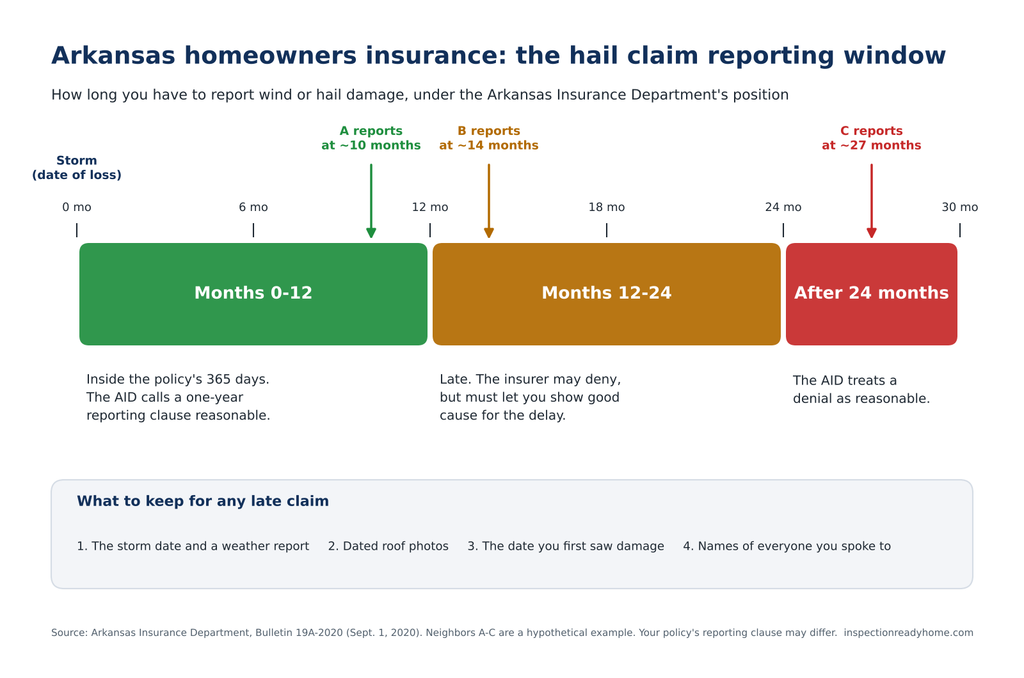
Hail damage is easy to miss from the ground. Bruised shingles can look fine for months until a leak shows up inside. In 2020 the AID took a position on how long you get to report it, after Arkansas homeowners insurance customers were denied for reporting too late. Bulletin 19A-2020, issued September 1, 2020, sets three zones:
- Within 365 days of the storm: a policy may require you to report wind or hail damage within a year, and the AID considers that reasonable in most cases.
- After 365 days: the insurer may deny a late claim, but it must let you show good cause for the delay, such as damage you could not reasonably have found sooner through no fault of your own.
- After 24 months: the AID treats a denial of a claim reported more than 24 months after the date of loss as reasonable under the policy.
The bulletin does not excuse slow reporting on an Arkansas homeowners insurance claim. Whether a delay was reasonable is decided case by case, so the safest date is always the earliest one. After any hailstorm big enough to dent cars, have the roof looked at and write down the date of the storm.
Worked example: one storm, three neighbors
A hypothetical hailstorm hits a street in Benton County on April 10, 2026. Three neighbors have Arkansas homeowners insurance policies with a one-year reporting clause. Each one finds the damage at a different time.
| Neighbor | Reports the claim | Time since the storm | Where it stands |
|---|---|---|---|
| A | February 2027, after a ceiling stain | About 10 months | Inside the policy’s 365 days |
| B | June 2027, after a roofer’s inspection | About 14 months | Late; the insurer can deny, but must hear B’s reason for the delay |
| C | July 2028, while selling the house | About 27 months | Past 24 months; the AID treats a denial as reasonable |
Neighbor B is the case the bulletin was written for. B’s best evidence is a dated weather report for the storm, photos from the roofer and proof that nothing was visible from inside before the inspection. Keep the same file for any claim: dates, photos and names.
Roofers and the three-day exit
Storm crews arrive with the hail, and many will sign you to a repair contract before the adjuster comes out. The law protects you if your Arkansas homeowners insurance company then says no. Under section 4-88-904, when your insurer tells you in writing that all or part of the claim is not covered, you have three business days to cancel the repair contract, and the contractor may not start work until that window has closed.
You can cancel by a written notice delivered in person or mailed to the address in the contract. The contractor must return your payments within 10 days, but it may keep the reasonable value of any emergency work it already did, such as a tarp. A clause charging you a cancellation fee for anything else cannot be enforced against you. For a neighboring state’s roofing law, see our guide to Oklahoma homeowners insurance.
Can your insurer do that? Arkansas homeowners insurance rules tested
Most disputes over Arkansas homeowners insurance come down to a letter: a cancellation, a nonrenewal or a new deductible at renewal. The table below tests common situations against the Arkansas Code and AID bulletins. A cancellation ends a policy mid-term; a nonrenewal means the insurer will not offer another term.
| Situation | Allowed? | Rule |
|---|---|---|
| Cancel a brand-new policy in its first 60 days | Generally yes, under the policy’s terms | § 23-66-206(15) limits start after 60 days |
| Cancel after 60 days for unpaid premium, with 10 days’ notice and the reason | Yes | § 23-66-206(15) |
| Cancel after 60 days for another listed reason (fraud, a material change in risk, a code violation that raises the hazard) with 20 days’ notice | Yes | § 23-66-206(15) |
| Cancel or refuse to renew only because you filed claims for hail, wind or other natural causes | No | § 23-63-109 |
| Cancel or raise your premium because you called to ask whether something is covered | No, unless the event materially increases the risk | § 23-63-110(b) |
| Refuse to renew because of the house’s age or location alone | No, unless there is a real business reason or a legal mandate | § 23-66-206(13)(C) and (D) |
| Add a separate wind and hail deductible at renewal | Yes, with the change described in the renewal offer at least 30 days ahead | Bulletin 17-2023; § 23-88-105 |
| Renew you with an affiliate company instead | Yes, if the affiliate’s financial strength rating is at least as good | § 23-88-105 |
Two dates matter most. A nonrenewal notice or a renewal offer must reach you at least 30 days before the policy ends, except for nonpayment, and a renewal offer must state the new premium and describe any change in the deductible. Thirty days is short, so put the date in our renewal paperwork tracker the day the letter arrives.
The natural-causes rule is narrower than it sounds. Section 23-63-109 defines a natural cause as the violence of nature with no human involvement, and it bars dropping you solely because of those claims. An insurer can still point to a roof it says you never repaired, so keep receipts for every repair.
The Arkansas FAIR plan question: where hard-to-insure homes go
Many states have a FAIR plan any homeowner can turn to after private insurers say no, as our guide to FAIR plan insurance explains. When no private company will sell you Arkansas homeowners insurance, the state’s version is narrower. Its residual pool is the Arkansas Rural Risk Underwriting Association (ARRUA), set up in chapter 88 of the insurance code. Every insurer licensed to write property insurance in the state must belong to it.
By law, ARRUA offers a plan of property insurance to insurable rural risk applicants: properties in areas its governing board designates as rural, with the Insurance Commissioner’s approval. A home in Little Rock or another city may not qualify. Ask a licensed agent whether your address is in a rural area under the plan; the AID lists ARRUA’s in-state number as 1-800-272-6588. If you are not eligible, an agent can look at the surplus lines market, where policies cost more and state protections are thinner.
Earthquake coverage and Arkansas homeowners insurance
Northeast Arkansas sits on the New Madrid Seismic Zone, the same fault system that worries southeast Missouri. Most standard Arkansas homeowners insurance policies do not cover earthquake damage; like flood, it is bought separately. The AID adds a useful rule: if your insurer does not offer earthquake coverage, it must tell you so and tell you how to get it through the state’s market assistance program.
That program, the MAP, came out of the Arkansas Earthquake Authority Act of 1999. It helps owners who cannot find residential earthquake coverage through normal channels, and any Arkansas-licensed agent can use it. If your agent will not, the AID says to call Argenia, LLC at 1-800-482-5968 to find one who will. How earthquake deductibles work, and how few homes near the fault carry coverage, is shown with Missouri’s official numbers in our guide to Missouri homeowners insurance.
Strengthen Arkansas Homes and the July 2026 FORTIFIED rules
Act 427 of 2025, the Strengthen Arkansas Homes Act, approved on April 3, 2025, does two things. It creates a grant program inside the AID to help owners rebuild to the FORTIFIED Home standard of the Insurance Institute for Business & Home Safety (IBHS). And it puts two duties on insurers that write wind or hail coverage, for Arkansas homeowners insurance policies issued or renewed on or after July 1, 2026:
- A discount for FORTIFIED homes: the insurer must give a premium discount or rate reduction on the wind or hail coverage of a certified home, if it is actuarially justified, once it receives your certificate. The law sets no fixed percentage.
- An upgrade endorsement: for homes that are not FORTIFIED, the insurer must offer an optional endorsement that pays the cost of upgrading when a covered claim requires a new roof.
The grant side is not open yet. As of November 2026, the AID had not posted an application page, and the Act leaves the grant amounts and final eligibility rules to department rules. When it opens, the law already sets the frame:
- The home is a detached single-family house that you own, live in as your primary residence and claim a homestead exemption on. Manufactured and mobile homes and condos are excluded.
- An IBHS-certified evaluator you choose from the AID’s list, and pay, inspects the home first.
- You get at least three bids from FORTIFIED-certified contractors and pay anything above the grant.
- You carry wind coverage, plus flood insurance if the home is in a special flood hazard area.
- The work is finished within three months, and the grant is paid to the contractor only after the home is certified.
Oklahoma’s program, which already pays grants, is a good preview of how this works in practice; see our guide to homeowners insurance in Oklahoma. Until Arkansas opens, ask your insurer about the new upgrade endorsement at your next renewal.
Questions to ask your agent
- Does my policy have a separate wind and hail deductible, and what is it in dollars?
- Is there a roof schedule endorsement on my policy, and what does it pay for a roof my age?
- How many days does my policy give me to report hail or wind damage?
- Do you offer the FORTIFIED roof upgrade endorsement, and what would it cost?
- Is earthquake coverage available, and if not, can you place it through the MAP?
Frequently asked questions
Is Arkansas homeowners insurance required by law?
No. The AID says no Arkansas law requires you to carry homeowners coverage. If you have a mortgage, though, your loan agreement probably does, and letting it lapse can put you in breach of that agreement.
Does it cover tornadoes?
Usually yes. Tornado damage is wind damage, and wind is a standard covered peril in Arkansas homeowners insurance. Expect the separate wind and hail deductible to apply instead of your regular one, so check its dollar amount on your declarations page before storm season.
Does it cover flooding?
No. Flood is excluded from standard Arkansas homeowners insurance policies, including rising water after a heavy storm. You need a separate flood policy through the NFIP or a private insurer. Our guide to flood insurance explains the 30-day waiting period.
Can an insurer drop me right after a disaster?
After major storms the AID sometimes orders a pause. After the May 24-26, 2024 tornadoes, Bulletin 7-2024 set a 60-day moratorium on cancellations and nonrenewals for unpaid premium in the affected counties. It was not automatic: owners with significant damage had to ask for it, and it delayed payment rather than waiving it.
Where do I complain about my insurer?
Contact the AID’s Consumer Services Division at 1-800-852-5494 or (501) 371-2640, or file a complaint online through its complaint page. Bring your Arkansas homeowners insurance policy, the letter and your claim dates.
When to call a pro
- A hailstorm hit your area and you have not had the roof checked yet.
- Your renewal added a wind and hail deductible or a roof schedule and you cannot tell what it pays.
- Your insurer denied a hail claim as late and you have a reason for the delay.
- You were turned down by private insurers and need to know if ARRUA or the surplus lines market can help.
A licensed Arkansas agent can compare Arkansas homeowners insurance quotes and explain your endorsements. A roofer you hire after the adjuster’s visit can document hail damage, and an attorney can help if a denial looks wrong. For the hail deductible math in another hail state, see our guide to Colorado homeowners insurance.
Sources
- NAIC, Dwelling Fire, Homeowners Owner-Occupied, and Homeowners Tenant and Condominium/Cooperative Unit Owner’s Insurance Report: Data for 2023 (July 2026)
- Arkansas Insurance Department, Consumers FAQs: Homeowners Insurance
- AID Bulletin 17-2023, Claims Settlements for Storm Damaged Roofs (November 2, 2023)
- AID Bulletin 19A-2020, Windstorm and Hail Claims (September 1, 2020)
- AID Bulletin 7-2024, Severe Storms and Tornados on May 24th through May 26th (May 28, 2024)
- AID, Earthquake Resources and the Market Assistance Program
- Arkansas General Assembly, Act 427 of 2025, Strengthen Arkansas Homes Act
- Ark. Code § 23-66-206, unfair practices, including cancellation of property policies (2025)
- Ark. Code § 23-88-105, notice before expiration of a property policy (2025)
- Ark. Code § 23-63-109, cancellation due to claims from natural causes
- Ark. Code § 23-63-110, cancellation or premium increase for claims without loss
- Ark. Code § 23-79-168, percentage deductibles shown in dollars
- Ark. Code § 4-88-904, cancelling a residential repair contract after a claim denial
- Ark. Code § 23-88-303, Arkansas Rural Risk Underwriting Association
- AID, property and casualty filing information and helpful phone numbers (ARRUA)
This guide to Arkansas homeowners insurance is general information, not insurance or legal advice, and this site is not affiliated with the Arkansas Insurance Department, ARRUA or any insurer. Daniel Aznar, who writes this site, is not a home inspector or an insurance agent. Rules, rates and programs change: confirm what applies to your home with your insurer or a licensed Arkansas agent. Read our full disclaimer, and if you spot an error, our corrections page explains how we fix it. Information checked in November 2026.