NC Homeowners Insurance: What Policies Cover, How Rates Are Set and the Coastal Pool
Quick answer
NC homeowners insurance costs about $1,852 a year for a standard HO-3 policy (NAIC, 2023 data), 15th highest in the country. Rates are not set company by company: the North Carolina Rate Bureau files them and the Commissioner of Insurance approves or settles them, and base rates rose 7.5% in June 2025 and again in June 2026. On the coast, the Coastal Property Insurance Pool is the last resort. Flood is always a separate policy.
NC homeowners insurance works differently from almost every other state. Insurers do not each file their own homeowners rates: the North Carolina Rate Bureau files one set of base rates for the whole market, and the North Carolina Department of Insurance (NCDOI) reviews it. A company can then charge less, or charge more with a printed notice on your declarations page.
This guide explains what an NC homeowners insurance policy covers, how prices are set and how to read the consent-to-rate notice, where coverage changes on the coast, what notice you get before a cancellation, and what the new 2027 homeowners program changes about roof claims. Every rule links to the NCDOI page, statute or Rate Bureau document we read, as explained in how we verify our guides.
Table of Contents
Where you live decides who sells your NC homeowners insurance
Before you compare NC homeowners insurance prices, ask one question: is the home inland, in one of the 18 coastal counties, or on the barrier islands? The answer decides which market you can buy from, and whether wind is inside the policy or sold separately. The state’s two residual-market pools draw the lines:
| Where the home is | Examples | Main market | Last resort if no company will insure it |
|---|---|---|---|
| Mountains and Piedmont (82 counties) | Asheville, Charlotte, Greensboro, Raleigh, Durham | Private insurers, at Rate Bureau rates or deviations | NCJUA (FAIR Plan): dwelling fire policy with wind, no liability |
| The 18 coastal counties, on the mainland | Wilmington, New Bern, Jacksonville, Elizabeth City | Private insurers; some exclude wind and hail on the coast | NCIUA (Coastal Property Insurance Pool): homeowners policy or a wind-and-hail-only policy |
| Beach area: south and east of the Intracoastal Waterway, including the Outer Banks | Outer Banks towns, Wrightsville Beach, Emerald Isle | Private insurers where available | NCIUA: homeowners, wind and hail, and fire policies |
The 18 coastal counties, as NCDOI lists them, are Beaufort, Brunswick, Camden, Carteret, Chowan, Craven, Currituck, Dare, Hyde, Jones, New Hanover, Onslow, Pamlico, Pasquotank, Pender, Perquimans, Tyrrell and Washington. If your address is in one of them, ask every quote one extra question: is windstorm and hail included, or excluded and sold separately?
NCDOI’s consumer guide to homeowners insurance warns that coastal policies may exclude windstorm and hail. When that happens, the gap is filled by a wind-and-hail-only policy, covered in the Coastal Property Insurance Pool section below. State law does not require any homeowners policy, but NCDOI notes that your mortgage lender will.
What an NC homeowners insurance policy covers
NCDOI’s guide describes the standard North Carolina homeowners forms by their official numbers. Most owners have the HO 00 03, but older homes and condos use different forms, and the form decides how a claim is paid:
| Form | Who it is for | How it covers the house | How it covers belongings |
|---|---|---|---|
| HO 00 02 (Broad Form) | Single-family home or townhouse | Named perils only | Named perils |
| HO 00 03 (Special Form) | Single-family home or townhouse; the most common choice | Open perils: everything not excluded | Named perils |
| HO 00 05 (Comprehensive) | Single-family home or townhouse | Open perils | Open perils |
| HO 00 06 (Unit-Owners) | Condominium owners | Your unit’s interior; the association insures the building | Named perils |
| HO 00 08 (Modified Coverage) | Older homes that do not qualify for the other forms | Named perils, paid at actual cash value | Named perils |
Inside each NC homeowners insurance form, the coverage limits follow a pattern. The guide says other structures are normally 10% of the dwelling limit (Coverage A), personal property 50%, and loss of use 20%. Liability (Coverage E) pays for your defense and damages if you are sued, and medical payments (Coverage F) pays small medical bills for guests hurt on your property, whatever the fault.
One rule shapes every NC homeowners insurance claim: insure the house for at least 80% of its full replacement cost. If the limit is lower, NCDOI says the insurer reduces what it pays on a partial loss. Your limits and deductibles are listed on your declarations page, and the replacement-cost figure there is worth checking against a contractor’s estimate.
What is excluded matters as much. NCDOI says homeowners policies do not cover floods, earthquakes, mudslides, mudflows or landslides, and do not cover water backing up through drains or a sump pump unless you add an endorsement. Flood coverage comes from the federal NFIP or a private flood policy, usually with a 30-day wait; our flood insurance guide explains the limits.
How NC homeowners insurance rates are set
The North Carolina Rate Bureau was created by state law in 1977. It is not part of NCDOI: it represents the insurance companies, and it files proposed homeowners rates for the whole market. The Commissioner then has three options: accept the filing, hold a hearing, or negotiate a settlement. Here is what happened in the most recent NC homeowners insurance rate case, according to NCDOI:
- What insurers asked for: an average statewide increase of 42.2%, and up to 99.4% in some territories.
- What was settled, in January 2025: an average statewide base rate increase of 7.5% on June 1, 2025, and another 7.5% on June 1, 2026.
- Territory cap: no rating territory could rise more than 35%.
- Rate freeze: the Rate Bureau cannot seek another increase before June 1, 2027.
Two things follow for your NC homeowners insurance bill. First, a base rate change reaches you at renewal, not mid-term, so a June 2026 change may only show on a policy renewing later in the year. Second, the 7.5% is an average: territories on the coast and inland moved by different amounts, and your own premium also moves with your coverage limit, deductible and claims.
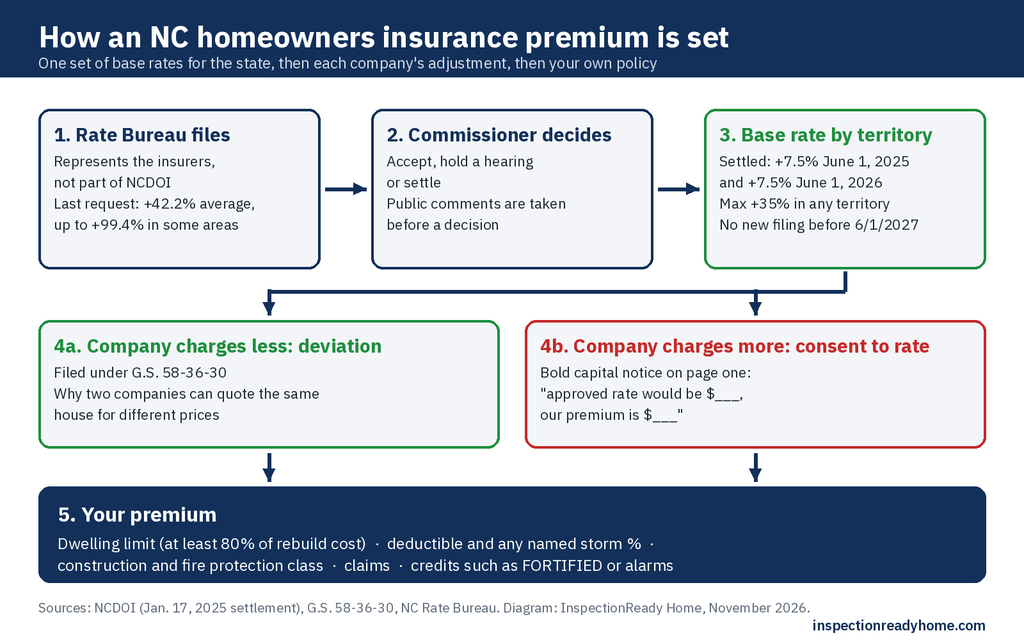
The base rate is a starting point, not the price every company charges. Under G.S. 58-36-30, the statute on deviations, a company may file a downward deviation to charge less than Rate Bureau rates, which is how two insurers can quote the same house differently. A company can also charge more than the approved rate, with your knowledge, under a rule called consent to rate.
Consent to rate: the notice on page one
Under G.S. 58-36-30(b1), an insurer may charge a higher rate than the Rate Bureau’s on a residential property of up to four units, under the Commissioner’s rules. When it does, the notice must appear on page one of the declarations page or on a page before it, in bold capital letters of at least 14-point type, and on renewals too. It reads, in part:
“NOTICE: IN ACCORDANCE WITH G.S. 58-36-30(b1), THE PREMIUM BASED UPON THE APPROVED RATES IN NORTH CAROLINA FOR RESIDENTIAL PROPERTY INSURANCE COVERAGE APPLIED FOR WOULD BE $____. OUR PREMIUM FOR THIS COVERAGE IS $____.”
Since January 1, 2019, the company no longer needs your signature to use consent to rate, according to NCDOI; the printed notice is what tells you. That makes it the most useful line on an NC homeowners insurance renewal, because it shows in dollars how far your price sits above the state-approved rate.
Worked example: reading a consent-to-rate notice
Say your renewal arrives with this notice filled in. The figures are an example, not a real quote:
| Line on the notice | Amount | What it tells you |
|---|---|---|
| Premium at the approved North Carolina rates | $2,140 | What the Rate Bureau rate would charge for this coverage |
| Our premium for this coverage | $2,780 | What this company charges you |
| Difference | $640 a year (about 30% more) | The part of your premium that comes from consent to rate |
A $640 gap is a reason to shop, not a reason to panic. The company may be charging more because of the home’s age, roof, claims or location, and other companies may decline it at the approved rate. Ask your agent two questions: why is this home rated above the manual rate, and can another company write it at the approved rate or below? Then compare the coverage lines, not just the price.
What NC homeowners insurance costs
The most recent regulator-compiled average comes from the NAIC’s homeowners report with 2023 data, published in July 2026. It puts the average North Carolina HO-3 premium at $1,852 a year, about $154 a month. That is $115 above the national HO-3 average of $1,737, and 15th highest of the 50 states plus Washington, D.C. Two rate increases have taken effect since that data year.
Search results quote higher averages, often $1,975 to over $3,000. Those are usually quotes for a sample house with a set dwelling limit, priced in 2025 or 2026, so they measure something different. The NAIC figure is what policyholders actually paid across all coverage amounts. For every state side by side, see our average cost of homeowners insurance ranking.
What moves your own NC homeowners insurance price? NCDOI’s guide names these factors:
- Construction: frame houses usually cost more to insure than brick.
- Fire protection class: from 1 (lowest rates) to 10 (highest), based on how close the nearest hydrant is and how well equipped the fire department is.
- Deductible: a higher deductible lowers the premium. Deductibles do not apply to liability or medical payments.
- Protective devices: deadbolts, fire extinguishers and alarms can earn credits.
- Claims history: frequent or severe claims can mean a higher deductible or a refusal to renew.
- Location and territory: the Rate Bureau rates by territory, so two similar houses in different counties can start from different base rates.
Hurricane and wind deductibles on the coast
Many coastal NC homeowners insurance policies carry a second deductible for wind. The Rate Bureau’s standard forms include a windstorm or hail percentage deductible and a named storm percentage deductible written for North Carolina. Either one is a percentage of your dwelling limit, not a flat dollar amount, so the bill grows with the size of the house.
Do the math before a storm, not after. On a $350,000 dwelling limit, a 2% named storm deductible means you pay the first $7,000 of hurricane damage; at 5%, the first $17,500. Your declarations page shows which deductible applies to which event, and the FAQ from NCDOI confirms an insurer can raise your deductible at renewal, with notice. A wind mitigation report or a FORTIFIED roof can earn wind credits; our guide to the wind mitigation inspection explains what inspectors record.
North Carolina Insurance Underwriting Association (Coastal Property Insurance Pool)
The North Carolina Insurance Underwriting Association (NCIUA) is the coast’s insurer of last resort. Created in 1969 and long called the Beach Plan, it now calls itself the Coastal Property Insurance Pool. It is an association of insurance companies, not a state agency, and its plan of operation is approved by the Commissioner. Its services and coverages page says it offers:
- Homeowners policies in the beach and coastal territories of the 18 eligible counties.
- Wind-and-hail-only policies in the same area, for homes whose main policy, from a company licensed in North Carolina, excludes windstorm. The wind policy must match the main policy’s dates, limits and form as closely as possible.
- Dwelling fire and crime coverage only in the beach area, south and east of the Intracoastal Waterway.
- Limits: up to $1,000,000 on the building, with personal property capped at 40% of the building limit and always paid at actual cash value.
Two rules catch people out. NCIUA does not sell flood insurance, and it publishes a named storm writing restriction on its underwriting page: when a storm threatens, it stops writing new coverage inside a mapped area. Buy or increase coverage before hurricane season, not when the forecast cone reaches the coast. For claims and payments, NCIUA lists 800-662-7048.
The pool is also where most of the state’s roof grants come from. In July 2025, NCDOI announced the Strengthen Your Coastal Roof program: $20 million in grants of $6,000 for eligible NCIUA policyholders in the 18 counties to upgrade to an IBHS FORTIFIED Roof, first come, first served. It joined the Strengthen Your Roof program for the Outer Banks and barrier islands, and a no-cost Stronger Roof Endorsement that adds up to $5,000 toward a FORTIFIED roof after a covered roof loss. Check the program site for current funding before you plan around a grant.
The FAIR Plan inland: NCJUA
Away from the beach area, the last resort for NC homeowners insurance is the North Carolina Joint Underwriting Association (NCJUA), the state’s FAIR Plan. It sells dwelling fire policies, not homeowners policies: they include windstorm, fire, lightning and vandalism, and can pay replacement cost or actual cash value on the building, but contents are paid at actual cash value. The residential building limit is $1,000,000.
NCDOI’s guide adds two warnings: a FAIR Plan policy has no liability coverage, so you need a separate liability policy, and it is meant as a temporary fix after several companies have turned you down. Our FAIR plan insurance guide compares North Carolina’s pools with other states’.
Cancellation, nonrenewal and rate-change notices
North Carolina homeowners policies follow the Rate Bureau’s standard forms, and NCDOI’s guide summarizes the notice you get. The deadlines are short, so the date on the envelope matters:
| The letter says | Minimum notice | When it is allowed | What to do first |
|---|---|---|---|
| Cancellation for unpaid premium | 10 days | Any time | Pay before the date in the notice. NCDOI warns there is no grace period |
| Cancellation in the first 60 days | 10 days | For any reason, on a new policy | Ask the reason in writing and start shopping the same day |
| Cancellation after 60 days, or at renewal | 30 days | Only for material misrepresentation or a substantial change in the risk | Ask what changed; correct errors on the application in writing |
| Nonrenewal | 30 days before the renewal date | Any reason | Ask for the reason, fix what you can, and get new quotes |
| Higher premium or lower coverage | 15 days | When the company changes rate or coverage, other than at your request | Compare the renewal with last year’s declarations page |
Can an insurer simply decide not to renew? NCDOI’s homeowners FAQ says yes: the law does not require you to carry homeowners insurance, and each company sets its own underwriting guidelines. If the reason is the roof or the condition of the house, ask whether a repair or an inspection report would change the decision; our roof age checker shows how insurers usually see an older roof.
Put every notice date in a calendar the day the letter arrives. Our renewal paperwork tracker can create the reminders, so a 30-day window does not shrink to ten while the letter sits unopened.
What changes for NC homeowners insurance on June 1, 2027
On October 21, 2025, the Commissioner approved a new North Carolina 2027 Homeowners Policy Program, based on the Insurance Services Office’s 2022 forms with North Carolina changes. It applies to new and renewal policies effective on or after June 1, 2027, and the Rate Bureau says it did not change base rates. The biggest changes are about roofs:
| New in the 2027 program | What it does | What to ask at your 2027 renewal |
|---|---|---|
| Roof Payment Schedule for windstorm or hail losses to roof surfacing | Pays a roof claim on a schedule based on roof age and material, with a lower premium if you choose it | How much a roof of your age and material would be paid, in dollars |
| Actual cash value settlement for wind or hail losses to roof surfacing | Pays the roof covering minus depreciation | Whether it is on your policy, and what the premium is without it |
| Cosmetic damage exclusion for windstorm or hail | Excludes dents and marks that do not affect how the surface works, with an optional buyback | Whether a metal roof or siding needs the buyback |
| Matching exclusion | Excludes paying to match undamaged surfaces, with an optional Matching Exterior Surfacing coverage | Whether to add matching coverage |
| FORTIFIED Roof new roof expense coverage | Revised North Carolina coverage for upgrading to a FORTIFIED roof after a covered hurricane loss | Whether your company includes it and the limit |
| Smart device credits and new add-ons | Credits for certain smart protective devices; options such as water backup, home-sharing and identity fraud | Which credits you qualify for |
Matching is the change most owners will feel. NCDOI already tells consumers that a policy generally replaces only the damaged part of a roof, even if new shingles do not match. Under the 2027 forms, matching becomes something you can buy back. Ask your agent which options your company will offer before your 2027 renewal, and read our guide to whether homeowners insurance covers roof replacement for how depreciation already works.
NC homeowners insurance companies also have to decide whether the switch needs a written notice to you at least 15 days before the change. Expect an advisory notice with your renewal, and compare it line by line with your current declarations page.
Best and cheapest homeowners insurance North Carolina: how to compare quotes
We do not rank insurers, and most “best” or “cheapest homeowners insurance North Carolina” lists price a sample house, not yours. With a single set of base rates, NC homeowners insurance quotes usually differ in three places: a downward deviation, a consent-to-rate surcharge, and the coverage choices underneath the price. Ask the same questions of every company:
Ask your insurer or agent
- Is this premium at the approved rate, below it (deviation), or above it (consent to rate)? Show me the notice if there is one.
- Is windstorm and hail included, and is there a separate named storm or wind deductible? What is it in dollars?
- Is the dwelling limit at least 80% of the rebuild cost? What is the replacement-cost estimate based on?
- Is the roof paid at replacement cost, actual cash value or on a schedule, now and after June 1, 2027?
- Which credits apply: protective devices, a newer roof, a FORTIFIED designation, wind mitigation features?
- Is the company licensed by NCDOI? Surplus lines insurers are not rate-regulated and are not backed by the state guaranty association.
Check licensing before you pay: NCDOI’s guide lists 1-800-546-5664 for company and agent license checks, and suggests looking at financial ratings from A.M. Best, Moody’s, S&P or Weiss. A quote hundreds of dollars lower usually differs somewhere above the price line.
Filing a claim and getting help
NCDOI’s guide and FAQ set out what to expect after an NC homeowners insurance loss:
- Report it promptly, make reasonable emergency repairs, and keep receipts and photos. Do not make extensive repairs before the adjuster sees the damage.
- Acknowledgment: the insurer should acknowledge your claim within 30 days. There is no fixed deadline to settle it.
- Replacement cost: the insurer pays actual cash value until you replace; you have 180 days from the loss to claim the rest.
- Fallen trees: removal is paid up to $500 per loss when a tree damages a covered structure or blocks the driveway.
- Disputes over the amount: either side can demand appraisal. Each picks an appraiser within 20 days of a written request, and the two choose an umpire.
If you cannot settle an NC homeowners insurance dispute with the company, NCDOI’s Consumer Services Division takes complaints at 855-408-1212, weekdays 8 a.m. to 5 p.m. NCDOI forwards the complaint, requires the company to respond and can require it to correct a violation. Send copies of your policy, claim number and letters, not the originals.
Frequently asked questions
How much is NC homeowners insurance?
The NAIC’s latest regulator-compiled average is $1,852 a year for a standard HO-3 policy in North Carolina (2023 data), $115 above the national average. Base rates have since risen 7.5% in June 2025 and 7.5% in June 2026 on average, so current quotes run higher.
Is homeowners insurance required in North Carolina?
Not by state law. NCDOI says no law requires it, but a mortgage lender will. If you let it lapse, the lender can buy force-placed coverage and bill you, and that policy protects only the lender’s interest.
Why did my NC homeowners insurance go up?
The most common reason is the Rate Bureau settlement: average base rates rose 7.5% on June 1, 2025, and 7.5% on June 1, 2026, with up to 35% in some territories. Other reasons are a higher dwelling limit, a new consent-to-rate surcharge, a lost credit or a claim. The Rate Bureau cannot seek another increase before June 1, 2027.
Does NC homeowners insurance cover hurricane flooding?
No. Wind damage from a hurricane can be covered, but flood and storm surge are excluded from every homeowners policy. You need a separate flood policy, and most NFIP policies start 30 days after you buy.
Is the Beach Plan still around?
Yes, under a new name. The Beach Plan is now the Coastal Property Insurance Pool, run by the North Carolina Insurance Underwriting Association for the 18 coastal counties. Inland, the FAIR Plan (NCJUA) is the last resort.
When to call a pro
- Licensed insurance agent: you need quotes, a coastal wind-and-hail policy or an NCIUA or NCJUA application.
- Roofer or home inspector: a nonrenewal cites the roof or the condition of the house and you need proof of repairs.
- Wind mitigation or FORTIFIED evaluator: you want wind credits or plan to apply for a roof grant.
- NCDOI Consumer Services (855-408-1212): you think a company wrongly canceled, nonrenewed or underpaid a claim.
- Attorney: a large claim dispute is heading toward court.
This site does not sell NC homeowners insurance or recommend insurers. Confirm coverage details with your agent or NCDOI.
Sources
- North Carolina Department of Insurance, Homeowners Insurance
- NCDOI, A Consumer’s Guide to Homeowner’s Insurance
- NCDOI, FAQs About Homeowners Insurance
- NCDOI, Commissioner Causey negotiates settlement on Rate Bureau’s homeowners’ insurance request (January 17, 2025)
- NCDOI, $20 million grant program to strengthen coastal roofs (July 17, 2025)
- NCDOI, Bulletin 18-B-08: Consent to rate changes
- North Carolina General Statutes, G.S. 58-36-30: Deviations and consent to rate
- North Carolina Rate Bureau, overview
- North Carolina Rate Bureau, Circular P-25-3: Implementation of the NC 2027 Homeowners Program (October 29, 2025)
- North Carolina Rate Bureau, Circular P-26-6: NC 2027 Homeowners Policy Program (July 21, 2026)
- NCJUA and NCIUA, Services and coverages
- NCJUA and NCIUA, Underwriting: mitigation credits and named storm restriction
- NAIC, Homeowners insurance report: Data for 2023 (July 2026)
This guide to NC homeowners insurance is general information, not insurance or legal advice. Daniel Aznar, who writes this site, is not an insurance agent or inspector and does not recommend any insurer. Rates, forms and grant programs change: confirm with NCDOI, the Rate Bureau, NCIUA, your agent or your insurer. Read our full disclaimer, and if you spot an error, our corrections page explains how we fix it. Information checked in November 2026.