Alabama Homeowners Insurance: Costs, the Beach Pool and $10,000 FORTIFIED Roof Grants
Quick answer
Alabama homeowners insurance costs about $1,906 a year for a standard HO-3 policy (NAIC, 2023 data), 12th highest in the country. Inland, wind is usually inside the policy. In coastal Mobile and Baldwin counties it may be excluded, and the Beach Pool (AIUA) sells wind coverage as a last resort. Since 2026, insurers cannot drop you only for a weather claim, and state grants of up to $10,000 pay for FORTIFIED roofs.
Alabama homeowners insurance splits into two markets at the 31st parallel. North of it, from Huntsville to Birmingham to Montgomery, most policies cover wind and hail with the rest of the house. South of it, in the coastal parts of Mobile and Baldwin counties, many policies leave wind out, and owners buy it separately from the Alabama Insurance Underwriting Association, the state’s Beach Pool.
Alabama also does something few states do: it pays homeowners to make their roofs stronger. This guide covers what an Alabama homeowners insurance policy includes, what it costs by official data, how the coastal wind gap works, who qualifies for a Strengthen Alabama Homes grant, the FORTIFIED discount law, and the 2026 rules on cancellations after storms. Every rule links to the source we read, as explained in how we verify our guides.
Table of Contents
Alabama homeowners insurance at a glance
Seven facts shape almost every Alabama homeowners insurance decision. Each row names the source, so you can check it yourself:
| Fact | What it means for you | Source |
|---|---|---|
| Average HO-3 premium: $1,906 a year (2023 data) | $169 above the national average of $1,737; 12th highest of 51 | NAIC |
| No state law requires a policy | Your mortgage lender will, and can buy coverage for you if it lapses | Your mortgage documents |
| Coastal wind may be excluded south of the 31st parallel in Mobile and Baldwin | You may need a separate wind-and-hail policy | AIUA |
| Beach Pool limits since November 1, 2025: $650,000 dwelling, $325,000 personal property | Larger homes need a plan for the value above the limit | AIUA |
| No canceling or nonrenewing only because of a weather or catastrophe claim, since January 1, 2026 | A storm claim alone should not cost you your policy | ALDOI Bulletin 2025-08 |
| Strengthen Alabama Homes grants of up to $10,000, no income limit | A FORTIFIED roof can cost you little or nothing beyond the evaluation fee | Strengthen Alabama Homes |
| Insurers must offer a wind premium discount for FORTIFIED homes | A FORTIFIED certificate lowers the wind part of your premium | Code of Alabama, Sections 27-31D-1 to 27-31D-5 |
What an Alabama homeowners insurance policy covers
An Alabama homeowners insurance policy uses the same building blocks as the rest of the country. The most common form is the HO-3: it covers the house against everything not excluded, and your belongings against a list of named perils. Each part of the policy has its own limit on your declarations page:
- Dwelling (Coverage A): the house and attached structures, insured for what it would cost to rebuild, not its market price.
- Other structures (B): fences, sheds and detached garages.
- Personal property (C): furniture, clothes and electronics, with lower limits for jewelry and similar items.
- Loss of use (D): extra living costs while the home cannot be lived in.
- Liability (E) and medical payments (F): injuries and damage you cause to others.
Three gaps cause most surprises. Flood is never part of an Alabama homeowners insurance policy; it comes from the NFIP or a private flood insurer, usually after a 30-day wait (our flood insurance guide explains the limits). Wind and hail often carry their own percentage deductible. And on the coast, wind can be excluded altogether, which is why the next sections matter more in Mobile than in Huntsville.
What Alabama homeowners insurance costs
The most recent regulator-compiled figure comes from the NAIC’s homeowners report with 2023 data, published in July 2026. It puts the average Alabama HO-3 premium at $1,906 a year, about $159 a month. That is about 10% above the national HO-3 average and 12th highest of the 50 states plus Washington, D.C. Across all policy forms, the Alabama average is $1,862.
Why do websites quote $3,000 or $4,000 instead? Most of those numbers price one sample house, with a fixed dwelling limit, in 2025 or 2026. The NAIC figure is what policyholders actually paid across every coverage amount, from small inland homes to large coastal ones. Both are useful; they just answer different questions. Our average cost of homeowners insurance ranking puts Alabama next to every other state.
For real prices on a house like yours, the Alabama Department of Insurance (ALDOI) publishes a homeowners premium comparison that lists sample premiums by company. What moves your own Alabama homeowners insurance price:
- Distance from the Gulf: the coastal territories of Mobile and Baldwin carry the highest wind risk.
- Roof age, shape and construction: the roof drives most wind and hail losses, which is why a FORTIFIED designation earns a discount.
- Rebuild cost: a higher dwelling limit means a higher premium and, with a percentage deductible, a bigger deductible.
- Deductibles: the all-other-perils amount and the wind or hurricane percentage.
- Claims history: past claims at the address or by you can raise the price; ask your insurer what it counts.
The coastal wind gap in Mobile and Baldwin counties
On the coast, Alabama homeowners insurance is often a stack of policies rather than one. The AIUA only covers property south of the 31st parallel in Mobile and Baldwin counties, which takes in cities such as Mobile, Daphne, Fairhope, Foley, Gulf Shores and Orange Beach. Here is how the layers usually compare:
| Layer | Most of Alabama | Coastal Mobile and Baldwin (south of the 31st parallel) |
|---|---|---|
| Fire, theft, liability and other perils | Homeowners policy | Homeowners policy, sometimes written “ex-wind” |
| Wind and hail | Usually inside the homeowners policy, often with a percentage deductible | Inside the policy, or a separate wind-and-hail policy from a private insurer or the AIUA |
| Flood and storm surge | Separate flood policy | Separate flood policy; the AIUA requires one in a flood zone, equal to your coverage |
| Last resort if no company will insure the wind risk | No state pool; an agent can look for other companies | AIUA (the Beach Pool) |
For coastal Alabama homeowners insurance, two policies means two deductibles, two renewal dates and two sets of paperwork. Make sure the wind policy’s dates and limits line up with the main policy, and keep both declarations pages together. The AIUA covers only that coastal zone, so inland owners who are turned down need an agent to find another company. Our FAIR plan insurance guide compares the last-resort pools in other states.
Worked example: a hurricane deductible in Baldwin County
A percentage deductible is a share of the insured value, not of the damage. The AIUA adds a twist: if a home is worth more than its maximum limit, the deductible is figured on the home’s total insurable value, not on the limit. Two example homes in Baldwin County, with figures that are illustrations, not quotes:
| Line | Home A | Home B |
|---|---|---|
| Cost to rebuild (total insurable value) | $320,000 | $800,000 |
| Wind limit | $320,000 | $650,000 (the AIUA maximum) |
| Hurricane deductible at 2% | $6,400 | $16,000 |
| Hurricane deductible at 5% | $16,000 | $40,000 |
| Hurricane damage to the roof and walls | $30,000 | $30,000 |
| Policy pays at 5% | $14,000 | $0 |
Home B’s owner pays the whole $30,000 repair, even though the policy has a $650,000 limit. Before you pick a percentage for your Alabama homeowners insurance wind coverage, multiply it by your rebuild cost and ask whether you could pay that amount the week after a storm. A FORTIFIED roof does not change the deductible, but it lowers the odds of reaching it.
Alabama Insurance Underwriting Association (the Beach Pool)
The Alabama Insurance Underwriting Association was formed in the early 1970s by insurers working with ALDOI, and the legislature wrote it into law in 2008. Its mission is narrow: to offer essential property coverage to owners in Baldwin and Mobile counties who cannot get it in the private market. The rules that matter most, from its FAQ:
- Where: only south of the 31st parallel in Baldwin and Mobile counties. Its zone map checks an address.
- How to buy: through an AIUA-authorized agent only. Agents cannot bind coverage; the policy starts when the AIUA receives the complete application and the full premium.
- What it will not insure: vacant or farm property, or a home with existing damage or unfinished repairs that led to a denial, cancellation or nonrenewal.
- Limits: the dwelling must be insured to 100% of its value, up to $650,000; personal property up to $325,000 and no more than half the dwelling limit (both raised on November 1, 2025).
- Not included: liability coverage and flood, so it never replaces a full Alabama homeowners insurance policy. In a flood zone, it requires flood insurance equal to your fire and wind coverage.
- Buying a home: at a closing with a new purchase mortgage, the AIUA can issue a 30-day binder while the application is completed.
The AIUA also gives wind mitigation discounts, one per home: for a community’s building code grade, for a home certified by an architect or engineer as built to the 2006 International Residential Code or later, and for an IBHS FORTIFIED designation. The second page of the policy outline printed with your declarations shows which discount was applied. Claims go to 1-866-780-2482, and your agent should hear about them too.
Strengthen Alabama Homes: up to $10,000 for a FORTIFIED roof
The Alabama Legislature created Strengthen Alabama Homes in 2011, and the Insurance Institute for Business & Home Safety (IBHS) calls it the first state-led FORTIFIED grant program. By IBHS’s count it has paid out more than $70 million and helped more than 7,000 residents install FORTIFIED roofs. ALDOI runs it, and the grant pays 100% of the mitigation cost up to $10,000, with no income limit. For many coastal owners it is the cheapest route to a lower Alabama homeowners insurance bill.
Grants are first come, first served on set dates. The schedule published by Smart Home America, the program’s nonprofit partner, opens the portal at 9 a.m. on these days and closes it when the money runs out:
- Mobile County: January 5, April 6 and July 6, 2027 (the last round opened October 6, 2026).
- Baldwin County: January 7, April 8 and July 8, 2027 (the last round opened October 8, 2026).
Outside those two counties, ask the grant office whether your county has a round or a local partner. It can be reached at 334-269-3550 or SAH@insurance.alabama.gov. The path from application to payment has strict 7-day deadlines at almost every step:
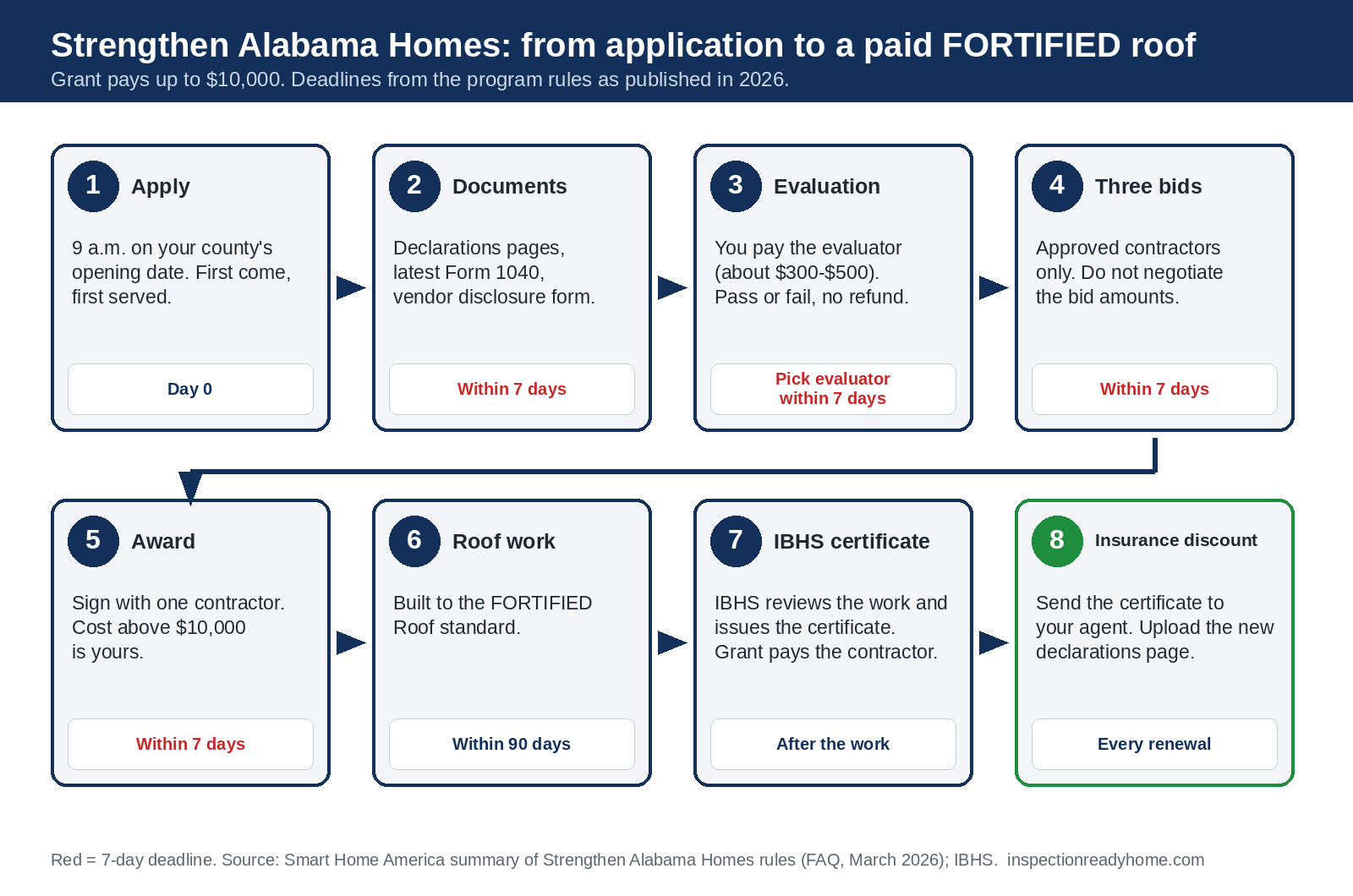
- Apply at 9 a.m. on your county’s opening date, on a computer rather than a phone.
- Upload your documents within 7 days: homeowners declarations page, wind and flood declarations if you have them, your latest Form 1040 and a notarized vendor disclosure form.
- Pick an approved FORTIFIED evaluator and pay the evaluation yourself, typically $300 to $500. It is pass or fail and not refunded.
- Choose three approved contractors to bid, then sign with one within 7 days of the award letter. Anything above $10,000 is yours to pay.
- Finish the roof within 90 days. IBHS reviews the work and issues the FORTIFIED certificate, and the grant pays the contractor directly.
- Send the certificate to your agent and upload your updated declarations page showing the discount.
Do you qualify? A quick pass or fail check
The evaluation fee is lost if the house fails, so check the basics first. Our checklist from the program rules as Smart Home America summarizes them (FAQ updated March 2026):
| Your situation | Result | Why |
|---|---|---|
| Single-family home you own and live in as your main residence | Pass | The program is for owner-occupied primary homes |
| Condo, townhome, mobile home or rental | Fail | These property types are excluded |
| Home listed for sale | Fail | It must not be on the market |
| Active homeowners policy when you apply | Pass | Required; wind coverage is required when the work is done, and flood in a high-risk flood zone |
| Roof insurance claim in the last 6 months | Fail | Wait until 6 months have passed |
| House in poor repair | Fail | The home must be in good repair to pass the evaluation |
| High household income | Pass | There is no income limit |
FORTIFIED Roof, Silver and Gold: what each level adds
FORTIFIED is a voluntary construction standard written by IBHS, the insurer-funded research institute. It has three levels, and each one includes everything in the level below it. The grant targets the first level; the higher two usually make sense during a major renovation or new build:
| Level | Main requirements | Who usually does it |
|---|---|---|
| FORTIFIED Roof | Roof deck at least 7/16-inch OSB or plywood with enhanced nailing; sealed roof deck so water stays out if shingles blow off; rated edge metal, shingles and vents | FORTIFIED-certified roofer, at re-roofing time |
| FORTIFIED Silver | Roof, plus impact protection for windows, doors and skylights, a pressure-rated garage door, braced gable ends and tied-down porches and carports | Licensed contractor |
| FORTIFIED Gold | Silver, plus a continuous load path from roof to walls to foundation, chimneys tied to the structure and pressure-rated windows | Licensed contractor or builder; usually new construction or a deep renovation |
Does it work? IBHS reports that after Hurricane Sally in 2020, FORTIFIED homes in Alabama were less likely to file a claim, and the claims they did file were smaller on average. Alabama now has more than 50,000 FORTIFIED designations, and only 17% of them came through the grant. If your roof is near the end of its life, our roof age checker shows when insurers start to care.
The FORTIFIED discount law
A FORTIFIED certificate is worth money on your Alabama homeowners insurance every year, not only on the day of the grant. Alabama Act 2009-500, now Sections 27-31D-1 to 27-31D-5 of the Code of Alabama, requires property insurers to include a premium discount or rate reduction for homes built to the 2006 International Residential Code with its hurricane provisions, or to the FORTIFIED standards. Under the commissioner’s benchmark, the discount:
- applies to the wind portion of the premium, not the whole bill;
- is mandatory in Baldwin and Mobile counties, according to ALDOI’s handout;
- depends on the level and on the age of the roof and home;
- applies only to single-family detached homes on a permanent foundation.
We do not quote percentages, because they vary by company and change with rate filings. Ask your agent for the dollar difference with and without the certificate, and check that it shows up on your renewal. The idea is close to Florida’s wind mitigation credits; our wind mitigation inspection guide explains what an inspector records.
Cancellations and nonrenewals after a storm: the 2026 rules
In December 2025, ALDOI issued Bulletin 2025-08 on unlawful trade practices, later revised. It applies to admitted property and auto insurers, including the AIUA, and changes what can happen to your Alabama homeowners insurance after a storm claim, as summarized by AAIS and ReSource Pro:
- From January 1, 2026: no cancellation or nonrenewal based solely on a claim from a catastrophe, natural disaster, act of nature or weather, or on a loss in another line of insurance, such as your auto policy.
- Surcharges: no surcharge or move to a pricier tier for those reasons on new business from March 15, 2026, and on renewals from May 15, 2026.
- What is still allowed: cancellation or nonrenewal for fraud, misrepresentation or concealment, and removing a claims-free discount after a weather claim.
Property condition is a different matter. An insurer can still decline to renew Alabama homeowners insurance over a worn roof or a hazard. ALDOI’s Bulletin 2025-03 tells companies using drone or satellite images that the burden of proof for a condition-based nonrenewal is theirs. If a letter cites aerial photos, ask for the images and the date they were taken, and answer with a roofer’s report or our 4-point self-check.
How much notice do you get? Alabama has no single statute that sets it for every homeowners policy; the conditions section of your policy does. A 2024 bill, HB8, would have set a written-notice minimum for property policies. It passed the House but stalled in the Senate. Neighbors differ: Georgia requires 60 days, and North Carolina 30. Put the date from any letter in a calendar the day it arrives.
Best homeowners insurance Alabama: how to compare quotes
We do not rank insurers, and most “best homeowners insurance Alabama” lists price a sample house, not yours. Two quotes with the same premium can hide a five-figure difference in the hurricane deductible. Start with ALDOI’s premium comparison, then ask every company the same questions:
Ask your insurer or agent
- Is wind and hail included? If not, who sells it for this address, and do the two policies’ dates match?
- What are the all-other-perils and wind or hurricane deductibles, in dollars?
- Is the dwelling limit based on a current rebuild estimate? Is the roof paid at replacement cost or actual cash value?
- What is the premium with and without a FORTIFIED Roof certificate?
- Is the company admitted in Alabama, or a surplus lines insurer outside the state guaranty fund?
The roof question matters more each year in Alabama homeowners insurance quotes, because some policies now pay older roofs at depreciated value. Our guide to whether homeowners insurance covers roof replacement explains how that works. A cheap quote that drops wind or pays the roof at actual cash value is not the same product.
Claims, complaints and your policyholder rights
Alabama’s Homeowners Bill of Rights Act (Section 27-22-42) lists twelve rights that apply to every Alabama homeowners insurance policy. The ones you will use after a loss:
- To get the reason for any cancellation in writing, with notice.
- To get written notice at renewal of any change in the policy language.
- To reject any settlement amount the insurer offers.
- To choose your own licensed contractor for repairs.
- To file a written complaint against an insurer or an agent with ALDOI and have it reviewed.
After a storm, report the Alabama homeowners insurance claim quickly, make temporary repairs to stop more damage, photograph everything and keep the damaged materials until the adjuster sees them. If a dispute goes nowhere, use ALDOI’s consumer complaint form and attach copies of your policy, claim number and letters, never the originals.
Frequently asked questions
How much is homeowners insurance in Alabama?
The NAIC’s latest regulator-compiled average is $1,906 a year for a standard HO-3 policy (2023 data), about $159 a month. Coastal homes in Mobile and Baldwin counties usually pay more for Alabama homeowners insurance, especially when wind is bought as a separate policy.
Why is homeowners insurance so high in Alabama?
Wind is the main driver: Gulf hurricanes on the coast, and severe storms and hail inland. On the coast, the AIUA says its rates must also cover the cost of buying reinsurance. The state’s answer is to reduce the risk itself, with grants and mandatory discounts for FORTIFIED roofs.
Is homeowners insurance required in Alabama?
Not by state law, but a mortgage lender will require it. If your policy lapses, the lender can buy force-placed coverage and bill you, and that coverage mainly protects the lender.
Do you have to pay back a Strengthen Alabama Homes grant?
No. It is a grant, paid straight to your contractor once IBHS issues the FORTIFIED certificate. You pay the evaluation fee and any cost above $10,000.
Does Alabama homeowners insurance cover hurricane flooding?
No. Wind damage from a hurricane can be covered, but flood and storm surge need a separate flood policy, which usually starts 30 days after you buy it.
When to call a pro
- Licensed insurance agent: you need quotes, a wind-and-hail policy or an AIUA application.
- Certified FORTIFIED evaluator: you plan to apply for a Strengthen Alabama Homes grant or want a designation on a new roof.
- FORTIFIED-certified roofer: your roof is due for replacement and you want the discount.
- ALDOI Consumer Services: you think a company wrongly canceled, nonrenewed or underpaid a claim.
- Attorney: a large claim dispute is heading toward court.
This site does not sell Alabama homeowners insurance or recommend insurers. Confirm coverage details with your agent or ALDOI.
Sources
- NAIC, Homeowners insurance report: Data for 2023 (July 2026)
- Alabama Department of Insurance, Homeowners Premium Comparisons
- Alabama Department of Insurance, Bulletins (2025-03 and 2025-08)
- AAIS, Alabama issues bulletin regarding unlawful trade practices for property and auto insurance (February 4, 2026)
- ReSource Pro, Revised Alabama Bulletin 2025-08 summary
- ALDOI, Windstorm damage mitigation handout (Code of Alabama Sections 27-31D-1 to 27-31D-5; Bulletin 2013-07)
- Code of Alabama, Section 27-22-42: Policyholders Bill of Rights
- Alabama Legislature, HB8 (2024 Regular Session), bill history
- Alabama Insurance Underwriting Association, About AIUA
- Alabama Insurance Underwriting Association, Frequently Asked Questions
- Alabama Insurance Underwriting Association, Wind Mitigation Discounts
- Smart Home America, Strengthen Alabama Homes: tips, schedule and eligibility
- IBHS, FORTIFIED Grant Programs (Alabama results)
- IBHS, FORTIFIED Home Hurricane technical summary
This guide to Alabama homeowners insurance is general information, not insurance or legal advice. Daniel Aznar, who writes this site, is not an insurance agent or inspector and does not recommend any insurer. Grant rounds, limits and bulletins change: confirm with ALDOI, Strengthen Alabama Homes, the AIUA, your agent or your insurer. Read our full disclaimer, and if you spot an error, our corrections page explains how we fix it. Information checked in November 2026.