Homeowners Insurance Florida: What a Policy Covers, How the Hurricane Deductible Works and Where to Buy
Quick answer
Homeowners insurance Florida rules come down to five layers: a dwelling policy with wind coverage, a separate hurricane deductible of $500, 2%, 5% or 10%, flood insurance bought on its own, optional sinkhole coverage and enough limit to rebuild to code. State law does not require a policy, but lenders usually do. Shop licensed agents first, then FMAP, surplus lines and Citizens, and have your 4-point, roof and wind mitigation reports ready.
Homeowners insurance Florida buyers face a market unlike any other state: hurricane deductibles set by statute, wind and flood split into different policies, inspections that decide whether an insurer will even quote, and a state-created insurer of last resort with its own rules. The Office of Insurance Regulation counts about 7.71 million residential policies in force under those rules.
This guide to homeowners insurance Florida rules walks through what a policy is made of, what the law and your lender require, how the hurricane deductible really works, where to buy when companies say no, and which reports to have ready. Every rule links to the state page we read, as explained in how we verify our guides. We do not sell insurance or recommend insurers.
Table of Contents
Homeowners insurance Florida coverage, layer by layer
A Florida home is rarely covered by one document. The OIR homeowners page lists the parts of a standard policy: Coverage A for the dwelling, B for other structures, C for personal property, D for loss of use, plus personal liability (L) and medical payments to others (M). Around that core sit four Florida-specific layers. Check each one before you compare prices.
| Layer | In a standard policy? | Where it comes from | What to check |
|---|---|---|---|
| Dwelling, contents, liability (A-D, L, M) | Yes | Your homeowners policy (HO-3 is the most common form) | Coverage A high enough to rebuild, not the purchase price |
| Windstorm and hurricane | Usually yes | Your homeowners policy, or a wind-only policy where wind is excluded | The separate hurricane deductible and any wind exclusion you signed |
| Flood (rising water, storm surge) | No | A separate flood insurance policy from the NFIP or a private flood insurer | The 30-day NFIP waiting period and whether your lender or Citizens requires it |
| Sinkhole | No (only catastrophic ground cover collapse) | Optional coverage the insurer may offer after an inspection | Whether you have sinkhole coverage or only collapse coverage |
| Ordinance or law | Often limited | A limit in the policy or an endorsement | Extra money to rebuild to current code after major damage |
Two of those layers trip people up most. The Department of Financial Services toolkit says Florida law lets you exclude windstorm coverage only if you personally write, sign and date a statement with the legally required wording, so wind is normally in the policy. Sinkhole is the opposite: insurers do not have to include it automatically, but every policy must cover catastrophic ground cover collapse, which only applies when the ground collapses suddenly and the home is condemned and ordered vacated.
The toolkit is also blunt about the limit: do not set Coverage A from the purchase price, the mortgage or the county’s taxable value. Insure for what it would cost to rebuild at current material and labor prices. Some counties treat damage above 50% of a structure’s value as a total loss that must be rebuilt to current code, which is where ordinance or law coverage matters.
What Florida law and your lender require
For homeowners insurance Florida requirements, the state’s own rule is short, and the ones that matter come from lenders and from Citizens:
- The state: the Insurance Consumer Advocate says on its homeowners insurance page that Florida law does not require homeowners to carry homeowners insurance.
- Your lender: if you have a mortgage, your lender may require it because it has a financial interest in the home. If you let a policy lapse, the lender can buy force-placed coverage; the DFS toolkit warns it may cost more, may cover only the structure and may only cover the loan balance.
- Flood: a homeowners policy does not cover flood, and the DFS toolkit notes that an NFIP flood policy normally has a 30-day waiting period unless you buy it when you buy or refinance the home.
- Citizens customers: per the Citizens flood page, personal residential policies with wind coverage must carry flood insurance in FEMA high-risk zones, and outside them once Coverage A reaches $400,000 (since January 1, 2026). From January 1, 2027 the rule covers all such policies regardless of value. Condo unit-owner, tenant and wind-excluded policies are exempt.
That last point changes the math of homeowners insurance Florida comparisons. A private company does not have to require flood insurance, so a private quote that looks higher than Citizens can end up cheaper once the separate flood premium is added. The worked example below shows how.
The hurricane deductible: Florida’s biggest surprise
Most homeowners insurance Florida policies carry two deductibles: an all other perils (AOP) deductible for things like a kitchen fire, and a hurricane deductible for wind damage during a hurricane. The Department of Financial Services lays out the rules on its hurricane deductible page, based on Florida Statutes 627.4025 and 627.701:
- When it applies: from the moment the National Hurricane Center issues a hurricane warning for any part of Florida until 72 hours after the last hurricane watch or warning ends anywhere in the state.
- The options: insurers must offer $500, 2%, 5% or 10% of the dwelling limit. At $250,000 of dwelling coverage or more they can skip the $500 option; between $1 million and $3 million they may offer 3%, 5% and 10%; above $3 million, only 5% and 10%.
- Above 10%: on a home insured for less than $500,000, a deductible above 10% needs a handwritten, signed statement from every named insured, and the lender’s written approval if there is a mortgage.
- Once a year: it applies per calendar year, not per storm, as long as you stay with the same insurer or insurer group. A second hurricane uses the larger of what is left of the hurricane deductible or the AOP deductible.
- One at a time: when the hurricane deductible applies, no other deductible in the policy can be applied.
The percentage is of your dwelling limit, not of the damage. Here is what each option means in dollars at three common limits:
| Dwelling limit (Coverage A) | 2% | 5% | 10% | $500 option required? |
|---|---|---|---|---|
| $200,000 | $4,000 | $10,000 | $20,000 | Yes, or a one-year non-renewal guarantee with up to 2% |
| $350,000 | $7,000 | $17,500 | $35,000 | No |
| $600,000 | $12,000 | $30,000 | $60,000 | No |
Worked example: two hurricanes in one year
The Department of Financial Services gives this case: a home insured for $200,000 with a 2% ($4,000) hurricane deductible and a $1,000 AOP deductible.
- Hurricane 1 causes $2,000 of wind damage. The owner pays it, and the insurer credits the $2,000 toward the year’s hurricane deductible, leaving $2,000.
- Hurricane 2 causes $5,000 of damage. The remaining $2,000 is larger than the $1,000 AOP deductible, so it applies. The insurer pays $3,000.
- Any later hurricane that calendar year uses the $1,000 AOP deductible.
The lesson from the state: file a claim even when the damage is below your deductible, so the insurer records the credit. Switching to an unrelated insurer mid-year resets it: the full hurricane deductible applies again on the new policy.
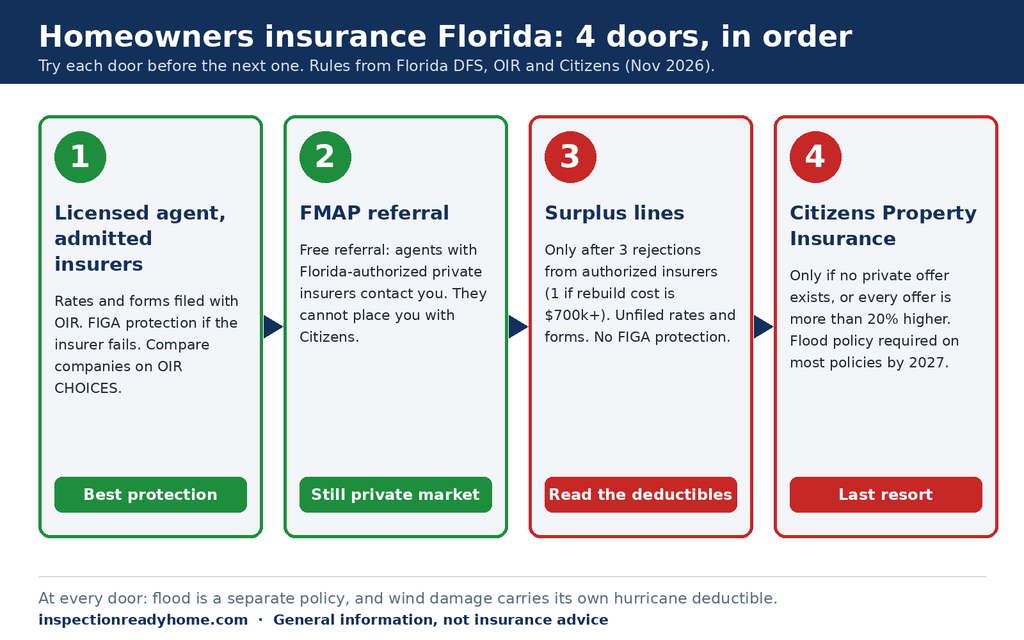
Where to buy homeowners insurance Florida companies will write: 4 doors
If the first agent you call cannot place the home, there is an order to the alternatives. Each door has its own trade-off:
- A licensed agent and the admitted market. Admitted (authorized) insurers file their rates and forms with OIR, and their policyholders are protected by the Florida Insurance Guaranty Association (FIGA) if the company fails. OIR’s CHOICES tool shows sample premiums by county and company for three model homes, so you can see who writes in your area.
- FMAP, the Florida Market Assistance Plan. A free referral service authorized by the Legislature in 1985. You submit a property quote request and licensed agents who can place the home with Florida-authorized private insurers contact you. FMAP agents cannot place you with Citizens, and FMAP gives no quotes itself (Citizens FMAP page).
- Surplus lines. Companies eligible to write risks the admitted market will not. Before placing you there, your agent must get rejections from at least three authorized insurers, or one if the home’s replacement cost is $700,000 or more, per the DFS toolkit. Rates and forms are not filed with OIR, deductibles can differ from the statutory ones above, and there is no FIGA protection.
- Citizens Property Insurance. The state-created insurer of last resort, available only if no authorized insurer will cover the home or every private offer is more than 20% above Citizens. Our Citizens insurance guide covers eligibility, inspections, assessments and takeout offers in detail.
Florida’s last-resort plan is one of several in the country; our guide to FAIR plan insurance compares how other states handle homes the market will not take.
The inspection reports insurers ask for
Older homes rarely get a homeowners insurance Florida quote without paperwork. These are the reports that decide whether a company will write the home and at what price:
| Report | When it is usually asked for | How long it counts | Our guide |
|---|---|---|---|
| 4-point inspection | Commonly when a policy is issued or renewed on an older home; Citizens requires it for homes over 20 years old | The DFS 4-point guide says insurers usually want one dated within the last 30 days; each insurer decides | 4 point inspection |
| Roof inspection | Roofs 15 years or older (Florida Statute 627.7011(5)); Citizens: shingle over 25 years, tile or metal over 50 | Citizens wants at least 5 years of remaining life | roof inspection for insurance |
| Wind mitigation (OIR-B1-1802) | Whenever you want hurricane mitigation discounts | Up to 5 years if nothing material changes, per OIR | wind mitigation form |
| Sinkhole inspection | If you ask for optional sinkhole coverage | Set by the insurer | Ask your agent |
The roof rule protects you in one direction: under 627.7011(5) an insurer cannot refuse or non-renew a home solely because its roof is under 15 years old, and for an older roof it must let you get an inspection first; with at least five years of life left, age alone cannot be the reason to refuse. Check yours with our roof age checker, and run the free 4-point self-check before the inspector comes.
Wind mitigation is the report that pays you back on homeowners insurance Florida premiums. Insurers must give you a notice of hurricane loss mitigation discounts with every new policy and renewal, and the discounts depend on the answers on the form. If your home has never had one, our wind mitigation inspection guide explains what the inspector checks, and the My Safe Florida Home program has offered free inspections to eligible owners.
What homeowners insurance Florida policies cost
OIR’s market overview (data as of October 2026) puts the average admitted-market premium at $3,736 a year with wind coverage and $2,124 without wind. Those are statewide averages; county averages range far wider, and your own premium depends on the home’s age, roof, construction, distance to the coast, deductibles and wind features.
For the county-by-county numbers behind homeowners insurance Florida prices, see our guide to the average cost of homeowners insurance in Florida. To compare Florida with other states using the same national data, see the average cost of homeowners insurance by state. The DFS toolkit adds one practical point: construction matters, and a frame house generally costs more to insure than one built of brick or masonry.
Worked example: one $450,000 home, two quotes
Say a home outside a FEMA high-risk flood zone is insured for $450,000 (Coverage A) and gets two quotes with the same 2% hurricane deductible. The premiums are assumptions to show the math, not real prices.
| Item | Private admitted insurer | Citizens |
|---|---|---|
| Annual premium (assumed) | $5,200 | $4,500 |
| Hurricane deductible at 2% | $9,000 | $9,000 |
| Flood policy required? | No (unless your lender requires it) | Yes: Coverage A is $400,000 or more |
| Citizens surcharge risk after a deficit (up to 15%) | None | Up to $675 |
| Emergency assessment risk (up to 10% a year) | Up to $520 | Up to $450 |
| Is Citizens available at all? | — | No: $5,200 is only 15.6% above Citizens, under the 20% line |
The private quote wins on availability alone, because it sits inside the 20% line. Even if it did not, the Citizens price would need a flood policy on top and would carry the extra surcharge risk described on Citizens’ Assessments page. Compare total cost, not the first number on each quote: that is the rule for any homeowners insurance Florida decision.
5 costly homeowners insurance Florida traps
- Insuring the purchase price. Market value includes land and moves with the housing market. Rebuilding cost is what Coverage A needs to match.
- Picking 10% to save on premium without doing the math. On a $350,000 dwelling, that is $35,000 out of pocket before wind damage is paid.
- Buying flood insurance when a storm is coming. The NFIP’s normal 30-day wait means a policy bought during a watch will not cover that storm.
- Letting a policy lapse on a mortgaged home. Force-placed coverage can cost more and protect only the lender’s interest.
- Treating a surplus lines policy like an admitted one. Different deductibles, unfiled forms and no FIGA backstop if the company fails.
Each trap comes from the state guides cited above, and all five are avoidable before you sign a homeowners insurance Florida policy.
Ask your agent before you sign
- Is this insurer admitted in Florida, or is it surplus lines?
- What is my hurricane deductible in dollars, and what other deductible options did you quote?
- How was my Coverage A calculated, and does it include ordinance or law coverage?
- Does the policy include sinkhole coverage, or only catastrophic ground cover collapse?
- Which inspection reports did you use, and which wind mitigation discounts are applied?
Once you choose a homeowners insurance Florida policy, keep the quotes, decline letters and reports together, and read your declarations page line by line when the policy arrives; our paperwork tracker explains each line and reminds you before each report expires.
Frequently asked questions
Is homeowners insurance required by law in Florida?
No. The Insurance Consumer Advocate says Florida law does not require it. Your mortgage lender usually does, and if you are with Citizens, flood insurance is also required under its phase-in rules.
Does homeowners insurance Florida coverage include hurricanes?
Most policies cover wind damage from a hurricane, subject to the separate hurricane deductible. Flooding and storm surge are not covered; you need a separate flood policy. Wind can be excluded only if you sign a statement with the wording the law requires.
Why is homeowners insurance Florida coverage so expensive?
Hurricane risk is the main reason: OIR’s average admitted premium is $3,736 with wind and $2,124 without it. Older roofs and systems, coastal location, construction type and claims history push individual premiums higher or lower.
What can I do if no company will insure my home?
Work through the doors in order: more licensed agents, FMAP, surplus lines after three rejections, then Citizens. Fixing what the inspection reports flag, such as an old roof or electrical hazards, often reopens the private market.
Can I lower my homeowners insurance Florida premium?
The most direct levers are a wind mitigation inspection, which can unlock the discounts insurers must notify you about, a higher hurricane deductible you can actually afford, and fixing items that make insurers price the home as riskier. Ask your agent to requote after each change.
When to call a pro
- Licensed agent: you got a non-renewal, a quote you cannot read, or no offers at all.
- Florida-licensed inspector: your home is older, your roof is near 15 years, or you have never had a wind mitigation report.
- Licensed roofer, electrician or plumber: a report lists hazards an insurer wants fixed.
- Florida Department of Financial Services (1-877-693-5236): you have a dispute with an insurer and want free consumer help.
For coverage decisions, talk to a licensed agent or the insurer directly. This site does not sell insurance or recommend insurers.
Sources
- Florida Office of Insurance Regulation, Homeowners Insurance
- Florida Office of Insurance Regulation, Market Overview (data as of October 2026)
- Florida Office of Insurance Regulation, CHOICES homeowners rate comparison
- Florida Office of Insurance Regulation, Wind Mitigation Resources
- Florida Department of Financial Services, Florida’s Hurricane Deductible
- Florida Department of Financial Services, Homeowners’ Insurance: A Toolkit for Consumers (March 2024)
- Florida Insurance Consumer Advocate, Homeowners Insurance
- Florida Insurance Consumer Advocate, What to Expect: Four-Point Inspection
- Florida Statutes, section 627.7011 (2026)
- Citizens Property Insurance Corporation, Flood
- Citizens Property Insurance Corporation, Florida Market Assistance Plan (FMAP)
- Citizens Property Insurance Corporation, Inspections
- Citizens Property Insurance Corporation, Assessments
This guide to homeowners insurance Florida rules is general information, not insurance or legal advice. Daniel Aznar, who writes this site, is not an insurance agent or home inspector and does not recommend any insurer. Rules, deductibles and requirements change: confirm your situation with a licensed agent or your insurer. Read our full disclaimer, and if you spot an error, our corrections page explains how we fix it. Information checked in November 2026.