Citizens Insurance: Who Qualifies, Which Inspections It Needs and How Takeouts Work
Quick answer
Citizens insurance is Florida’s state-created, not-for-profit insurer of last resort, Citizens Property Insurance Corporation. You can only get a policy if no Florida-authorized company will cover your home, or if every private offer costs more than 20% above Citizens for comparable coverage. Homes over 20 years old need a 4-point inspection, older roofs need proof of at least five years of life left, and policyholders can be assessed after a major storm and moved to a private insurer through takeout.
Citizens insurance is the policy many Florida homeowners end up with after a non-renewal letter or a quote they cannot afford. It is meant to be a safety net, not a first choice, and the rules reflect that: you have to prove the private market will not take you, pass the same inspections other insurers ask for, and accept that you may be offered to a private company at any renewal.
This guide covers who qualifies, which inspections Citizens asks for, what usually blocks an application, how assessments work, and what to do when a takeout offer arrives. Every rule links to the Citizens or state page we read, as explained in how we verify our guides. To log in, pay a bill or report a claim, go straight to citizensfla.com.
Table of Contents
Is Citizens insurance your only option? 6 situations
Start with your situation, not with Citizens. The table shows the first move in each common case and why it matters.
| Your situation | First move | Why |
|---|---|---|
| Your insurer sent a non-renewal notice | Ask your agent to shop private companies and the clearinghouse | Citizens can only write you if the private market says no or quotes more than 20% above it |
| You got a private quote you think is too high | Compare it with a Citizens quote for comparable coverage | Only a gap of more than 20% makes you eligible |
| Your home is more than 20 years old | Book a 4-point inspection and fix hazards first | Citizens requires it on owner, dwelling and mobile home applications |
| Your roof is old (25+ years shingle, 50+ years tile or metal) | Get a roof inspection showing at least 5 years of life left | Without it, Citizens wants proof of a full roof replacement |
| You only need wind coverage | Check the address on Citizens’ wind-only eligibility page | Wind-only policies depend on location |
| You are already with Citizens and got a takeout packet | Compare every offer with your agent before the deadline | If you do nothing, Citizens assigns you to the lowest-priced offer |
What Citizens is, and who stands behind it
Citizens Property Insurance Corporation was created by the Florida Legislature in August 2002 as a not-for-profit, tax-exempt government entity, according to its Who We Are page. Its stated mission is to serve the people of Florida as the state’s insurer of last resort. It is run by a board of governors under a Plan of Operation approved by the Florida Financial Services Commission: the Governor, the Chief Financial Officer, the Attorney General and the Commissioner of Agriculture.
The money side is the part most owners miss. Citizens is funded by policyholder premiums, but Florida law also requires it to charge assessments on most Florida policyholders if a storm or series of storms leaves it short. So the state does not simply write a check: policyholders do, starting with Citizens’ own customers. More on that in the assessments section below.
Citizens insurance is also shrinking on purpose. The Florida Office of Insurance Regulation’s market overview reports 1,883,487 policies approved for Citizens takeout in 2025, and OIR’s July 2026 Property Insurance Stability Report counted 293,465 Citizens policies in early June 2026. Florida’s version is one of several state plans for hard-to-insure homes; our guide to FAIR plan insurance compares it with other states.
Who qualifies for Citizens insurance: the 20 percent rule
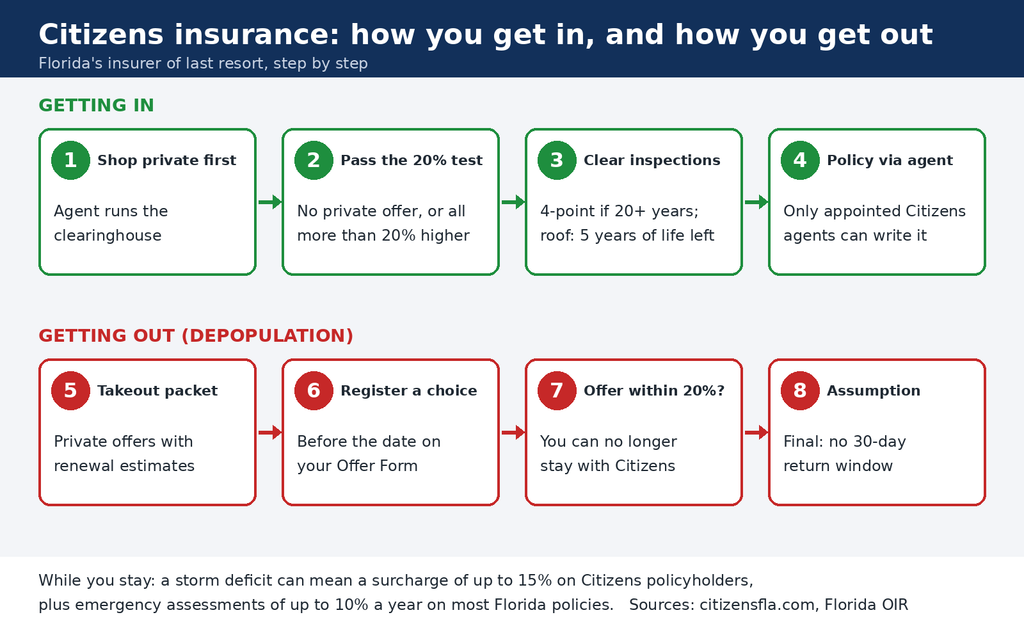
Under Florida law, Citizens insurance can be written for a new policy only if one of two things is true, as its Get a Policy page spells out:
- No coverage is available from a Florida-authorized insurance company.
- Every private premium is more than 20% higher than the Citizens premium for comparable coverage.
Agents check this through the Citizens clearinghouse, which Florida Statute 627.3518 requires. The clearinghouse compares private-market offers with Citizens before a policy is placed or renewed. Only appointed Citizens agents can sell the policy; Citizens has an agent look-up tool on its site. Before that, the free Florida Market Assistance Plan (FMAP), a referral service, and OIR’s CHOICES rate comparison can help you find private companies in your county.
Worked example: three quotes and one 20% line
Say Citizens quotes $4,000 a year for a home. Two private companies quote the same coverage. The figures are assumptions to show the math, not real premiums.
| Quote | Annual premium (assumed) | Above Citizens | Eligible for Citizens? |
|---|---|---|---|
| Citizens | $4,000 | — | — |
| Private offer A | $4,700 | 17.5% | No: not more than 20% higher |
| Private offer B | $5,000 | 25% | Yes, if offer A did not exist |
The math is the easy part. The hard part is “comparable coverage”: a cheaper private quote with a much higher hurricane deductible is not the same policy. Ask your agent to line up deductibles, roof settlement terms and limits before you decide which number counts.
How to get Citizens insurance in 6 steps
Getting Citizens insurance is a process your agent runs for you, not a form you fill in online. In order:
- Shop the private market first. Your agent runs the clearinghouse; you can also use FMAP or CHOICES.
- Keep every decline and quote. They are the proof that you meet the eligibility rule.
- Book the inspections your home needs. A 4-point if the home is over 20 years old, a roof inspection if the roof is old, and a wind mitigation report if you want the discounts.
- Fix hazards before you apply. Citizens says serious hazards such as exposed wiring or active leaks should be repaired before an application goes in.
- Apply through an appointed Citizens agent. Citizens says only its appointed agents can help you buy a policy.
- Expect a field survey later. Citizens may send a free exterior or interior survey during the policy and can ask you to repair what it finds.
Citizens insurance inspections: what each one checks
Citizens lists its inspection rules on one Inspections page. Some you pay for; the underwriting surveys are free.
| Inspection | When Citizens asks for it | Who pays | What it checks |
|---|---|---|---|
| 4-point | All owner, dwelling and mobile home applications for homes more than 20 years old | You | Age, type and condition of roof, wiring, plumbing and HVAC, by a Florida-licensed inspector |
| Roof inspection | Shingle or similar roofs over 25 years; tile, slate, clay, concrete or metal over 50 years | You | At least 5 years of remaining useful life, or proof of a full replacement |
| Wind mitigation | When you want premium discounts | You | Wind features on the OIR-B1-1802 form |
| Sinkhole | Under certain conditions, if you want optional sinkhole loss coverage | Ask your agent | Ground and structure; coverage is not issued until Citizens approves it |
| Underwriting field survey | Any time during the policy, or as a condition for new coverage | Citizens (free) | Exterior only, or exterior plus electric, plumbing and HVAC |
Our guides go deeper on each one: the 4 point inspection, the roof inspection for insurance with our roof age checker, and the wind mitigation form answer by answer. Sinkhole coverage cannot be added mid-term, so tell your agent well before renewal if you want it.
What can stop a Citizens application
Most rejections trace back to something on the inspection reports. These are the ones Citizens documents in writing:
- Polybutylene supply pipes. A 2022 Citizens underwriting bulletin says new-business risks over 20 years old with polybutylene piping are not insurable by Citizens. See our guide to polybutylene pipes.
- Electrical hazards on the 4-point. The Citizens sample 4-Point form asks about active knob and tube and lists 12 electrical hazards, and it tells agents not to submit applications with existing hazards. Our guides to knob and tube wiring and the Federal Pacific panel cover the usual culprits.
- A roof with less than 5 years of life left. The policy is not written until a full roof replacement is documented.
- Active leaks or exposed wiring. Citizens wants them repaired before the application is submitted.
- A cheaper private offer. Not a defect, but it ends eligibility just the same.
Run our free 4-point self-check before the inspector comes. It costs nothing and catches most of what the 4-point records.
Assessments: the hidden cost of Citizens insurance after a big storm
Assessments are the reason Citizens tells its own customers to look at the true cost of a policy. Per its Assessments page, if a storm or series of storms leaves Citizens in deficit, the charges come in two layers:
- Citizens policyholder surcharge: up to 15% of your annual premium, paid only by Citizens policyholders.
- Emergency assessment: if a deficit remains, up to 10% a year on assessable statewide premium, charged to Citizens and private-market policyholders alike, on homeowners, renters, auto, boat and pet policies, for as many years as needed.
Citizens gives its own example: on a $3,000 premium, the surcharge alone could add $450, a charge a private-market customer with the same premium would not pay. Citizens says it remains in a solid financial position, so this is a risk to price in, not a bill you will get. It is also the main reason a private offer can beat Citizens insurance even when it costs a little more.
Depopulation and takeout offers: how you leave Citizens
Florida law requires Citizens to run a depopulation program that matches its policyholders with private insurers that want to take over their policies. Every takeout company must be approved by OIR, which publishes the list of take-out companies and their financial details, and issues a consent order for each assumption.
The personal lines rules on Citizens’ depopulation page are strict. If a takeout offer is not more than 20% above your Citizens renewal premium, you are no longer eligible to stay with Citizens, a rule from Senate Bill 2-A of December 2022. If you register no choice by the deadline, Citizens assigns you to the company with the lowest estimated premium. And the old 30-day window to return to Citizens after an assumption is gone: once the policy moves, the transfer is final.
Timeline: one takeout offer, from packet to new policy
| Step | What happens | What you do |
|---|---|---|
| 1. Packet arrives | Citizens sends a Depopulation Packet listing every offer, each with an estimated renewal premium and a coverage worksheet | Read the worksheets side by side with your Citizens policy |
| 2. Check eligibility | Any offer not more than 20% above Citizens makes you ineligible to stay | If so, your choice is which private offer, not whether to leave |
| 3. Compare with your agent | Your agent gets the same offer details from Citizens | Line up deductibles, roof terms and limits, not just price |
| 4. Register your choice | Online with the registration code on your Offer Form, or through your agent | Do it before the date on the form |
| 5. No choice registered | Citizens assigns you to the lowest estimated premium offer | Avoid this unless that is the offer you want |
| 6. Assumption date | You get a Notice of Assumption and Nonrenewal and a Certificate of Assumption | Keep both; the move is final |
| 7. Staying with Citizens | If eligible and you choose to stay, more offers can come later | Answer every new offer, every time |
Leaving Citizens insurance through takeout is final, so read the worksheets carefully. If an assumption falls through after you accept, Citizens sends a letter saying your policy stays where it is, and you can still receive future offers. Citizens’ Customer Care Center is at 866.411.2742.
What Citizens costs
There is no single price for Citizens insurance: your premium depends on your county, home, roof, deductible and wind features. Two official tools help. OIR’s CHOICES shows sample premiums by county for private companies and Citizens on three model homes. And our guide to the average cost of homeowners insurance in Florida breaks down the official county averages, so you can see whether a quote is out of line before you assume Citizens is cheaper.
Whatever the premium, add the assessment risk from the section above when you compare a Citizens quote with a private one. A wind mitigation report can also lower the number, because Citizens offers premium discounts for the wind features that inspection documents. For the wider market, from hurricane deductibles to surplus lines, see our guide to homeowners insurance Florida rules.
Ask your agent before you choose
- Which private companies did the clearinghouse check, and what did each one offer?
- Is the private quote truly comparable: same hurricane deductible, roof settlement and limits?
- Which inspections does my home need, and how recent must each report be?
- If a takeout offer comes, will you compare the coverage worksheets with me before the deadline?
- What would a 15% Citizens surcharge add to my premium, and does the private offer avoid it?
Keep every quote, decline letter, inspection report and takeout notice together; our paperwork tracker reminds you before each report expires and before renewal.

Frequently asked questions
Is Citizens insurance backed by the state of Florida?
Citizens is a government entity created by the Legislature, but its money comes from policyholder premiums. If it runs short after storms, Florida law has it charge assessments: first up to 15% on its own policyholders, then emergency assessments on most Florida insurance policies. So the backing comes from policyholders across the state.
Can anyone get Citizens home insurance in Florida?
No. You have to show that no Florida-authorized insurer will cover the home, or that every private offer is more than 20% higher than Citizens for comparable coverage. The home also has to pass the inspections above, and you must apply through an appointed Citizens agent.
Is Citizens Property Insurance a good company?
That depends on what you compare. Citizens itself says private policies often offer more coverage options and fewer restrictions, and its policyholders carry a higher assessment risk. Its role is to make sure a home can be insured at all. Compare the coverage worksheets of a Citizens insurance quote and a private one, not just the premium, and check the latest complaint data with the Florida Department of Financial Services.
Is Citizens insurance the same company as other Citizens insurers?
No. Searches for Citizens insurance also show companies with similar names, such as Citizens Insurance Company of America, part of The Hanover, Louisiana Citizens, or Citizens Inc., a life insurer. This guide covers only Citizens Property Insurance Corporation in Florida. Check the company name on your declarations page.
How do I pay my Citizens bill or report a claim?
Use the official citizensfla.com site: its myPolicy portal handles payments, documents and claims. Be careful with look-alike sites and phone numbers from ads; take the number from your policy papers or the Citizens site.
When to call a pro
- Licensed agent: you got a non-renewal, need the clearinghouse run, or received a takeout packet.
- Florida-licensed inspector: your home is over 20 years old, your roof is near the 25- or 50-year mark, or you want wind mitigation discounts.
- Licensed electrician, plumber or roofer: a report lists hazards that must be fixed before Citizens will write the policy.
- Florida Department of Financial Services: you have a dispute with Citizens or any insurer and want free consumer help.
For coverage decisions, talk to your agent or Citizens directly. This site does not sell insurance or recommend insurers.
Sources
- Citizens Property Insurance Corporation, Who We Are
- Citizens Property Insurance Corporation, Get a Policy (eligibility requirements)
- Citizens Property Insurance Corporation, Clearinghouse
- Citizens Property Insurance Corporation, Inspections
- Citizens Property Insurance Corporation, 4-Point Inspection Form (sample, Insp4pt 03 25)
- Citizens Property Insurance Corporation, Assessments
- Citizens Property Insurance Corporation, Depopulation
- Citizens Property Insurance Corporation, Personal Lines Depopulation Program
- Citizens Property Insurance Corporation, Wind-Only Eligibility
- Florida Office of Insurance Regulation, Take-Out Companies
- Florida Office of Insurance Regulation, Market Overview (data as of October 2026)
- Florida Office of Insurance Regulation, CHOICES homeowners rate comparison
- Florida Office of Insurance Regulation, Property Insurance Stability Report (July 1, 2026)
- Citizens Property Insurance Corporation, underwriting bulletin Clarification of February 1, 2022, Eligibility Rules (April 28, 2022)
This guide to Citizens insurance is general information, not insurance or legal advice. Daniel Aznar, who writes this site, is not an insurance agent or home inspector and has no link to Citizens Property Insurance Corporation. Rules and eligibility change: confirm your situation with an appointed Citizens agent or with Citizens directly. Read our full disclaimer, and if you spot an error, our corrections page explains how we fix it. Information checked in November 2026.