Polybutylene Pipes: How to Spot Them and What Home Insurers Do About Them
Quick answer
Polybutylene pipes are gray, flexible plastic water supply lines installed in homes from the late 1970s to the mid-1990s. They are a red flag for home insurers because they are linked to leaks. Florida’s 4-point form records them by name, and Citizens has said it does not insure homes that still have them. Replacing them, and keeping the re-pipe paperwork, is usually what makes a home insurable again.
Polybutylene pipes rarely show up in a sales listing, but they show up fast on an insurance inspection. If your home was built or re-plumbed between the late 1970s and the mid-1990s, there is a real chance some of its water lines are made of this plastic, even if the pipes you can see are copper.
This guide gives you a 5-check method to spot polybutylene pipes yourself, explains what a homeowners policy usually pays when they leak, follows a Florida application from the 4-point form to the underwriting decision, and lists the re-pipe paperwork insurers ask for. Every rule links to its source, as explained in how we verify our guides.
Table of Contents
Polybutylene pipes at a glance
| Fact | What it means for you | Where it comes from |
|---|---|---|
| Made from the late 1970s to the mid-1990s | Homes built or re-plumbed in those years are the ones to check | Plumbing industry sources |
| Usually gray inside the home | Look at the lines feeding the water heater, sinks and toilets | Plumbing industry sources |
| Listed by name on the Florida 4-point form | The inspector ticks it, and the underwriter sees it | Citizens 4-Point Inspection Form Insp4pt 03 25 |
| Not insurable at Citizens on older homes | Citizens’ published rule covers new business on homes over 20 years old | Citizens bulletin, April 28, 2022 |
| Class action settled in 1995 | The claim deadline expired in 2009, so no settlement money is left to claim | Class counsel, Cox v. Shell |
| Sudden leaks are often covered, the pipe itself is not | Insurance may pay for water damage, not for replacing the plumbing | Texas Department of Insurance |
How to identify polybutylene pipes in 5 checks
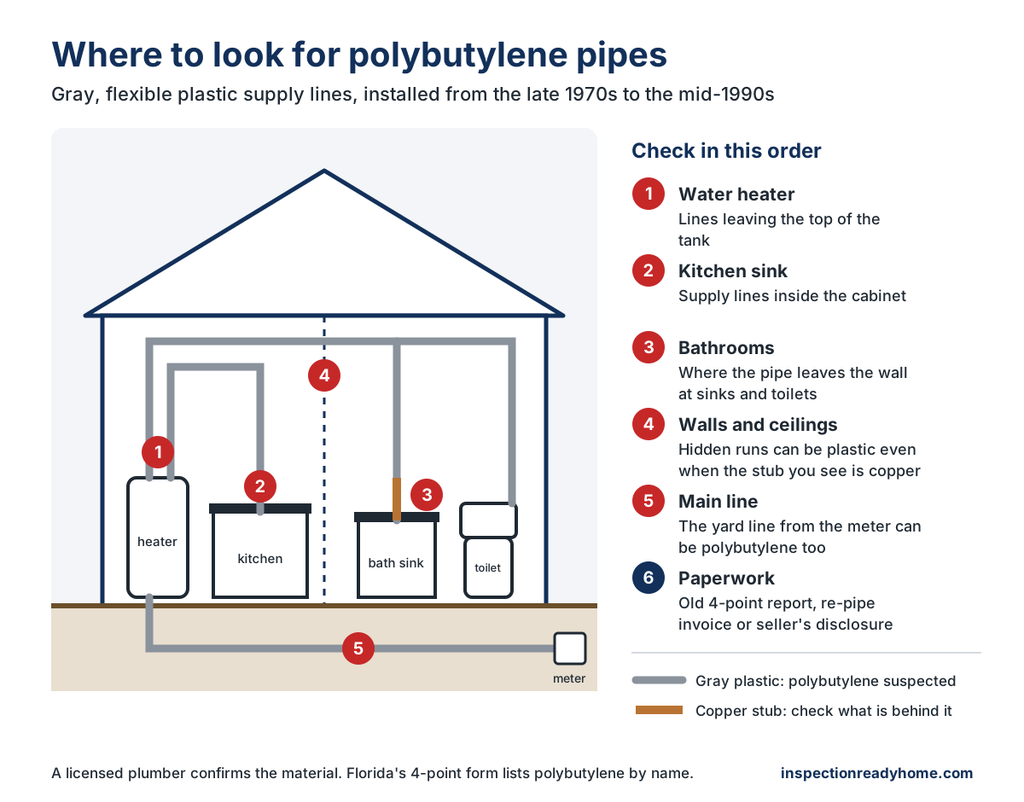
You do not need tools for a first look, just a flashlight and 15 minutes. Do the checks in this order, because each one narrows down the next. A licensed plumber or inspector makes the final call.
- Check the year. Find when the home was built and whether it was ever re-piped. Plumbing industry sources date polybutylene from the late 1970s through the mid-1990s. A home built in 2005 with original plumbing is very unlikely to have it. A home built in 1988 needs the next four checks.
- Start at the water heater. Follow the cold and hot lines coming out of the top. Gray, flexible plastic pipe here is the classic sign.
- Open the cabinets. Look at the supply lines under the kitchen and bathroom sinks and behind each toilet, where the pipe comes out of the wall.
- Do not trust a copper stub. SageWater, a re-piping company, notes that some homes mixed copper and polybutylene: the short piece you see can be copper while the runs behind the walls, ceilings and slab are plastic.
- Read your paperwork. A seller’s disclosure, an old home inspection or a re-pipe invoice may already name the pipe material. If a previous 4-point report exists, its plumbing section lists the pipe types the inspector saw.
If checks 2 or 3 turn up gray plastic, treat the home as having polybutylene pipes until a professional says otherwise. Our diagram shows where to look, room by room.
Why polybutylene pipes worry insurers
Polybutylene was cheap and easy to install, which is why builders used it so widely. Its weak point showed up later. Disinfectants such as chlorine in public water supplies have been linked to the plastic and its fittings breaking down over time, with stress at bends and joints making it worse. Failures can come after a few years or after decades.
That unpredictability is the problem for an underwriter. A pipe can look fine from the outside and still be weakening inside, as SageWater points out. A supply line is under pressure all day, so a split can release water until someone shuts the main valve. For an insurer, that means a higher chance of a water damage claim than with copper, PEX or CPVC.
Florida’s insurance regulator has said that insurers may consider the age of the home, roof, plumbing, wiring and HVAC when they decide whether to offer coverage, according to an NBC 6 report. This pipe material is one of the plumbing answers that carry the most weight.
Does homeowners insurance cover polybutylene pipes?
Two different questions hide inside this one. Will the policy pay when polybutylene pipes leak? And will an insurer write or renew a policy on a home that has them? This table answers the first; the Florida section below answers the second.
| What happened | Usually | Why |
|---|---|---|
| A polybutylene pipe splits and floods the kitchen | Water damage often covered | Most home policies cover sudden and accidental water damage, such as a burst pipe |
| A slow drip behind a wall rots the subfloor over months | Usually not covered | Damage from gradual leaks or seepage is generally excluded |
| Mold grows after a sudden, covered leak | Sometimes covered | Mold on items damaged by a covered loss can be covered; many policies limit mold cleanup |
| Mold from a long-term leak | Usually not covered | It follows the gradual leak, which is not covered |
| Replacing the pipes before they fail | Not covered | It is an upgrade or maintenance, not an insured loss |
| Insurer will not renew until you re-pipe | Not a claim | It is an underwriting condition you pay for |
Notice the pattern. Insurance is built for sudden events. Polybutylene pipes are a known, gradual risk, so the pipe itself is your cost, and slow leaks are too. The Texas Department of Insurance also says hidden water damage usually has to be reported within days of when you first notice it, so do not wait. Water coming through the ceiling follows the same sudden-versus-gradual logic; our guide to whether homeowners insurance covers roof leaks sorts the usual causes one by one.
Florida: what happens when the 4-point form says polybutylene
In Florida, most homes with polybutylene pipes are old enough to need a 4 point inspection before an insurer writes the policy. Here is how the pipe material travels from your cabinet to the underwriter’s desk, in five stages.
- The inspection is ordered. Citizens requires a 4-point inspection for homes more than 20 years old. Any home built in the polybutylene years is already past that line in 2026.
- The inspector ticks the pipe type. The plumbing section of the Citizens form lists copper, PVC/CPVC, galvanized, PEX, ABS, cast iron, polybutylene and other. It also asks whether the supply and drain piping is original, completely re-piped or partially re-piped, with the year and extent of the work.
- The photos back it up. The form asks for photos of the water heater and of the plumbing under the cabinets, exactly where this plastic is easiest to see.
- The underwriter applies the rules. Citizens’ bulletin of April 28, 2022 says new-business risks over 20 years old with polybutylene piping are not insurable by Citizens (Rule 206.B, HO-3 and HO-8). The bulletin is archived, so ask your agent for the current rule. Our guide to Citizens insurance covers its other eligibility rules and inspections. Citizens repeated the position to NBC 6 in 2023. Other insurers set their own rules.
- Repairs come first. The Florida CFO’s guide to the four-point inspection says insurers may require repairs before they issue a policy. For this plumbing, that usually means a full re-pipe documented on a new 4-point form.
If you already have a policy and your insurer decides not to renew it, Florida law sets notice rules. Under section 627.4133 of the Florida Statutes, a homeowners insurer must generally give at least 120 days’ written notice of nonrenewal with the reason, with some shorter exceptions. Use that time to get quotes for the re-pipe and to talk to a licensed agent.
Texas is different on age but not on condition. On September 29, 2026, the Texas Department of Insurance clarified that insurers cannot decline or refuse to renew a home policy because of the age of the house or its roof, but they can still look at the physical condition of the home, plumbing included.
Worked example: one 1991 home, three plumbing histories
Picture the same 1991 Florida house applying for a new Citizens policy in November 2026. It is 35 years old, so a 4-point inspection is required. Only the plumbing history changes. The scenarios are invented to show how the published rules combine.
| Plumbing history | What the 4-point form shows | Likely outcome under Citizens’ published rule | What to do first |
|---|---|---|---|
| A. Original polybutylene throughout | Pipe type: polybutylene. Piping: original to the home | Not insurable as new business while the pipes remain | Get re-pipe quotes, then a new 4-point inspection after the work |
| B. Kitchen and one bath re-piped in PEX in 2015, rest original | Pipe types: PEX and polybutylene. Piping: partially re-piped, 2015 | Still has polybutylene piping, so the same problem as A | Finish the re-pipe; a partial job does not remove the flag |
| C. Whole house re-piped in PEX in 2019 | Pipe type: PEX. Piping: completely re-piped, 2019 | Polybutylene no longer present; the rest of the form decides | Keep the permit and the plumber’s invoice with the report |
Scenario B is the trap. Many owners replace the pipes they can reach after a leak and assume the problem is solved. But the form asks which pipe types are present, not which ones were replaced, so polybutylene pipes left in the walls still show up. Only scenario C clears the plumbing question.
Replacing polybutylene pipes: the paperwork insurers ask for
A re-pipe is a job for a licensed plumber, and the right material for your home is their call. Your job is to make sure the insurer can see it was done. Keep these six documents together, because the next inspector and underwriter will want them.
- The plumbing permit, if your city or county required one, with the final inspection date.
- The plumber’s invoice, naming the new pipe material and stating whether the whole house was re-piped.
- The plumber’s license number, which you can check on the state license search before you hire them.
- Photos of the new lines at the water heater and under the sinks, taken after the work.
- A new 4-point report that records the re-pipe as complete, with the year.
- Any leak repair receipts from before the re-pipe, in case the insurer asks about prior leaks.
Before the inspector comes back, run through our free home insurance inspection checklist. It covers the plumbing questions on the form, plus the roof, electrical and HVAC, so a re-pipe is not undone by a problem somewhere else.
Buying or selling a home with polybutylene pipes
These are the two questions people ask most after “what are polybutylene pipes?” The answer for both starts with insurance, because a lender will usually want proof of homeowners coverage before closing.
If you are buying, ask your home inspector to report the pipe materials and get an insurance quote early, before your inspection contingency runs out. If the insurer you want will not cover the home as it is, you can negotiate a re-pipe before closing, a price reduction, or walk away within your contract terms. Our guide to the home insurance inspection explains what else the insurer may check after you buy.
If you are selling, expect the buyer’s inspector to find the pipes. Sellers generally have to disclose known defects, and the rules depend on your state, so ask your real estate agent or an attorney what you must disclose. A completed re-pipe with paperwork is often easier to sell than a credit, because the buyer can get insured.
Is there still a polybutylene settlement?
No. The national class action, Cox v. Shell, was filed in 1993 against Shell Oil, Hoechst Celanese and DuPont, and the court approved the settlement in November 1995. According to class counsel, the defendants committed $950 million to cover leak damage and replacement pipes, and the claim filing deadline expired in 2009.
Be wary of anyone offering to recover settlement money for this plumbing today. If a company says it can, ask for the case name and court in writing, and check with your state attorney general’s consumer office before you pay anything.
Ask your insurer about polybutylene pipes
- Will you write or renew a policy on a home with any polybutylene piping, including a partial re-pipe?
- If not, what proof of a re-pipe do you need: invoice, permit, a new 4-point report or all three?
- Does the pipe material change my premium, even after a re-pipe?
- How does my policy treat sudden water damage, gradual leaks and mold, and is there a limit for mold?
- How soon after I notice a leak must I report it?
Frequently asked questions
Do polybutylene pipes need to be replaced?
No law forces you to replace working polybutylene pipes in your own home. Insurance often does. If your insurer, or Citizens in Florida, will not cover a home that has them, replacing them becomes the practical way to keep or get coverage. A licensed plumber can tell you how much of your system is polybutylene.
Should I buy a house with polybutylene pipes?
Only once you know you can insure it. Get a homeowners quote before your inspection contingency ends, and price a full re-pipe into your offer. Many buyers ask the seller to re-pipe before closing or to reduce the price by the plumber’s quote.
Can I sell my home with polybutylene pipes?
Yes, but disclose them and expect the buyer’s insurer to ask questions. Disclosure rules depend on your state, so check with your agent or an attorney. A finished re-pipe with permit and invoice usually removes the objection.
Does homeowners insurance cover polybutylene pipes?
It may cover sudden water damage when one of these pipes bursts, but not the cost of replacing the pipes, and usually not damage from slow leaks. Some insurers will not write a policy on a home that still has them at all.
When did builders stop using polybutylene pipes?
In the mid-1990s. Plumbing industry sources say use was discontinued after the 1995 class action settlement. A home built after that with original plumbing is unlikely to have it, but a later repair could still have used leftover material, so check if in doubt.
When to call a pro
- You see gray plastic supply lines at the water heater or under a sink.
- There is a damp spot, a stain or a drop in water pressure you cannot explain.
- Your insurer or agent asked for a 4-point inspection on a home built before the late 1990s.
- You received a nonrenewal or a request to re-pipe.
A licensed plumber can confirm whether you have polybutylene pipes and quote a re-pipe. A Florida-licensed inspector can complete the 4-point inspection afterwards. For coverage questions, talk to your insurer or a licensed agent.
Sources
- Citizens Property Insurance Corporation, 4-Point Inspection Form, sample Insp4pt 03 25
- Citizens, Clarification of February 1, 2022, Eligibility Rules (April 28, 2022)
- Citizens, Inspections
- Florida Department of Financial Services (CFO), What to Expect: Four-Point Inspection
- Florida Statutes 2026, section 627.4133 (Florida Senate)
- Texas Department of Insurance, When are water damage and mold covered by insurance? (updated April 24, 2025)
- Texas Department of Insurance, news release (September 29, 2026)
- NBC 6 South Florida, Does your home have poly pipes? Getting insurance may be difficult (March 13, 2023)
- Lieff Cabraser (class counsel), Polybutylene Piping: Cox v. Shell
- Public Justice, Cox v. Shell polybutylene case summary
- SageWater, Polybutylene piping problems (updated August 6, 2026)
- Wikipedia, Polybutylene (background on failure causes)
This guide to polybutylene pipes is general information, not insurance, legal or plumbing advice. Daniel Aznar, who writes this site, is not a plumber, a home inspector or an insurance agent. Insurer rules change and vary by company: confirm what applies to your home with your insurer, a licensed agent, a licensed plumber or a Florida-licensed inspector. Read our full disclaimer, and if you spot an error, our corrections page explains how we fix it. Information checked in October 2026.