Homeowners Insurance Texas: Coverage, Wind and Hail Deductibles, Costs and Your Renewal Rights
Quick answer
Homeowners insurance Texas rules start with one split: inland, your home policy usually covers wind and hail, but on the coast it often does not, and you buy that coverage from TWIA after a private insurer turns you down. No state law requires a policy, but lenders do. Wind and hail deductibles are often a percentage of your coverage, and flood always needs its own policy.
Homeowners insurance Texas buyers face a market with its own rules: percentage deductibles, a state wind pool for the coast, and a 2026 rule on roof age. The Texas Department of Insurance (TDI) says the law does not require home insurance, but if you still owe money on your house, your lender will.
This guide to homeowners insurance Texas rules explains which policies a home needs depending on where it sits, what a standard policy pays for, how a percentage deductible turns into dollars, what it costs, what an insurer can and cannot do at renewal, and where to turn if no one will sell you a policy. Every rule links to the TDI, TWIA or state page we read, as explained in how we verify our guides.
Table of Contents
Homeowners insurance Texas at a glance
| Question | Short answer | Source |
|---|---|---|
| Is a policy required by law? | No. Your mortgage lender will require one | TDI home insurance guide |
| Average annual premium | $3,489 for homeowners policies, the latest figure TDI shows | TDI market overview |
| Who regulates it? | TDI. It does not approve rates in advance but can order refunds if rates are too high | TDI home insurance guide |
| Wind and hail inland | Usually included, often with a separate deductible | TDI, What is windstorm insurance? |
| Wind and hail on the coast | Often excluded; bought from TWIA in 14 coastal counties and part of Harris County | TDI and TWIA |
| Flood | Never in a standard policy; a separate flood policy with a 30-day wait in most cases | TDI home insurance guide |
| Can an insurer refuse you for roof age alone? | No, since TDI’s September 29, 2026 clarification. Condition still counts | TDI news release |
| Biggest cause of paid losses | Hail, in 9 of the last 10 years TDI charts | TDI market overview |
| If nobody will insure you | Texas FAIR Plan after two refusals, surplus lines, or TDI’s Voluntary Inspection Program | TDI |
Which policies a Texas home needs, by location
Under homeowners insurance Texas rules, where your house sits decides how many policies you carry. TDI’s home, flood and wind chart puts it in three lines: homeowners for your house and things, flood because most home policies do not cover it, and wind and hail because most home policies on the coast do not cover them. Here is how that works out on a map:
| Where you live | Homeowners policy | Wind and hail | Flood |
|---|---|---|---|
| Most of Texas (inland) | Yes | Usually inside the home policy, maybe with its own deductible | Separate policy; required by the lender in a designated flood zone |
| 14 first-tier coastal counties | Yes, often with wind and hail excluded | Separate policy, often from TWIA | Separate policy; TWIA can require it in V zones |
| Harris County east of Highway 146 (La Porte, Morgan’s Point, Pasadena, Seabrook, Shore Acres, inside city limits) | Yes, often with wind and hail excluded | Separate policy, often from TWIA | Separate policy |
| Rest of Harris County, including most of Houston | Yes | Usually inside the home policy | Separate policy; more than half of homes flooded by Hurricane Harvey were outside designated flood zones |
The 14 counties are Aransas, Brazoria, Calhoun, Cameron, Chambers, Galveston, Jefferson, Kenedy, Kleberg, Matagorda, Nueces, Refugio, San Patricio and Willacy, according to TDI. Wind coverage there is not required by law, but TDI’s windstorm page says a lender will likely require it if you have a mortgage. For the flood side, our flood insurance guide explains the NFIP limits and the 30-day wait.
How to qualify for TWIA wind coverage
The Texas Windstorm Insurance Association sells only wind and hail coverage: no fire, no theft and no flood, says TWIA. Its eligibility page lists five conditions:
- The property is in the designated area: the 14 coastal counties or the part of Harris County east of Highway 146.
- At least one authorized insurer writing wind and hail coverage in that area has turned you down.
- The building has a certificate of compliance (WPI-8, WPI-8-E or TWIA’s WPI-8-C) showing it was built to the applicable building code, with limited exceptions.
- Homes in flood zones V, VE or V1-30 built, altered, remodeled or enlarged on or after September 1, 2009 must show flood insurance if the NFIP offers it.
- The home is in insurable condition: in good repair, with no unrepaired damage or hazards.
The certificate is the step that trips people up. TDI’s windstorm inspection page says most new construction, roof replacements and major repairs on the coast need an inspection. A WPI-8 covers work inspected while it is underway, by a TDI-appointed engineer or a TDI inspector; a WPI-8-E covers finished work, inspected by a Texas licensed engineer, and may cost more. Roof repairs under 100 square feet that do not touch the decking do not need one. Ask your roofer how they will get the certificate before work starts. Our guide to Texas windstorm insurance covers the certificate, TWIA costs and claim deadlines step by step.
Timing matters too. TDI warns that TWIA will not sell you a policy while a hurricane is in the Gulf, so a coastal buyer who waits for the forecast is too late.
What a Texas home policy covers and leaves out
TDI’s home insurance guide says most homeowners insurance Texas policies combine six coverages: dwelling, personal property, other structures (detached garage, shed, fence), additional living expenses, personal liability and medical payments. Which events they pay for depends on the policy, but TDI lists the common split:
| Most policies cover damage from | Most policies do not cover damage from |
|---|---|
| Fire and lightning | Flooding |
| Sudden and accidental release of water or smoke | A continuous leak, and mold removal unless a covered event caused it |
| Explosion, theft, vandalism, riot | Termites, insects, rats or mice |
| Aircraft and vehicles | Losses while the house is vacant longer than the policy allows |
| Windstorm, hurricane and hail, except on the Gulf Coast | Wear and tear, earthquakes and earth movement |
Two other choices change what you collect. An all-risk policy covers anything it does not exclude, while a named-perils policy covers only the events it lists, and TDI’s policy-type page says a lender will probably want the all-risk kind. And replacement cost pays to rebuild at today’s prices, while actual cash value subtracts depreciation for age and wear. TDI’s own example: a 10-year-old roof that costs $10,000 to replace, with a $2,000 deductible, pays $8,000 on replacement cost but about $5,000 on actual cash value.
Check the dollar limits on any homeowners insurance Texas quote as well. TDI says most companies require you to insure the house for at least 80% of its replacement cost, some for 100%, and additional living expenses may be capped at 10% to 20% of the dwelling limit. Your declarations page shows all of it on page one. If the roof is your worry, our guide to whether homeowners insurance covers roof replacement walks through what an older roof collects.
Homeowners insurance Texas deductibles for wind and hail
A Texas policy can have a different deductible for wind and hail than for everything else, and it can be a percentage of your dwelling coverage instead of a flat amount. TDI’s deductibles page shows why that matters: on a home insured for $150,000, a 5% deductible is $7,500, so a $6,500 hail repair pays nothing. It also notes that home deductibles apply to each claim, not once a year as with health insurance.
| Dwelling coverage | 1% deductible | 2% deductible | 5% deductible |
|---|---|---|---|
| $250,000 | $2,500 | $5,000 | $12,500 |
| $350,000 | $3,500 | $7,000 | $17,500 |
| $500,000 | $5,000 | $10,000 | $25,000 |
Hail is the reason this deductible deserves attention. TDI’s market overview charts paid homeowners losses by cause, and hail is the largest every year from 2016 to 2025 except 2021, when water and freeze losses from the February winter storm took the top spot. In 2024, hail accounted for about $4.9 billion of roughly $10.2 billion in paid losses, close to half.
Worked example: one hailstorm, three policies
Say a home has $350,000 of dwelling coverage and a 12-year-old roof. Hail destroys it, and a new roof costs $16,000. The adjuster subtracts $6,000 of depreciation. All amounts are assumptions to show the math, not a quote.
| Policy | Deductible | Insurer pays | You pay |
|---|---|---|---|
| Replacement cost, $1,000 flat deductible | $1,000 | $15,000 (two checks: $9,000, then $6,000 after the work) | $1,000 |
| Replacement cost, 2% wind and hail deductible | $7,000 | $9,000 (two checks: $3,000, then $6,000) | $7,000 |
| Actual cash value roof, 2% deductible | $7,000 | $3,000 | $13,000 |
The same storm costs this owner anywhere from $1,000 to $13,000. Before you renew homeowners insurance Texas coverage, find both numbers on your declarations page: the wind and hail deductible, and whether the roof is paid at replacement cost or actual cash value.
Homeowners insurance Texas cost: the official averages
For homeowners insurance Texas prices, TDI’s market overview lists an average annual premium of $3,489 for homeowners policies, across about 8.2 million active policies and 157 companies. In his August 24, 2026 letter to the insurance commissioner, Governor Greg Abbott wrote that the average premium rose 79% in six years, from under $2,000 in 2020 to over $3,500 in 2026.
National data says the same thing from a different angle. In the NAIC figures we use in our state-by-state cost ranking, Texas has the second-highest average HO-3 premium in the country for 2023, at $2,864. The numbers differ because of the year and the method: TDI counts all homeowners policies in its own statistical plan, the NAIC report covers 2023. On the coast, TWIA says its average residential wind policy is about $1,700 a year, on top of the home policy.
TDI says most companies set your premium from the same short list of factors:
- Age and condition of the home. They cannot turn you down just for age or value, but they can charge more.
- Replacement cost. A house that costs more to rebuild costs more to insure.
- Construction. All-wood houses pay more than brick or stone.
- Location and fire protection. More storms or crime raise it; a nearby fire station lowers it.
- Claims history. Insurers check the seven-year CLUE report on you and the house.
- Credit score. Good credit lowers it, but a company cannot turn you down for credit alone.
Discounts are set by each company. TDI lists monitored alarms, sprinklers, an impact-resistant roof, a newer home, bundled policies and three claim-free years, and its HelpInsure.com site compares policies and discounts by area. Commissioner’s Bulletin B-0008-26, issued after the governor’s August 2026 directive, tells insurers to account for a FORTIFIED roof in rate setting, according to the Office of the Governor. Ask how your company applies it.
Roof age, cancellation and nonrenewal: what an insurer can and cannot do
Homeowners insurance Texas law gives you more protection at renewal than many states do. The rule that made news in 2026 is about roofs: on September 29, 2026, TDI clarified that insurance companies cannot decline or refuse to renew a home policy based on the age of the house or its roof. Condition is still fair game. Here is the full picture from TDI’s guide:
| Situation | Allowed? | What TDI says |
|---|---|---|
| Refuse or drop you only because the roof or house is old | No | Age alone is not a reason since the September 29, 2026 clarification |
| Charge more for an older home | Yes | Age and condition can affect the price |
| Nonrenew a house in bad condition | Yes | Companies usually give at least six months to repair instead |
| Cancel in the first 60 days | Yes, in two cases | An undisclosed risk, or a required inspection report it does not accept |
| Cancel later in the term | Only for set reasons | Unpaid premium, fraud, a legal conflict, or a risk increase within your control; 10 days’ notice |
| Nonrenew after 3 non-weather claims in 3 years | Yes, with a warning | After the second claim it must warn you, or it cannot use the third |
| Nonrenew because you claimed something the policy does not cover | No | A denied, non-covered claim is not a reason |
| Turn you down only for your credit score | No | Credit can affect the price, not the decision alone |
| Nonrenew without notice | No | 60 days for policies bought or renewed in 2024 or later; it must give the reason if you ask |
The first-60-days rule is why inspections matter in Texas too: if the insurer asked for an inspection report and does not accept it, the policy can end early. Our guide to the home insurance inspection after you buy explains what inspectors look at, and the roof age checker shows where your roof stands against the rules in Texas and Florida.
When no one will sell you a policy
If regular companies keep refusing your homeowners insurance Texas application, the state has three routes, plus one way to prove your house is insurable. TDI warns that FAIR Plan and surplus lines coverage costs more than a standard policy.
| Option | Who can use it | What you get |
|---|---|---|
| Texas FAIR Plan Association | Homeowners turned down by at least two insurance companies, with no offer of the same coverage | Basic, limited coverage for one- and two-family homes, townhouses and condos. Where TWIA is available, wind comes from TWIA |
| TWIA | Coastal properties that meet the five conditions above | Wind and hail only, to pair with a home or FAIR Plan policy |
| Surplus lines company | Risks Texas-licensed companies will not take; the agent must try licensed companies first | Coverage from an out-of-state company that is not licensed in Texas but must meet state standards |
| Voluntary Inspection Program | Owners who cannot find a company willing to insure the home | A certificate of insurability: a company cannot refuse or nonrenew over the home’s condition unless it reinspects and lists the problems in writing |
Our FAIR plan insurance guide compares the Texas plan with those in other states, including what each one leaves out.
How a homeowners insurance Texas claim gets paid
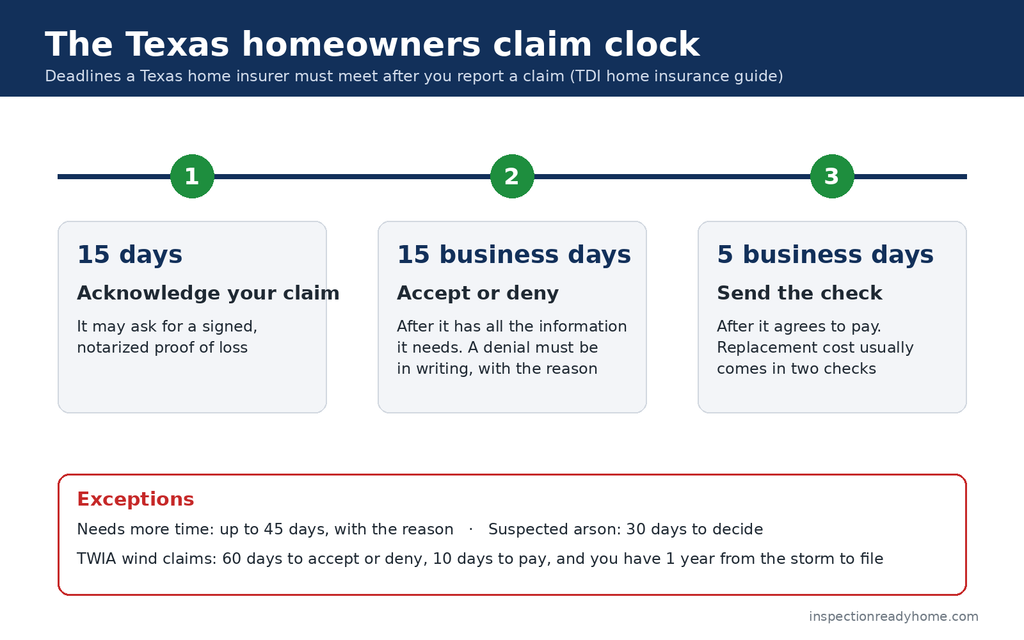
Texas law puts the insurer on a clock once you report a claim. TDI’s guide gives these deadlines:
- 15 days to acknowledge your claim. It may ask for a signed, notarized proof of loss.
- 15 business days after it has everything it needs to accept or deny, in writing if it denies. It can take 45 days if it tells you why, and longer after major disasters.
- 5 business days after it agrees, to send the check.
- TWIA has 60 days to accept or deny and 10 days to pay, and you have one year from the storm to file.
If you owe money on the house, the repair check is made out to you and your mortgage company, which releases money as work is done. With replacement cost coverage, most companies pay twice: first the estimate minus depreciation and deductible, then the depreciation once you send the bill for the finished job. Make only temporary repairs, such as a tarp, until the adjuster has seen the damage.
If you disagree on the amount, you can ask for appraisal, file a written complaint with TDI, or go to court; after a disaster you must give the insurer written notice at least 61 days before you sue. Claims under $20,000 can go to Justice Court.
Ask your agent before you renew
- What is my wind and hail deductible in dollars, not just as a percentage?
- Is my roof covered at replacement cost or actual cash value?
- Do I have wind coverage at all, or do I need TWIA? If so, does my home have a WPI-8 or WPI-8-E?
- Which discounts apply to my home, and do you credit an impact-resistant or FORTIFIED roof?
- Does my flood policy, or the lack of one, match my lender’s and TWIA’s rules?
Frequently asked questions
What is the average cost of homeowners insurance in Texas?
TDI’s market overview lists $3,489 a year for homeowners policies, and the governor’s office says the average passed $3,500 in 2026. Your premium depends on replacement cost, location, construction, claims and credit, so compare quotes for your own address.
Is homeowners insurance required in Texas?
Not by law. TDI says your lender will require it while you owe money on the house, and on the coast a lender will likely require wind coverage too. Once the loan is paid off, it is your choice.
Does Texas homeowners insurance cover hail?
Usually yes, outside the coastal wind area, but often with a separate wind and hail deductible that can be a percentage of your dwelling coverage. On the coast, hail is often excluded and covered by a TWIA policy instead.
Can my insurer drop me because my roof is old?
Not for age alone. TDI clarified on September 29, 2026 that companies cannot decline or nonrenew a home policy based on the age of the house or roof. They can still charge more, ask for repairs, or act on a roof in poor condition.
How do I compare home insurance companies in Texas?
When you shop for homeowners insurance Texas quotes, ask several companies for the same coverage, deductible and roof settlement. TDI’s HelpInsure.com site lets you compare policies and discounts sold in your area, and TDI’s Help Line at 800-252-3439 can tell you if an agent is licensed.
When to call a pro
- Licensed insurance agent: you need quotes, a TWIA policy, FAIR Plan coverage or a surplus lines policy.
- TDI-appointed engineer or licensed professional engineer: you are replacing a roof on the coast and need a WPI-8 or WPI-8-E.
- Licensed public adjuster: you need help negotiating a large claim. TDI says they charge fees and must hold a TDI license.
- TDI Help Line (800-252-3439): you think a company wrongly canceled, nonrenewed or denied you. TWIA questions go to TDI’s coastal team at 855-352-6278.
This site does not sell homeowners insurance Texas policies or recommend insurers. Confirm coverage details with your agent or TDI.
Sources
- Texas Department of Insurance, Home insurance guide (updated June 1, 2026)
- Texas Department of Insurance, Home insurance
- Texas Department of Insurance, Texas homeowners insurance market overview
- Texas Department of Insurance, What to know about deductibles
- Texas Department of Insurance, What is windstorm insurance?
- Texas Department of Insurance, What you need to know about windstorm inspections
- Texas Department of Insurance, Home, flood, wind: Which policies do you need?
- Texas Department of Insurance, Home insurance policies: All risk or named peril
- Texas Department of Insurance, Texas homeowners protected from being denied insurance based on roof age (September 29, 2026)
- Texas Windstorm Insurance Association, Coverage and eligibility
- Texas Windstorm Insurance Association, Inside a policy
- Office of the Texas Governor, Governor Abbott announces TDI action on property insurance costs (September 16, 2026)
- Office of the Texas Governor, Letter to Commissioner Amanda Crawford (August 24, 2026)
This guide to homeowners insurance Texas rules is general information, not insurance or legal advice. Daniel Aznar, who writes this site, is not an insurance agent or inspector and does not recommend any insurer. Rules, rates and programs can change: confirm with TDI, TWIA, your agent or your insurer. Read our full disclaimer, and if you spot an error, our corrections page explains how we fix it. Information checked in November 2026.