A homeowners insurance declarations page is the one- or two-page summary at the front of your policy: who is insured, where, for which dates, the coverage limits, the deductibles and the premium. Its dates also decide when your inspection reports need renewing. Enter them in the free tracker below to see what is still valid and save calendar reminders.
Free tool · Home Insurance Paperwork Tracker
Dates stay in this browser. Nothing is sent to us.
Add the date of each report you have. You will see how long it stays valid and can save calendar reminders.
-
Not added
Policy renewal
From your declarations page
Reports that run out before this date may be asked for again. Start gathering them early.
-
Not added
Wind mitigation report
Florida form OIR-B1-1802
Valid for up to 5 years if nothing material changes on the house and the form has no errors.
Source: Florida OIR, Wind Mitigation Resources (checked 7 Nov 2026)
-
Not added
4-point inspection
Roof, electrical, plumbing, HVAC
Insurers usually want it dated within 30 days before they issue the policy. Your insurer sets the window.
Source: Florida CFO, What to Expect: Four-Point Inspection (checked 7 Nov 2026)
-
Not added
Roof inspection or roof certification
Roof condition form or letter
There is no single rule. Ask your insurer or lender how old a roof report it accepts, then enter it here.
-
Not added
Texas certificate of insurability Texas
TDI Voluntary Inspection Program
The certificate is good for 3 years.
Source: Texas Department of Insurance, Voluntary Inspection Program (checked 21 Oct 2026)
Other documents
A permit, a roof replacement invoice, a lender letter: add anything with a date your insurer may ask for.
Reminders open in Google Calendar, Apple Calendar or Outlook. Each one links back here. Rules checked November 2026; your insurer always has the final word.
InspectionReady Home · https://inspectionreadyhome.com/tools/homeowners-insurance-declarations-page/
Table of Contents
What a homeowners insurance declarations page shows
State regulators describe the same core lines. The Texas Department of Insurance says the dec page shows the insurer’s name and address, the insured location, the dates the policy is in effect and the amounts and types of coverage. Maryland’s regulator adds the agent, the mortgage company, each deductible and the endorsements. The table maps each line to what to check.
| Line on the dec page | What it means | What to check |
|---|---|---|
| Insurer and agent | Who issued the policy and who sold it | Spelling and contact details; who to call for changes |
| Named insured | The people the policy covers | Every owner on the deed is listed |
| Property address | The insured location | Matches the house, not a mailing address |
| Policy number | Your file at the insurer | Keep it handy: your agent asks for it on every call |
| Policy period | Effective and expiration dates, usually one year | The expiration date is your renewal date |
| Coverage A, Dwelling | The amount to rebuild the house | Rebuild cost, not market value |
| Coverage B, Other structures | Detached garage, shed, fence | Big enough for what you have |
| Coverage C, Personal property | Belongings such as furniture and clothing | Replacement cost or actual cash value |
| Coverage D, Loss of use | Extra living costs if you cannot live at home | The limit or time cap |
| Liability and medical payments | Claims from people hurt on your property | The limits shown |
| Deductibles | What you pay before the insurer pays | Each one in dollars; any hurricane or wind percentage |
| Endorsements, discounts, premium | Add-ons, credits applied, the price | Wind mitigation or other credits you expect |
Two rules make the deductible line easy to check. In Texas, the insurer must list the exact dollar amount of each deductible, and the dec page or a separate page must list anything in the policy that changes one. Maryland explains that a percentage deductible is a share of Coverage A, not of the claim: 5% of $200,000 is $10,000.
The Texas Office of Public Insurance Counsel adds a warning: the dec page is only a summary, not the whole policy. The forms and endorsements listed on it hold the details, so read them before you rely on a line.
The dates that matter for your inspection reports
Your homeowners insurance declarations page gives the policy period, and the end of that period is the renewal. Your inspection reports run on their own clocks. If one runs out before the renewal, the insurer may ask for a new one, and a credit tied to it can drop. These are the clocks the tracker uses.
| Document | How long it is usually good for | Source |
|---|---|---|
| Wind mitigation report (Florida, OIR-B1-1802) | Up to 5 years, if nothing material changes on the house | Florida Office of Insurance Regulation |
| 4-point inspection | Usually dated within 30 days before the policy is issued; each insurer decides | Florida CFO, Insurance Consumer Advocate |
| Roof inspection or roof certification | No single rule: ask your insurer or lender | — |
| Texas certificate of insurability (VIP) | 3 years | Texas Department of Insurance |
| Notice if the insurer will not renew | At least 120 days in Florida; at least 60 days in Texas | Fla. Stat. 627.4133; TDI Consumer Bill of Rights |
In Florida, admitted insurers must also send the Notice of Premium Discounts for Hurricane Loss Mitigation with every new policy and every renewal. Compare it with the credits on your homeowners insurance declarations page: if a credit you paid an inspection for is missing, ask why. Our wind mitigation form guide explains which answers earn credits.
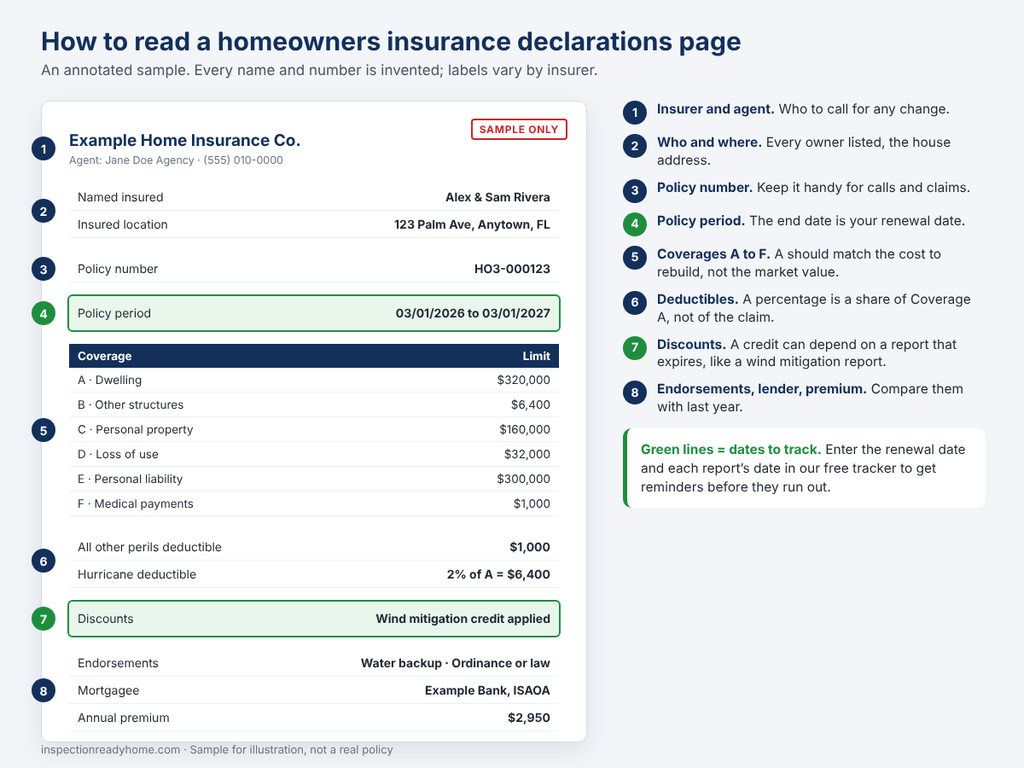
How to use the tracker
- Start with the renewal date. Copy the expiration date of the policy period from your homeowners insurance declarations page. Every other card is compared with it.
- Add each report you have. Use the inspection date printed on the report, not the day you received it.
- Set the 4-point window. Leave 30 days unless your insurer gave you another number.
- Enter the roof rule if you know it. The tool will not guess one; until you add the months, the card says to ask your insurer.
- Save reminders. One file holds alerts 60 and 30 days before each date and on the day itself, each with a link back here.
A card turns amber when a date is close or runs out before your renewal, and red when it has passed. Dates stay in your browser and are never sent to us, as our privacy policy explains.
Worked example: one renewal, three reports
An invented Florida home renews on March 1, 2027. Its homeowners insurance declarations page lists a wind mitigation credit, and the owner has three reports on file. Here is what the tracker shows on November 7, 2026.
| Report | Dated | Good until | What the tracker says |
|---|---|---|---|
| Wind mitigation | January 12, 2022 | January 12, 2027 | Runs out before the March 1 renewal: book a new inspection |
| 4-point | October 28, 2026 | November 27, 2026 (30-day window) | Fine for an application this month, too old by renewal |
| Roof certification | March 1, 2025 | Unknown | Ask the insurer how old a roof report it accepts |
The wind mitigation report is the one that costs money if it lapses: without it, the credit on the declarations page may not carry into the renewal. Booking in December leaves time to send it to the agent before March. Our wind mitigation inspection guide covers what the visit checks.
Homeowners insurance renewal: what to do in the last 60 days
Most policies renew once a year on the same date. The renewal offer comes with a new homeowners insurance declarations page, so treat it as a fresh document, not a copy of last year’s.
- Put the old and new dec pages side by side and compare the premium, every limit, every deductible and the discounts.
- Check that Coverage A still matches the cost to rebuild. Our average cost of homeowners insurance by state gives a benchmark for the premium.
- Confirm which reports the insurer wants this year. A 4 point inspection or a roof inspection for insurance may be asked for again on an older home.
- Send any new report to your agent before the renewal date, and keep the confirmation.
- If you get a non-renewal notice, use the time it gives you. Our guide to FAIR plan insurance explains the fallback in each state.
What a homeowners insurance declarations page does not show
The Texas Office of Public Insurance Counsel calls the dec page a summary that does not show everything in your policy. Three kinds of detail live in the policy forms instead:
- Exclusions. What the policy will not pay for. Flood is the classic example: a standard homeowners policy does not cover it, whatever the limits on the dec page say; you need separate flood insurance.
- Conditions. Your duties after a loss, such as how fast to report a claim and what records to keep.
- Endorsement wording. The dec page names an endorsement; the endorsement form says what it actually adds, removes or caps.
So when a claim could turn on one line of your homeowners insurance declarations page, read the forms listed on it before you rely on that line. Maryland’s regulator gives the same advice: read the policy forms and endorsements to understand each coverage the dec page lists.

Frequently asked questions
How do I get my homeowners insurance declarations page?
Ask your insurer or agent for a copy, or download it from your online account if the insurer has one. It is usually the first page of the policy package you get when you buy or renew. Lenders often ask for it as proof of insurance.
What is the declarations page of a homeowners policy?
It is the summary at the front of the policy: the insurer, the insured people and address, the policy period, the coverages and limits, the deductibles, the endorsements and the premium. The Texas Office of Public Insurance Counsel says you should get one each renewal period.
What does a declarations page look like?
Usually one or two pages with your name and address at the top, then a table of coverages A to F with a limit next to each, then deductibles, endorsements and the premium. The order and labels change by insurer, but the lines in our table above appear on almost all of them.
Where can I find my homeowners insurance declarations page?
Look at the first pages of the policy package from your last purchase or renewal, in the insurer’s emails, or in its app or website. If you pay through an escrow account, your mortgage servicer may also have a copy. Each renewal brings a new one, so keep the latest.
Is a homeowners insurance declarations page proof of insurance?
Many lenders and buyers accept it as proof, because it shows the insurer, the insured address, the policy period and the coverage amounts. Some ask for a separate evidence of insurance form instead, so ask which document they need before a closing or a refinance.
How long is a wind mitigation inspection good for?
In Florida, the form is valid for up to 5 years as long as no material changes are made to the house and no errors are found on it, according to the Office of Insurance Regulation. The tracker counts the 5 years from the inspection date. Our guide to the OIR-B1-1802 form explains each answer.
How long is a 4-point inspection good for?
There is no fixed expiry. Florida’s CFO guide says insurers usually want a report dated within 30 days before they issue the policy, and each insurer sets its own window. Prepare with our free 4-point self-check.
When to call a pro
Call your agent if a line on your homeowners insurance declarations page is wrong, if a credit you expected is missing, or if the renewal brings a new deductible you do not understand. Book a licensed inspector early when a report is about to run out; a roofer can tell you how much life is left on an older roof, which our roof age checker helps you size up first.
Sources
- Texas Department of Insurance, Consumer Bill of Rights: Homeowners, Dwelling, and Renters Insurance (28 TAC §5.9971(b), 2026 version)
- Texas Office of Public Insurance Counsel, What is a Dec Page?
- Maryland Insurance Administration, Understanding Your Homeowners Insurance Declarations Page
- Florida Office of Insurance Regulation, Wind Mitigation Resources
- Florida CFO, Mitigation Notices, Inspections and Forms
- Florida CFO, Insurance Consumer Advocate, What to Expect: Four-Point Inspection
- Florida Statutes 2026, section 627.4133 (Florida Senate)
- Texas Department of Insurance, Voluntary Inspection Program
This tracker and guide are general information, not insurance or legal advice. Daniel Aznar, who writes this site, is not an insurance agent or a home inspector. Insurers set their own rules: confirm what applies to your policy with your insurer, a licensed agent or a licensed inspector. Read our disclaimer and how we verify each rule. Information checked in November 2026.