Texas Windstorm Insurance: TWIA Eligibility, the WPI-8 Certificate, Costs and Claim Deadlines
Quick answer
Texas windstorm insurance pays for wind and hail damage. Inland, your homeowners policy usually includes it. In the 14 first-tier coastal counties and part of Harris County, private policies often leave it out, so most owners buy it from the Texas Windstorm Insurance Association (TWIA). To qualify you need one private insurer to turn you down and, for most homes, a WPI-8 certificate of compliance. TWIA never covers flood, and you have one year to report a claim.
Texas windstorm insurance is the policy that pays when a hurricane, tornado or hailstorm damages your house. Most Texans never buy it separately, because their homeowners policy already covers wind. On the coast it is different: insurers often exclude wind and hail, lenders still require the coverage, and the state-created TWIA becomes the insurer of last resort.
Getting a TWIA policy is mostly paperwork: a declination, a building code certificate and, in some flood zones, proof of flood insurance. This guide walks through each document, what the WPI-8 certificate is and how to get one, what the coverage costs, which endorsements change a payout and the claim deadlines that matter after a storm. Each rule links to the Texas Department of Insurance (TDI), TWIA or the Insurance Code, as described in how we verify our guides. For a wider look at the Texas market, see our guide to homeowners insurance Texas.
Table of Contents
Do you need Texas windstorm insurance? A four-question check
Answer these in order. Stop at the first one that settles it.
- Is the house inland, outside the coastal counties? Then your homeowners policy almost certainly covers wind and hail already, often with its own deductible. You do not need a separate policy (TDI).
- Is it in one of the 14 first-tier coastal counties or in Harris County east of Highway 146? If yes, check what your homeowners policy says about windstorm and hail. Many exclude it.
- Will a private insurer sell you wind and hail coverage? If one will, you can buy it there. If every insurer you ask turns you down, TWIA is open to you.
- Do you have a mortgage? State law does not require windstorm coverage, but TDI says a coastal lender will likely require it. If you own the house outright, the choice is yours.
That last point surprises many buyers. Texas windstorm insurance is not required by law anywhere in the state, but a coastal closing usually will not happen without it, and the TWIA application takes time. Start before you are under contract.
Where TWIA sells Texas windstorm insurance: 14 counties and a Harris County strip
TWIA writes policies only in the area the Commissioner of Insurance designates. According to TWIA’s eligibility page, that is every first-tier coastal county: Aransas, Brazoria, Calhoun, Cameron, Chambers, Galveston, Jefferson, Kenedy, Kleberg, Matagorda, Nueces, Refugio, San Patricio and Willacy, plus parts of Harris County east of State Highway 146. TDI names the Harris County cities as La Porte, Morgan’s Point, Pasadena, Seabrook and Shore Acres.
TWIA is a not-for-profit association created by the Legislature in 1971, after Hurricane Celia. It insures homes, contents, manufactured homes, commercial buildings, condominiums and items such as fences, signs and pools. By law it covers only direct wind and hail damage: no fire, no theft and no flood or storm surge. Many coastal owners therefore carry three policies, and Texas windstorm insurance is only one of them: a homeowners policy for everything except wind, a TWIA policy for wind and hail, and flood insurance.
TWIA eligibility for Texas windstorm insurance: five rules and the proof
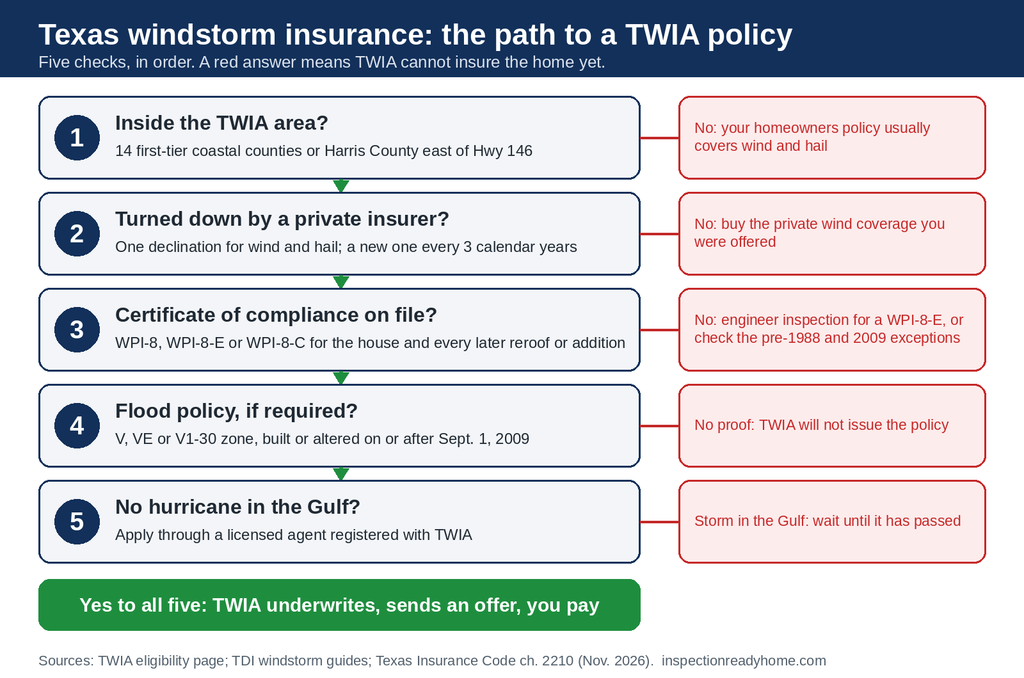
Texas Insurance Code Chapter 2210 sets the rules, and TWIA lists them on its get windstorm insurance page. Here is what each one asks of you in practice when you apply for Texas windstorm insurance:
| Rule | What you need | Where it comes from |
|---|---|---|
| In the designated catastrophe area | An address in one of the 14 counties or the Harris County strip | Your property records |
| Turned down by a private insurer | One declination from an authorized insurer that writes wind and hail on the coast; again every three calendar years before renewal | Your agent, from the insurer (Sec. 2210.202) |
| Built to the windstorm code | A WPI-8, WPI-8-E or WPI-8-C certificate of compliance, with limited exceptions | TDI (or TWIA for 2017-2020 WPI-8-C) |
| Flood insurance, if required | Proof of a flood policy for homes in zones V, VE or V1-30 built or altered on or after September 1, 2009, if NFIP coverage is available | Your flood policy declarations page |
| Insurable condition | Good repair, no unrepaired damage or hazards; TWIA may inspect in person or with aerial images | Your own upkeep |
You apply through a licensed agent registered with TWIA; TWIA does not sell directly and does not recommend agents. TDI adds one timing rule: you cannot get a TWIA policy while a hurricane is in the Gulf of Mexico. If you are buying on the coast between June and November, put the Texas windstorm insurance application in early.
The WPI-8 certificate: what it is and how to get one
The certificate of compliance is TDI’s proof that a structure meets the windstorm building code for its area. TWIA says that without one it has no evidence the home was built to code and may treat it as uninsurable. There are three versions, and the TWIA certification page explains who issued which:
| Certificate | Issued by | For | Who inspects |
|---|---|---|---|
| WPI-8 | TDI | New or ongoing work: new homes, additions, reroofs and repairs inspected while underway | A TDI appointed qualified inspector (engineer) or a TDI windstorm inspector |
| WPI-8-E | TDI, since June 1, 2020 | Completed work that was not inspected during construction | Any Texas licensed professional engineer |
| WPI-8-C | TWIA, January 1, 2017 to May 31, 2020 | Completed work in that period | No longer issued; look it up with TWIA |
Before you buy a coastal house, search the address on TDI’s certificate database to see what Texas windstorm insurance will need. For a WPI-8-C issued by TWIA, use the TWIA certificate lookup, because those are not on the TDI site.
Which projects need a certificate
Per TDI’s windstorm inspection guide and TWIA, most new construction, roof replacements, major repairs and alterations need an inspection and a certificate. Examples on each side of the line:
| Needs a certificate | Does not need one |
|---|---|
| New homes and additions | Roof repairs under 100 square feet that do not involve decking |
| Replacing a roof, or repairing a large part of one | Painting, carpeting, cabinets and other non-structural work |
| New windows, entry doors and garage doors | Glass replacement in existing windows or doors |
| Patio covers and decks | Fences, gutters, decorative shutters, steps and screen doors |
| Re-siding a large part of an exterior wall | Plumbing and electrical repairs; temporary repairs after a storm |
Getting a WPI-8 while the work is underway
- Before you sign, ask the contractor how they will meet the windstorm inspection requirement. TDI warns against contractors who are not familiar with the program.
- Pick a TDI appointed qualified inspector from the public list or ask TDI at 800-248-6032.
- The file opens with TDI form WPI-1, the application for a windstorm inspection certificate of compliance. Book the inspector before the work is covered up: TDI notes that finished work is harder to verify.
- The inspector checks the work while it is underway. Windows, doors, roofing and siding should carry a TDI product evaluation or a published wind rating, which you can look up with TDI.
- When the work passes, TDI issues the WPI-8 and publishes it in its database.
- Hold the final payment until the certificate is issued, as TDI recommends, then give a copy to your agent.
Finished work with no certificate: the WPI-8-E route
If the work is done and nobody inspected it, a Texas licensed professional engineer can inspect the completed structure. TDI then needs a signed WPI-2E application and a sealed post-construction inspection report with supporting evidence, or a sealed design, before it issues a WPI-8-E (TDI completed construction page; Insurance Code Sec. 2210.2515). TDI says this route may cost more, because it is harder to confirm code compliance once walls and roofs are closed.
When you may not need a certificate at all
- Built before 1988: under Sec. 2210.251, structures finished before January 1, 1988 can be eligible without the inspection, if a recognized building code applied at the time or if the house had private wind coverage in the past 12 months and has not changed structurally.
- Built 1988 to June 18, 2009 without a certificate: TWIA may still insure the home, but the policy carries a 15% annual surcharge on the premium (Sec. 2210.259).
- Dropped by a private insurer: a home insured in the private market on or after June 19, 2009 that was nonrenewed or cancelled, and lacked a required WPI-8 at that time, may still be eligible (Sec. 2210.258).
Worked example: a 2021 reroof with no certificate
Take a 1996 house in Port Aransas, Nueces County, with an original certificate. In 2021 the owners replaced the roof, but the roofer never arranged a windstorm inspection. In 2026 their private insurer renews without wind and hail coverage and gives them a written declination. Their lender wants Texas windstorm insurance before the hurricane season. Here is how the case runs (example facts):
| Step | What happens | Rule behind it |
|---|---|---|
| 1. Search | TDI’s database shows the 1996 certificate but nothing for the 2021 reroof | A reroof needs its own certificate |
| 2. Declination | The renewal without wind counts as a refusal to offer wind and hail coverage | Sec. 2210.202 |
| 3. Exception? | The private policy that lapsed covered wind in 2021-2025, so the agent asks TWIA whether the nonrenewal exception applies | Sec. 2210.258 (TWIA decides) |
| 4. Fallback | If it does not apply, a licensed engineer inspects the finished roof for a WPI-8-E | Sec. 2210.2515 |
| 5. Timing | Everything must be bound before a storm forms in the Gulf | TDI |
The lesson: the cheapest certificate is the one ordered before the roofer starts. A reroof done without one can hold up a TWIA policy right when the lender needs it. Our roof replacement guide lists the other papers to keep after new roofing work.
What Texas windstorm insurance costs
TWIA says its average residential premium was about $2,541 a year as of June 30, 2026 (TWIA rates page). Your premium depends on standard factors: the amount of insurance, the type of construction, the deductible and any optional coverage you add. TWIA’s own policy guide says the deductible you choose has the biggest effect. Two things TWIA does not use are credit scores and territorial rating, so where you live on the coast is not itself a rating factor. Premium credits apply to items certified to recent windstorm codes.
The TWIA board sets rates, subject to TDI review, and must file each year by August 15. The record since 2015 shows how rarely residential rates have moved:
| Filing year | Residential change | Note |
|---|---|---|
| 2015, 2016 | +5% each year | |
| 2017 | 0% | |
| 2018 | +5% | |
| 2019 | 0% | A 10% filing was withdrawn after the governor suspended its review |
| 2020, 2021 | 0% | 2021: a 5% filing was rejected on procedural grounds |
| 2022 | +5% | |
| 2023 to 2025 | 0% | 2024: a 10% filing was disapproved by TDI |
Remember the other two policies. Your coastal homeowners policy without wind and your flood policy add to the total, so compare the full cost of Texas windstorm insurance plus both, not the TWIA premium alone. For statewide averages, see our average cost of homeowners insurance ranking.
Coverage limits, replacement cost and the roof
Sec. 2210.501 makes the TWIA board propose maximum limits, with a floor of $350,000 for a dwelling and its contents, and Sec. 2210.502 adjusts them each year for construction costs. Ask your agent for the current maximum. If your house would cost more to rebuild, you need excess Texas windstorm insurance from another insurer on top.
Replacement cost has a condition. Under Sec. 2210.207, a dwelling insured for at least 80% of its full replacement cost (or for the TWIA maximum) is paid without depreciation. Insure it for less and TWIA pays the replacement cost of the damaged part minus depreciation. The same section lets the Commissioner allow actual cash value coverage on roof coverings, and TWIA’s forms list includes endorsements you should look for on your declarations page:
| Form | Name on the TWIA forms list | Why it matters |
|---|---|---|
| TWIA 804 | Replacement Cost Coverage A (Dwelling), Actual Cash Value Roofs | The roof covering is paid with depreciation taken off |
| TWIA 420 | Cosmetic Damage to Roof Coverings Caused by Hail Exclusion | Purely cosmetic hail damage to the roof covering, such as dents, is excluded |
| TWIA 311 | Extension of Coverage, Additional Living Expense | Pays extra costs if you cannot live in the house |
| TWIA 321 | Extension of Coverage, Wind-Driven Rain | Rain driven in by the wind; read the form for when it applies |
| TWIA 365 | Replacement Cost Endorsement, Personal | Contents at replacement cost instead of cash value |
| TWIA 431 | Increased Cost of Construction, Residential | Extra cost of meeting current code when you rebuild |
Your deductible and every form number appear on the declarations page; our declarations page guide and tracker shows how to read one. For how roofs are paid after a storm, see whether homeowners insurance covers roof replacement.
Flood and storm surge are never covered
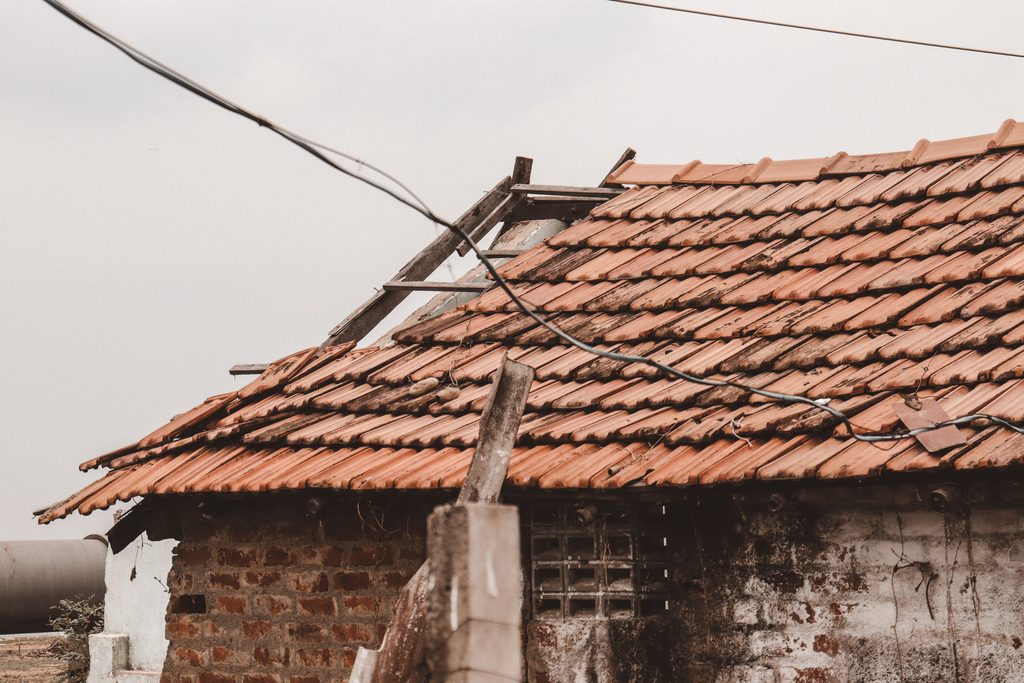
TWIA policies cover only direct wind and hail damage. Water from storm surge, rising rivers or heavy-rain runoff needs flood insurance, usually through the NFIP. For homes in coastal V zones built, altered, remodeled or enlarged on or after September 1, 2009, TWIA requires proof of flood coverage before it will insure the wind. After a hurricane, only the wind and hail part of the damage goes to TWIA; water from surge or flooding goes to the flood policy. Our guide to flood insurance covers the 30-day wait and the NFIP limits.
TWIA insurance claims: the deadlines in order
The TWIA claim process looks like any homeowners claim, but the deadlines are set by statute and they are strict. In order, from the TWIA claims page and Chapter 2210:
| When | What happens | Source |
|---|---|---|
| Within 1 year of the damage | Report the claim. For good cause the Commissioner may extend this by up to 180 days | Sec. 2210.573, 2210.205 |
| Within 30 days of filing | TWIA may ask in writing for information it needs | Sec. 2210.573(b) |
| Within 60 days of receiving everything requested | TWIA accepts, denies or partly accepts the claim, in a written notice | TWIA claims page |
| Within 10 days of acceptance | TWIA pays, once you have sent all requested materials | TWIA claims page |
| Within 60 days of the notice letter | Request appraisal on the actual cash value amount; replacement cost gets a later date in the letter | TWIA claims page |
| Within 2 years of the decision | Notify TWIA of a coverage dispute and, after any mediation it requests (60 days), sue in district court | TWIA claims page; Sec. 2210.576 |
After any Texas windstorm insurance claim, make temporary repairs, keep receipts and do not start permanent work or throw out damaged items before you talk to a TWIA claims examiner. Ask contractors for line-item estimates and send them in: TWIA compares them with its own and can issue supplemental payments. If you cannot resolve a problem, TDI’s Coastal Outreach and Assistance Services Team (COAST) helps TWIA policyholders.
Renewing, cancelling and leaving TWIA
- New declination every three years: Sec. 2210.202 requires evidence of a private declination every three calendar years before a TWIA policy renews.
- Refunds are limited: since HB 3208 (2023), TWIA keeps the full annual premium on a cancellation unless you bought similar coverage elsewhere, the policyholder died, the house was a total loss or you sold it (TWIA cancellations page).
- Depopulation is voluntary: under SB 900 (2015), private insurers can offer to take TWIA policyholders, but both programs are optional (TWIA depopulation page).
- Keep the house in insurable condition: your Texas windstorm insurance depends on it. TWIA can reinspect and reevaluate eligibility at any time, including with aerial images.
If a private company offers you wind coverage at renewal, compare deductibles, the roof basis and limits before you leave Texas windstorm insurance from TWIA, as you would any quote. Where no one will sell you a homeowners policy at all, the Texas FAIR Plan is the backstop; our FAIR plan insurance guide compares it with other states.
Ask your agent before you apply
- Does my homeowners policy exclude windstorm and hail, and is that exclusion my declination?
- Does TDI or TWIA hold a certificate for every part of the house, including the latest roof, windows and garage door?
- What is the current TWIA dwelling limit, and do I need excess wind coverage on top?
- Which deductible options do I have, and what is each one in dollars?
- Does the quote include actual cash value roofs, the cosmetic hail exclusion or additional living expense?
Frequently asked questions
Is Texas windstorm insurance required?
Not by state law. TDI says that if you live near the coast and have a mortgage, your lender will likely require windstorm coverage. Without a mortgage, buying it is your decision.
What does TWIA insurance cover?
Only direct damage from wind and hail to the property on the policy: the house, contents if you insure them and other listed items. Fire, theft, flood and storm surge are excluded by law and need other policies.
Can I buy TWIA coverage when a hurricane is coming?
No. TDI says you cannot get a TWIA policy while a hurricane is in the Gulf of Mexico, so apply well before the season or before a closing date.
How do I find the WPI-8 certificate for my house?
Search the address in TDI’s windstorm certificate database. Certificates TWIA issued between January 2017 and May 2020 (WPI-8-C) are in TWIA’s own lookup tool instead.
Does TWIA use my credit score?
No. TWIA says it does not use credit scoring or territorial rating. Premiums depend on the amount of insurance, construction type, deductible, optional coverage and credits for certified building features.
When to call a pro
- Licensed agent registered with TWIA: to get the declination, compare private wind offers and submit the application.
- TDI appointed qualified inspector: before any reroof, window, door or addition work on the coast, so the WPI-8 is issued during the job.
- Texas licensed professional engineer: finished work has no certificate and you need a WPI-8-E.
- TDI (800-252-3439) or the COAST team: a TWIA claim is stuck or you disagree with a decision.
This site does not sell Texas windstorm insurance or recommend insurers or agents. Confirm details with your agent, TWIA or TDI.
Sources
- Texas Department of Insurance, What is windstorm insurance? (updated June 1, 2026)
- Texas Department of Insurance, What you need to know about windstorm inspections (updated May 8, 2026)
- Texas Department of Insurance, Completed construction certificates
- Texas Department of Insurance, Making repairs after a storm
- TWIA, Coverage and eligibility
- TWIA, Get windstorm insurance
- TWIA, Windstorm certification
- TWIA, Rates (average premium as of June 30, 2026)
- TWIA, Inside a policy
- TWIA, Forms, sample policies and endorsements
- TWIA, Claims process and how to dispute a claim
- TWIA, Policy cancellations and refunds
- TWIA, Depopulation
- Texas Insurance Code, Chapter 2210 (Sections 2210.202, 2210.205, 2210.207, 2210.251, 2210.2515, 2210.258, 2210.259, 2210.501, 2210.502, 2210.573, 2210.576)
This guide to Texas windstorm insurance is general information, not insurance or legal advice. Daniel Aznar, who writes this site, is not an insurance agent, engineer or inspector and does not recommend any insurer. Rules, limits and rates change: confirm with TWIA, the Texas Department of Insurance or your agent. Read our full disclaimer, and if you spot an error, our corrections page explains how we fix it. Information checked in November 2026.