California FAIR Plan: What It Covers, What It Doesn’t and How to Fill the Gaps
Quick answer
The California FAIR Plan is the state’s insurer of last resort for homes that regular insurers will not cover. It sells a basic fire policy: fire, lightning, internal explosion and smoke, with wind, hail and vandalism as options. It does not cover theft, water damage or liability, so most owners pair it with a separate difference in conditions (DIC) policy. Residential limits reach $3 million, and you apply through a licensed broker.
The California FAIR Plan is where many homeowners land after a non-renewal letter, and it is easy to buy without understanding what you bought. It is not a full homeowners policy. It is a fire policy with a short list of add-ons, and the gaps are where people get hurt after a claim.
This guide starts with a decision table so you can see whether the California FAIR Plan is your best move, then breaks down the perils it covers, the options to tick, how to fill the gaps with a DIC policy, and the 2026 rate change. A worked example runs one house through seven common losses. Every rule links to the California Department of Insurance or the FAIR Plan itself, as explained in how we verify our guides.
Table of Contents
Is the California FAIR Plan right for you? A decision table
Start with your situation, not with the FAIR Plan. The California Department of Insurance says the plan is for residents and businesses who cannot get insurance through a regular insurance company, and it tells you to shop the market first. Find the row that matches you.
| Your situation | Best first move | Why |
|---|---|---|
| Your insurer sent a non-renewal, but a broker still finds a regular (admitted) policy | Take the regular policy | A standard homeowners policy covers theft, water damage and liability in one contract |
| The only offers are from surplus lines (non-admitted) insurers | Compare that offer with FAIR Plan plus DIC | United Policyholders suggests shopping surplus lines too; compare total cost and coverage, not price alone |
| No insurer will write your home at all | California FAIR Plan plus a DIC policy | The FAIR Plan covers fire; the DIC policy adds the perils it leaves out |
| You are buying a home and the lender needs proof of insurance to close | FAIR Plan for the fire coverage, then add DIC | United Policyholders says a FAIR Plan policy satisfies a lender’s requirement that the home be insured |
| You own a 1-4 unit rental | FAIR Plan dwelling policy for rentals plus landlord coverage elsewhere | The plan lists rentals of 1-4 units among eligible dwellings; it has no liability coverage |
| You rent, or own a condo unit | Ask a broker about the FAIR Plan’s personal property options | The plan offers coverage for renters and for condo unit owners |
If you land in rows 3 or 4, the rest of this guide is your checklist. If you land in row 1, keep that policy: the FAIR Plan describes itself as a temporary option, and the Department calls it a last resort.
What the California FAIR Plan covers, peril by peril
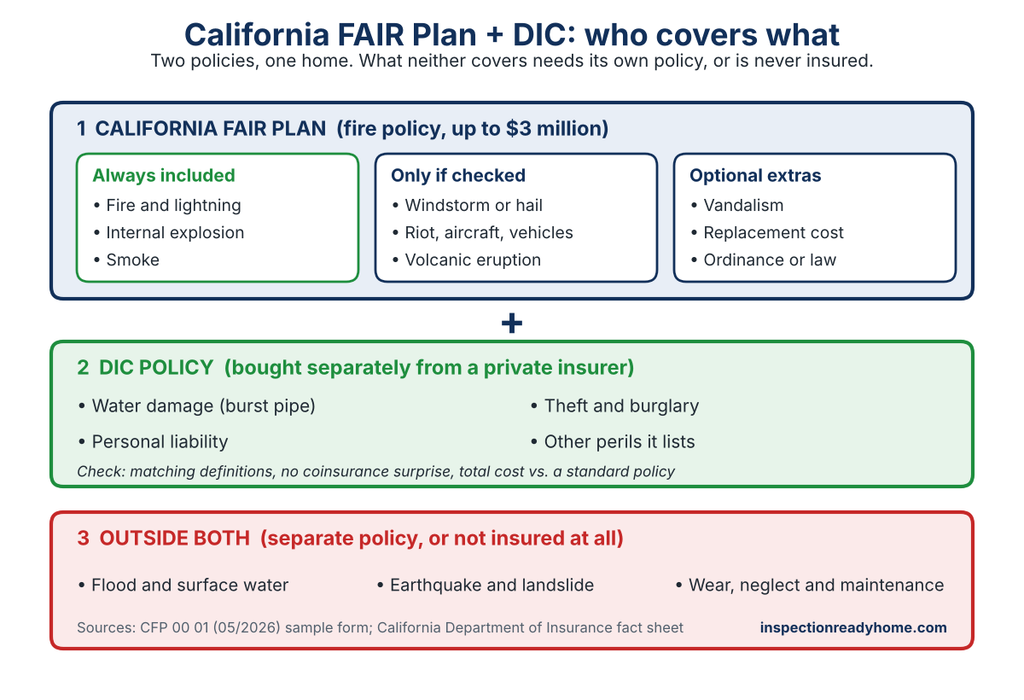
The FAIR Plan’s dwelling policy is a named-peril policy: it covers only the causes of loss it lists, and nothing else. The sample Dwelling Property Policy form CFP 00 01 (05/2026) posted on the FAIR Plan site sorts those perils into three groups.
| Group | Perils | Included? |
|---|---|---|
| Basic perils | Fire or lightning; internal explosion; smoke | Yes, in every policy |
| Extended coverage | Windstorm or hail; explosion; riot or civil commotion; aircraft; vehicles; volcanic eruption | Only if checked on your declarations page |
| Vandalism or malicious mischief | Damage done on purpose by others (theft is not included) | Only if checked, for an extra premium |
| Not covered | Theft; water damage such as burst pipes; flood and sewer backup; earthquake and landslide; liability to others; wear and neglect | No: buy DIC, flood or earthquake coverage separately |
Two lines in that table cause most surprises. First, wind and hail are not automatic. If a windstorm strips shingles and you did not buy extended coverage, the plan pays nothing for it. Second, water damage from inside the house, such as a burst pipe, is not a covered peril at all. That is the job of the DIC policy.
The policy has four coverage parts: Coverage A for the dwelling, B for other structures such as a detached garage or fence, C for personal property and D for fair rental value, which helps if a covered loss makes the home unlivable. There is no Coverage E: the form has no personal liability section, only a fire department service charge of up to $500.
California FAIR Plan limits and how claims are paid
The Department of Insurance lists the current maximum as $3 million for residential policyholders and $20 million per location for commercial policies. The residential cap doubled from $1.5 million after a 2019 order by the Insurance Commissioner, as United Policyholders also notes.
The limit is only half of the story. How the policy values a loss matters just as much, and the default is less generous than many owners expect.
- Default for the dwelling (A and B): a total loss is paid at actual cash value, and a partial loss at repair or replacement cost minus depreciation, up to the limit.
- Dwelling Replacement Cost option: pays to rebuild without subtracting depreciation, but only if you insure the home to at least 80% of its replacement cost and finish the repairs.
- Personal property: depreciated value by default; a Personal Property Replacement Cost option pays the difference after you actually replace the item.
- Ordinance or law: extra costs to meet current building codes are excluded unless you add this option.
If depreciation is new to you, our guide to whether homeowners insurance covers roof replacement shows how actual cash value shrinks a roof claim on an older home. On a FAIR Plan policy, the replacement cost option is the line that changes that math.
California FAIR Plan plus DIC: the two-policy setup
A difference in conditions policy, often called a wrap-around policy, is sold by private insurers to sit on top of the FAIR Plan. The Department’s 2024 fact sheet says DIC policies cover perils that a standard HO-3 homeowners policy includes but the FAIR Plan does not, such as water damage, theft and liability. The FAIR Plan itself does not sell DIC policies; the Department publishes a list of insurers that sell DIC policies.
The same fact sheet shows the gap is real: from 2020 to 2022, only about half of California FAIR Plan policyholders also had a DIC policy. The other half had a fire policy and nothing for a burst pipe, a burglary or a guest who slips on the stairs.
Before you buy a DIC policy, United Policyholders suggests three checks:
- Match the definitions. Read how each policy defines its perils and exclusions so the two contracts fit together without a hole between them.
- Look for coinsurance. Most DIC policies do not have it, but if yours does, it can cut a claim payment when your limit is too low.
- Compare the total. The two policies together often cost more than one standard policy would, so keep shopping the regular market.
Flood and earthquake sit outside both policies. You need a separate flood policy, and a separate earthquake policy; the FAIR Plan site has its own earthquake page.
How to apply for the California FAIR Plan, step by step
There is no direct online sign-up for homeowners. The FAIR Plan’s dwelling page tells you to contact a licensed broker, and the Department adds that you can also call the plan at 800-339-4099. Here is the order that avoids a coverage gap.
- Shop the regular market first. The Department points to its Top Ten Tips for Finding Residential Insurance before you turn to the plan.
- Find a broker registered with the FAIR Plan. The Department recommends one, and the plan’s site has a Broker Finder.
- Apply through the broker. A 2016 Department order, cited in its June 2025 release, lets the plan issue coverage without first requiring a diligent search of the market.
- Choose your options. Decide on extended coverage (wind and hail), vandalism, dwelling and personal property replacement cost, and ordinance or law.
- Pick a payment plan. See the payment table in the next section.
- Bind the DIC policy at the same time, so theft, water damage and liability are covered from day one.
- Set a re-shop reminder. Ask your broker to check the regular market before every renewal.
Ask your broker before you sign
- Which perils are checked on my declarations page, and is windstorm or hail among them?
- Is my dwelling limit at least 80% of the replacement cost, so the replacement cost option works?
- Do I have ordinance or law coverage, and how much?
- Does my DIC policy cover water damage, theft and liability, and does it have coinsurance?
- Do I qualify for the wildfire-hardening discount, and what proof do you need?
California FAIR Plan cost in 2026: the rate change and payment plans
There is no official average premium you can rely on. The price depends on the home, its location and its wildfire risk, and only a broker’s quote tells you your number.
What changed in 2026 is the rate level. AM Best reported on May 27, 2026, that the plan received approval to raise dwelling rates by an average of 29.1%, effective October 15 for new and renewing policies. Averages hide a wide spread: a San Francisco Chronicle report, reposted by United Policyholders, said about a quarter of policyholders could see decreases while half could see increases of 30% to 50%.
The Department also says the plan applies a residential wildfire-hardening discount to the wildfire portion of the premium, so ask your broker what work qualifies. How you pay changes the cost too.
| Payment plan | How it works | Watch for |
|---|---|---|
| Annual (Full Pay) | One payment per term | Not eligible for autopay |
| Triannual (3 Pay) | Three installments | Installment fees apply; autopay available |
| Monthly (11 Pay) | Eleven installments | Installment fees apply; autopay available |
| Autopay (from April 1, 2026) | Drawn on each invoice due date; re-enroll every term | ACH has no processing fee; cards carry a 3.5% vendor fee |
Worked example: one hillside home, seven losses
A family owns a house in a high wildfire-risk area. Their insurer did not renew, and no regular company would write the home. They buy a FAIR Plan dwelling policy with extended coverage and dwelling replacement cost, and add a DIC policy from a private insurer. Here is how seven losses would play out, compared with a neighbor who bought the FAIR Plan alone.
| Loss | FAIR Plan only | FAIR Plan plus DIC | The rule behind it |
|---|---|---|---|
| Kitchen fire damages the walls | Covered | Covered by the FAIR Plan | Fire is a basic peril |
| Wildfire smoke soaks the interior | Covered, subject to claim review | Covered by the FAIR Plan | Smoke is a basic peril |
| Windstorm blows off shingles | Only if extended coverage was checked | Same, or under DIC if it lists wind | Wind is in extended coverage |
| Pipe bursts under the sink | Not covered | Usually covered by the DIC policy | Water damage is not a FAIR Plan peril |
| Burglar steals a laptop | Not covered | Usually covered by the DIC policy | Theft is excluded, even with vandalism |
| Guest is hurt on the steps | Not covered | Usually covered by the DIC policy | The FAIR Plan has no liability coverage |
| Earthquake cracks the foundation | Not covered | Not covered | Needs a separate earthquake policy |
The neighbor with the FAIR Plan alone is covered for two of the seven losses and maybe a third. The family with both policies is covered for five or six. The difference is not the FAIR Plan; it is the second policy.
Notice that the smoke row says subject to claim review. In June 2025 the Department said it was investigating how the FAIR Plan handled smoke damage claims from the Los Angeles wildfires. Photograph smoke damage carefully and keep cleaning receipts.
How to leave the California FAIR Plan and what may change
The Department says the FAIR Plan is a last resort, and the plan calls itself a temporary option. Leaving means getting a regular insurer to take you back.
- Re-shop before every renewal. Ask your broker to check admitted and surplus lines markets each year.
- Use the clearinghouse. The state created clearinghouse programs to help policyholders move back to the regular market, though the Department said in February 2026 that only some insurers take part.
- Harden the home. Wildfire mitigation work can help with the plan’s wildfire-hardening discount and with regular insurers. Keep receipts and photos.
- Keep the roof and systems in shape. When a regular insurer quotes you, it may order an inspection. Our guide to the home insurance inspection shows what that visit looks at, and our free roof age checker flags roof-age issues before an inspector does.
On the horizon: in February 2026 the Commissioner and an Assemblymember announced AB 1680, the Make It FAIR Act. As announced, it would create a comprehensive homeowners option with water damage and liability, add staff to speed up claims and improve the clearinghouse. It was a proposal when announced, not law; check its status before you count on it.

Frequently asked questions
What is the California FAIR Plan?
It is an association the Legislature and Governor created more than 50 years ago, run day to day by the insurance companies that do business in California, not by taxpayers. The California FAIR Plan sells basic fire insurance to property owners who cannot find coverage from a regular insurer. The Department of Insurance calls it a last resort. Other states run their own versions with different rules; our guide to FAIR plan insurance compares six of them.
What is the average cost of the California FAIR Plan?
There is no official average that fits every home. Premiums depend on location, construction, wildfire risk, limits and options. The best figure is a quote from a registered broker, and remember to add the cost of a DIC policy to compare it fairly with a standard policy.
Is the California FAIR Plan good insurance?
It does one job: it keeps a home insured against fire when no one else will. It is not a complete homeowners policy, and United Policyholders notes that pairing it with DIC often costs more than one standard policy. Use it as a bridge and keep shopping.
How much will the California FAIR Plan premium increase in 2026?
AM Best reported an approved average increase of 29.1% for dwelling policies, effective October 15, 2026, for new and renewing policies. Your own change can be higher, lower or even a decrease, so check your renewal notice and ask your broker about the wildfire-hardening discount.
Do I need a DIC policy with the FAIR Plan?
You are not required to buy one, but without it you have no coverage for theft, water damage from inside the home or liability. The Department’s fact sheet notes that about half of FAIR Plan policyholders went without DIC from 2020 to 2022.
When to call a pro
- You received a non-renewal notice: call an independent broker who is registered with the FAIR Plan and also sells DIC.
- You are closing on a home in a high-risk area: get the quotes before you remove contingencies.
- A claim was underpaid or denied: the Department of Insurance takes consumer complaints at 800-927-4357.
- You plan wildfire mitigation work: ask your broker which items count for the discount before you pay a contractor.
For coverage decisions, talk to a licensed broker or agent. A broker can also check whether a regular insurer will now take your home.
Sources
- California Department of Insurance, California FAIR Plan (consumer page)
- California Department of Insurance, Fact Sheet: Summary on Residential Insurance Policies and the FAIR Plan (updated June 2024)
- California Department of Insurance, List of Insurers that Sell Difference in Conditions Policies
- California Department of Insurance, press release on the FAIR Plan overhaul (June 25, 2025)
- California Department of Insurance, AB 1680 Make It FAIR Act announcement (February 2, 2026)
- California FAIR Plan, Dwelling policy page
- California FAIR Plan, sample Dwelling Property Policy CFP 00 01 (05/2026)
- California FAIR Plan, Autopay and payment plan options (revised March 16, 2026)
- United Policyholders, The lowdown on the California FAIR Plan
- United Policyholders, California FAIR Plan set to increase rates (May 2026)
- AM Best, California Fair Plan approved for 29.1% dwelling rate increase (May 27, 2026)
This guide to the California FAIR Plan is general information, not insurance or legal advice. Daniel Aznar, who writes this site, is not an insurance agent, broker or home inspector. Coverage depends on your declarations page and policy forms: confirm what applies to your home with a licensed broker, the FAIR Plan or the California Department of Insurance. Read our full disclaimer, and if you spot an error, our corrections page explains how we fix it. Information checked in October 2026.