Missouri Homeowners Insurance: Costs, the Earthquake Gap, Sinkholes and the 30-Day Notice Rule
Quick answer
Missouri homeowners insurance averages $1,589 a year for a standard HO-3 policy (NAIC, 2023 data), $148 below the national average. The bigger risk is what the policy leaves out. Earthquake damage needs its own coverage, and only 10.4% of homes in the seven New Madrid counties had it in 2024. Sinkholes are usually excluded too. Insurers must give you 30 days’ notice before they cancel or drop you.
Missouri homeowners insurance looks cheap on paper. The state sits in the middle of the national price ranking, well below its neighbors to the west and south. But a regular policy here has two holes that most owners only discover after the ground moves: it does not cover earthquakes, and it usually does not cover sinkholes. Hail and tornado damage, by contrast, is normally covered, and state rules set the deadlines your insurer has to meet.
This guide uses the Missouri Department of Commerce and Insurance (DCI)’s own earthquake survey, the state’s claim-handling rules and the notice laws in chapter 375 of the Missouri statutes. You get a region-by-region table, a worked earthquake claim and a checklist for any letter your insurer sends. Every rule links to its source, as explained in how we verify our guides.
Table of Contents
Missouri homeowners insurance at a glance
| Question | Short answer |
|---|---|
| Average HO-3 premium | $1,589 a year, about $132 a month (NAIC, 2023 data) |
| National rank | 24th of 51 (the 50 states plus Washington, D.C.) |
| Earthquake covered? | No, unless you add an endorsement or a separate policy |
| Homes with earthquake coverage | 19.4% statewide; 10.4% in the seven New Madrid counties (2024) |
| Sinkhole covered? | Usually no; the Missouri FAIR Plan sells a sinkhole-only policy |
| Notice before cancellation | 30 days; 10 days for unpaid premium |
| Notice before nonrenewal | 30 days, with the actual reason in writing |
| Insurer of last resort | Missouri FAIR Plan, up to $200,000 per home |
| Consumer hotline | DCI, 800-726-7390 |
What Missouri homeowners insurance costs
The newest regulator-compiled numbers come from the NAIC’s homeowners report for 2023, published in July 2026. The average Missouri homeowners insurance premium for an HO-3 policy was $1,589 a year. That is $148 less than the national average of $1,737 and puts Missouri 24th of 51. Counting every policy form, including dwelling fire and HO-5, the state average was $1,675.
Missouri is the inexpensive corner of its region. Oklahoma averaged $2,486, Nebraska $2,142, Arkansas $1,870, Kansas $1,733 and Tennessee $1,649. Only Kentucky ($1,525), Illinois ($1,480) and Iowa ($1,342) came in lower. For the full 51-state ranking, see our guide to the average cost of homeowners insurance.
Quote sites often show $2,900 to $3,800 for Missouri homeowners insurance. They are measuring a different thing: one sample house with a chosen dwelling limit, priced today, while the NAIC averages what real policyholders paid in 2023 across every limit. Use the NAIC figure to compare states and a real quote to budget. Neither one includes earthquake coverage, which is priced separately, as the next section shows.
The earthquake gap in Missouri homeowners insurance
Southeast Missouri sits on the New Madrid Seismic Zone, which the DCI’s earthquake report describes as a significant hazard to the state. A standard Missouri homeowners insurance or renters policy does not cover earthquake damage. You have to add it as an endorsement or buy a separate policy, and the price and availability depend on where you live.
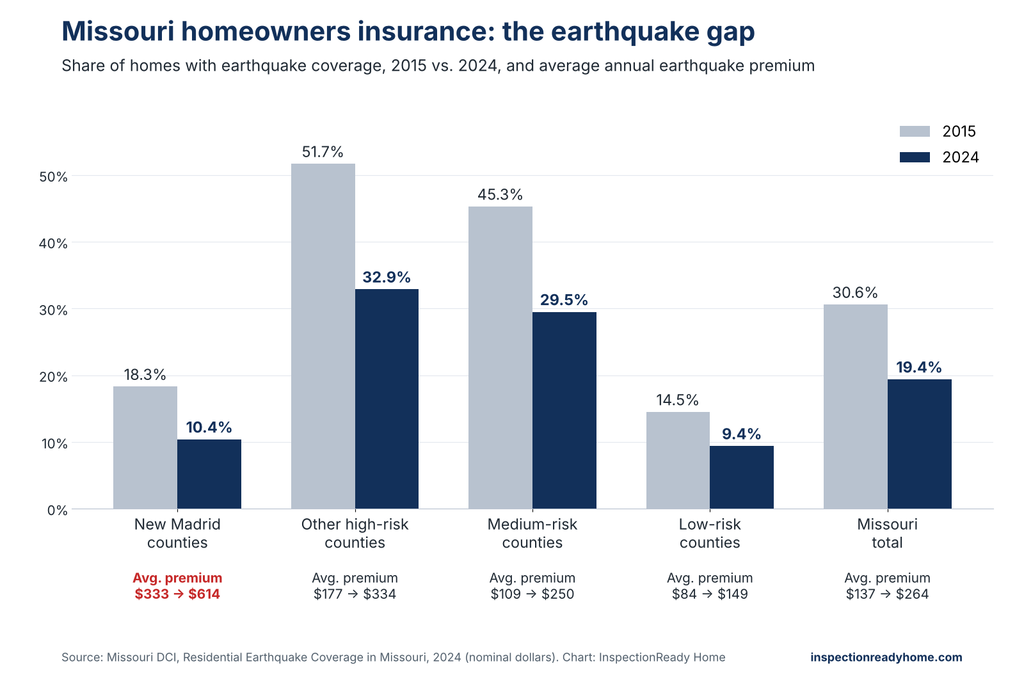
Every year the DCI surveys insurers and publishes a report on how many homes carry earthquake coverage and what it costs. Its 2024 report, released in November 2025, shows coverage falling in every part of the state while premiums rose. We pulled the two key tables together below.
| DCI risk region | Homes covered, 2015 | Homes covered, 2024 | Average premium, 2015 | Average premium, 2024 |
|---|---|---|---|---|
| New Madrid counties | 18.3% | 10.4% | $333 | $614 |
| Other high-risk counties | 51.7% | 32.9% | $177 | $334 |
| Medium-risk counties | 45.3% | 29.5% | $109 | $250 |
| Low-risk counties | 14.5% | 9.4% | $84 | $149 |
| Missouri total | 30.6% | 19.4% | $137 | $264 |
Read the first row twice. In the counties closest to the fault, the average earthquake premium almost doubled in nine years, from $333 to $614, and the share of homes covered fell from about one in five to about one in ten. Statewide, fewer than 20% of residences have earthquake coverage in 101 of Missouri’s 115 counties, and no county reaches 50%.
The seven New Madrid counties
| County | Homes with earthquake coverage | Average earthquake premium |
|---|---|---|
| Butler | 11.5% | $500 |
| Dunklin | 8.9% | $717 |
| Mississippi | 6.5% | $660 |
| New Madrid | 10.5% | $645 |
| Pemiscot | 7.5% | $675 |
| Scott | 10.9% | $704 |
| Stoddard | 12.3% | $527 |
Deductibles are the other half of the cost. Earthquake deductibles are a percentage of the coverage limit, not a flat dollar amount. In the New Madrid region, 85.1% of the earthquake market starts at a 10% deductible, and the DCI notes that some insurers only sell policies with 20% or 25%. Elsewhere in the state, just over half of the market (54.3%) can start at 5%. Ask for the deductible in dollars before you add the endorsement to your Missouri homeowners insurance policy.
Worked example: one earthquake claim, two deductibles
A hypothetical owner in Scott County adds earthquake coverage with a $200,000 limit. A moderate quake cracks the foundation, drops the chimney and splits drywall in four rooms. The repair estimate is $35,000. This is what the deductible does to the check.
| 10% deductible | 20% deductible | |
|---|---|---|
| Coverage limit | $200,000 | $200,000 |
| Deductible in dollars | $20,000 | $40,000 |
| Repair estimate | $35,000 | $35,000 |
| Insurer pays | $15,000 | $0 |
| Owner pays | $20,000 | $35,000 |
The lesson is not that earthquake coverage is useless. It is that a percentage deductible is built for a big loss, not a medium one. If you would struggle to pay $20,000 out of pocket, ask what a lower deductible costs, and compare at least two companies; the DCI’s 2025 survey found more insurers writing new earthquake policies than the year before.
Sinkholes: the second gap
Parts of Missouri sit on limestone, and water can dissolve it into underground voids. When the ground above collapses, a standard Missouri homeowners insurance policy usually pays nothing, because ground movement is excluded. Since January 1, 2015, the Missouri FAIR Plan has been allowed to sell a policy that covers sinkhole loss only, under section 379.827 of the Missouri statutes.
That policy sits on top of your regular Missouri homeowners insurance: the law says it supplements primary coverage issued by an insurer authorized in Missouri. And sinkhole loss has a narrow legal meaning. The damage must come directly from underground voids created by water acting on limestone or similar rock, shown by all of these:
- An abrupt collapse of the ground cover.
- A depression in the ground you can see with the naked eye.
- Structural damage to the house, including the foundation.
- Where it applies, a condemnation order showing the house cannot be lived in.
Driveways and detached buildings that nobody lives in are not covered, and neither are the value of the land or the cost of filling the hole. Belongings are covered only if they are inside the house when a covered collapse hits it. Slow settling is not a sinkhole under this definition, and the FAIR Plan does not cover earthquakes either.
Homeowners insurance Missouri claims: the hail and tornado deadlines
Start with what is covered. The DCI lists fire, lightning, windstorm and hail among the perils a typical policy covers, and roof damage from ordinary wear and tear is not covered. Once you report a loss, Missouri’s unfair claims rules set the clock your insurer has to follow.
| Step | Deadline | Rule |
|---|---|---|
| Insurer acknowledges your claim | 10 working days after it is notified | 20 CSR 100-1.030 |
| Insurer replies to your letters or calls that need an answer | 10 working days | 20 CSR 100-1.030 |
| Investigation finished | 30 days after notice, unless it reasonably cannot be | 20 CSR 100-1.050 |
| Status letter if the investigation is still open | Within 45 days, then every 45 days | 20 CSR 100-1.050 |
| Claim accepted or denied | 15 working days after the insurer has all the forms it needs | 20 CSR 100-1.050 |
| A denial | In writing, citing the policy provision it relies on | 20 CSR 100-1.050 |
Write down the date you reported the claim and the name of everyone you speak to. If the 45-day status letter never arrives, you have a concrete fact to give the DCI. Before you file, check how your Missouri homeowners insurance policy pays the roof: replacement cost or actual cash value. Our guide on when insurance pays for a roof replacement explains the difference.
Roofers and your deductible
Storm chasers follow hail across the Plains, and Missouri wrote a law for them. Section 407.725 covers any contractor who repairs or replaces a roof or other exterior work on a home and gets paid from a Missouri homeowners insurance claim.
- No deductible deals: the contractor may not offer to pay, rebate or discount any part of your insurance deductible to win the job.
- No claim negotiating: the contractor may not represent you or negotiate the claim with your insurer.
- Five-day exit: if your insurer tells you in writing that all or part of the claim is not covered, you can cancel the contract until midnight of the fifth business day after that notice.
- Refund in 10 days: after you cancel, the contractor must return your money within 10 days, minus the reasonable value of any emergency work you approved in writing.
A violation counts as an unfair practice under the Missouri Merchandising Practices Act. Oklahoma has a similar roofing law, explained in our guide to Oklahoma homeowners insurance, and our guide to Colorado homeowners insurance shows how percentage hail deductibles work. If your roof is getting old, our roof age checker shows how close it is to the limits insurers use.

Cancellation and nonrenewal rules for Missouri homeowners insurance
Chapter 375 of the Missouri statutes protects owner-occupied homes. For the first 60 days of a new policy, the insurer can cancel more freely. After that, or on any renewal policy, Missouri homeowners insurance can only be cancelled mid-term for four reasons: unpaid premium; fraud or material misrepresentation, or breaking the policy’s terms; a conviction for a crime that increases the insured hazard; or physical changes to the property that increase the risk.
If a letter arrives, check it against these five points:
- Is it a cancellation or a nonrenewal? A cancellation ends the policy before its end date. A nonrenewal means the insurer will not offer another term.
- Did it arrive in time? A cancellation needs at least 30 days’ notice, or 10 days for unpaid premium. A nonrenewal needs at least 30 days before the policy ends.
- Does it give the real reason? The law asks for the actual reason, clear enough for an average person to understand. Vague phrases such as “living conditions” do not count.
- Does it mention the FAIR Plan? Both kinds of notice must say you may be eligible for coverage through the state’s placement program.
- Is it really a transfer? If your insurer moves you to an affiliate in the same group, it does not need a nonrenewal notice, but it needs 15 days’ notice if the new coverage is not substantially the same.
Thirty days is tight. Start shopping the day the letter arrives and keep it; you may need it for a FAIR Plan application. Our renewal paperwork tracker can put the deadline in your calendar. Missouri’s renewal letters can also arrive just 30 days before the date, the DCI warns, so check your premium as soon as it lands.
The Missouri FAIR Plan: coverage of last resort
When no regular insurer will take your home, the Missouri Property Insurance Placement Facility, known as the Missouri FAIR Plan, is the backstop of Missouri homeowners insurance. It was set up in October 1969 for property that is insurable but cannot find coverage in the normal market. You cannot apply yourself: a Missouri-licensed agent submits the application after a diligent effort to place the home with a regular company.
- Limit: up to $200,000 per location for a home, subject to its insurable value (section 379.825).
- Coverage: the DCI describes it as fire-only coverage, much thinner than a regular homeowners policy.
- Earthquake: not covered.
- Sinkhole: available as the separate sinkhole-only policy described above.
- Contact: 800-392-7240 (Missouri only) or (314) 421-0170.
If the FAIR Plan will not fit, the DCI also points to the surplus lines market. How FAIR plans compare across states, and how to leave one, is covered in our guide to FAIR plan insurance.
Questions to ask before you renew
- Does my policy include earthquake coverage, and if not, what would it cost?
- What is the earthquake deductible in dollars, not just as a percentage?
- Is there any sinkhole or ground-collapse coverage, and if not, where can I get it?
- Do you pay replacement cost or actual cash value on the roof after hail?
- Is there a separate wind or hail deductible on this policy?
Frequently asked questions
Is Missouri homeowners insurance required by law?
We found no Missouri law that makes you buy it, but your mortgage lender almost certainly requires it. The DCI warns that if your coverage lapses, the lender may buy a policy for you at a high price that protects only the lender’s interest.
Does it cover tornadoes?
Usually yes. Tornadoes are windstorms, and the DCI lists windstorm and hail among the perils a typical Missouri homeowners insurance policy covers. Read your declarations page for a separate wind or hail deductible, which can be higher than your regular one.
Does it cover flooding?
No. Standard Missouri homeowners insurance policies generally exclude flood. You need a separate flood policy, through the NFIP (800-638-6620) or a private flood insurer. Our guide to flood insurance explains the 30-day wait.
How much does earthquake coverage cost in Missouri?
Earthquake coverage is an add-on to Missouri homeowners insurance, priced on its own. In 2024 the DCI found an average of $264 a year statewide and $614 in the seven New Madrid counties, with county averages there from $500 to $717. Your price depends on your county, your home and the deductible you choose.
Where do I complain about my insurer?
Call the DCI’s Insurance Consumer Hotline at 800-726-7390 or file a complaint through the department’s consumer pages. Keep your claim dates and letters; the deadlines in the claims table above are the department’s own rules.
When to call a pro
- You got a cancellation or nonrenewal letter and have 30 days to find new coverage.
- You live in or near the New Madrid counties and want earthquake quotes with different deductibles.
- You see cracks, a depression in the yard or doors that suddenly stick, and suspect a sinkhole.
- A roofer offers to cover your deductible or to deal with your insurer for you.
A licensed Missouri agent can compare Missouri homeowners insurance quotes and submit a FAIR Plan application. A structural engineer can tell settling from a sinkhole. For neighbors with different rules, see our guide to homeowners insurance in Oklahoma.
Sources
- NAIC, Dwelling Fire, Homeowners Owner-Occupied, and Homeowners Tenant and Condominium/Cooperative Unit Owner’s Insurance Report: Data for 2023 (July 2026)
- Missouri DCI, Residential Earthquake Coverage in Missouri, 2024 report
- Missouri DCI, earthquake insurance news release (February 17, 2026)
- Missouri DCI, Homeowners Insurance FAQs
- Revisor of Missouri, section 375.002 RSMo, grounds for cancellation
- Revisor of Missouri, section 375.003 RSMo, notice of cancellation
- Revisor of Missouri, section 375.004 RSMo, refusal to renew
- Revisor of Missouri, section 379.827 RSMo, sinkhole loss policies
- Revisor of Missouri, section 379.825 RSMo, FAIR Plan coverage limits
- Revisor of Missouri, section 407.725 RSMo, roofing contractors and insurance claims
- 20 CSR 100-1.030, acknowledgment of claims
- 20 CSR 100-1.050, standards for prompt, fair and equitable settlements
- Missouri FAIR Plan (Missouri Property Insurance Placement Facility)
This guide to Missouri homeowners insurance is general information, not insurance or legal advice, and this site is not affiliated with the Missouri Department of Commerce and Insurance, the Missouri FAIR Plan or any insurer. Daniel Aznar, who writes this site, is not a home inspector or an insurance agent. Rules, rates and survey figures change: confirm what applies to your home with your insurer or a licensed Missouri agent. Read our full disclaimer, and if you spot an error, our corrections page explains how we fix it. Information checked in November 2026.