Homeowners Insurance Georgia: Coverage, Costs, the 60-Day Nonrenewal Rule and the GUA
Quick answer
Homeowners insurance Georgia policies cost about $1,828 a year on average for a standard HO-3 (NAIC, 2023 data), a little above the national average. For policies issued or renewed since January 1, 2026, an insurer must give you at least 60 days’ written notice before it refuses to renew. Flood needs its own policy, and if no company will insure you, the Georgia Underwriting Association sells basic coverage.
Homeowners insurance Georgia rules changed twice in two years. A 2025 law doubled the notice an insurer must give before dropping you, and a 2026 law, which takes effect on January 1, 2027, limits how insurers can use drone and satellite photos of your roof to cancel a policy. The Georgia Office of Commissioner of Insurance and Safety Fire (OCI) regulates all of it.
This guide covers what a Georgia policy pays for, how coverage differs between the six coastal counties and the rest of the state, what it costs, your rights when an insurer wants to drop you, how the state’s FAIR plan works and how to compare quotes. Every rule links to the OCI page, state law or GUA document we read, as explained in how we verify our guides.
Table of Contents
Homeowners insurance Georgia in five rules
If you read nothing else, these five points cover most of what goes wrong with homeowners insurance Georgia policies. Each one has its own section below.
- Insure the rebuild, not the sale price. OCI says to insure your home for at least 80% of what it would cost to rebuild, and your lender may set a minimum of its own.
- Flood is never in the policy. OCI says most home policies exclude floods and earthquakes; you buy those separately.
- 60 days is your minimum warning. For policies issued or renewed since January 1, 2026, an insurer must mail or hand you a written nonrenewal notice, with the reason, at least 60 days ahead.
- You have 15 days to ask the state to step in. If you think a cancellation or nonrenewal breaks the law, you can ask the Commissioner for a review within 15 days of getting the notice.
- There is a last resort. If no company will cover you, the Georgia Underwriting Association (GUA) sells a basic policy with fixed limits.
What a Georgia home policy covers
OCI’s home insurance page describes four parts that most homeowners insurance Georgia policies share. How much each one pays depends on the policy you buy, its limits and your deductible:
| Part of the policy | What it pays for | What to check on your quote |
|---|---|---|
| Dwelling and other structures | Damage to the house and detached buildings such as a garage or shed | The dwelling limit is at least 80% of the rebuild cost |
| Contents | Furniture, clothes, electronics and other belongings | Replacement cost or actual cash value |
| Additional living expenses | The extra cost of living elsewhere while the house cannot be lived in | The dollar or percentage cap |
| Personal liability and medical payments | A claim or lawsuit when someone is hurt or their property is damaged at your home | The liability limit |
Two choices decide how much a homeowners insurance Georgia claim actually pays. Replacement cost pays to rebuild or repair with materials of similar kind and quality, with no deduction for depreciation. Actual cash value subtracts depreciation, so an older roof or sofa pays less. OCI also reminds you that the deductible applies to each claim on the house and your belongings, and a lower deductible means a higher premium.
Disasters are where homeowners insurance Georgia policies differ most. OCI says most policies do not cover floods or earthquakes, and that coverage for other disasters depends on where you live, how the house is built and the options you pick. It points homeowners to A Homeowner’s Guide to Natural Disasters, which covers hurricanes, tornadoes, lightning and more. For the flood side, our flood insurance guide explains the federal limits and the 30-day wait.
All of these limits and deductibles sit on your declarations page. OCI suggests checking your coverage with your agent at least once a year, since an added room, new insulation or a remodel can raise what it would cost to rebuild.
Coast or inland: how your county changes the policy
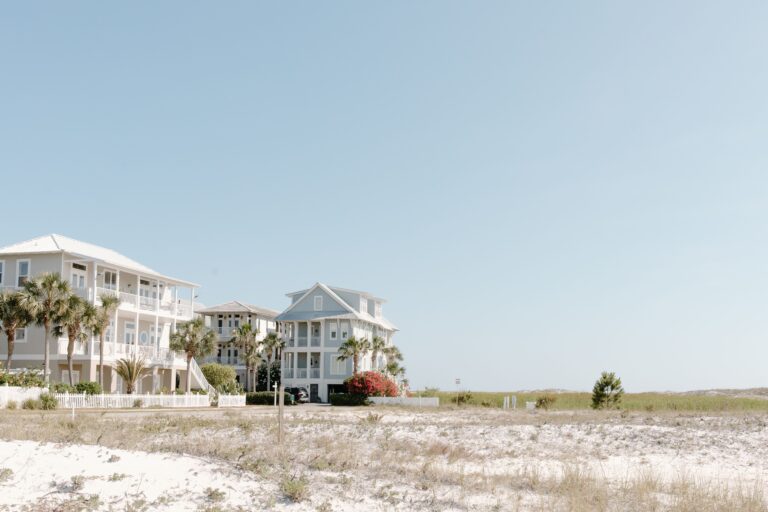
Georgia has a short coastline, but it changes the rules for homeowners insurance Georgia buyers who live on it. The GUA’s homeowners application names six coastal counties, Bryan, Camden, Chatham, Glynn, Liberty and McIntosh, where it applies a 2% wind and hail deductible, and its quote guide sells wind-and-hail-only policies there for homes whose main policy excludes wind. Here is how that plays out:
| Where the home is | Wind and hail | Deductible to watch | Flood |
|---|---|---|---|
| Atlanta metro and most of the state | Usually part of the home policy | Your all-peril deductible; check whether the policy adds a separate wind or hail deductible | Separate policy, even outside mapped flood zones |
| Savannah, Brunswick and the rest of the six coastal counties | Can be excluded from the home policy and bought separately | Percentage wind and hail deductible (2% at the GUA) | Separate policy; lenders require it in high-risk flood zones |
Timing matters on the coast. The GUA application says it accepts no new application or coverage increase while a hurricane tracked by the National Hurricane Center is inside a set area of the Atlantic, until 24 hours after the warning is lifted. Ask your agent whether your own company has a similar rule, and settle coverage before hurricane season starts on June 1, not when a storm is in the forecast.
If your coastal homeowners insurance Georgia policy has a percentage deductible, do the math in dollars: 2% of $300,000 of dwelling coverage is $6,000 out of your pocket on a wind claim. Our guide to the wind mitigation inspection explains which roof and window features insurers look at when they price wind risk.
Homeowners insurance Georgia cost
The most recent regulator-compiled figure for homeowners insurance Georgia prices comes from the NAIC. Its homeowners report with 2023 data, published in July 2026, puts the average Georgia HO-3 premium at $1,828 a year, about $152 a month. That is $91, or about 5%, above the national HO-3 average of $1,737, and 16th highest of the 50 states plus Washington, D.C.
| State | Average HO-3 premium, 2023 | Compared with Georgia |
|---|---|---|
| Florida | $2,779 | $951 more |
| Alabama | $1,906 | $78 more |
| North Carolina | $1,852 | $24 more |
| Georgia | $1,828 | — |
| South Carolina | $1,753 | $75 less |
| Tennessee | $1,649 | $179 less |
| United States | $1,737 | $91 less |
You will see higher figures on insurer and comparison sites, from about $2,300 to $3,200. Those are usually quotes for a sample house with a set coverage amount, priced in 2025 or 2026, so they are not the same measure. The NAIC average is what policyholders actually paid, across every coverage amount, and it is two to three years old. The NAIC itself warns that an average premium is an imperfect measure of price, because homes, values and risks differ.
What moves your own homeowners insurance Georgia premium? OCI lists the coverage amount you buy for the house and contents, and the deductible you choose. It also says that in some states insurers give lower prices for bundling home and car, deadbolts or alarm systems, or a new roof; ask which ones your company offers. For every state’s average, see our average cost of homeowners insurance ranking.
Your renewal rights under homeowners insurance Georgia law
This is where Georgia stands out. Senate Bill 35, signed in May 2025, changed the minimum nonrenewal notice in Code Section 33-24-46 from 30 days to 60 days for policies issued or renewed on or after January 1, 2026. The notice must be mailed by at least first-class mail, with proof of mailing, or delivered in person, to you and to your lender, and it must state the reasons.
OCI’s Bulletin 24-EX-2 lists what an insurer may and may not do with a residential policy:
- Not allowed: refusing to renew because you have two or fewer claims in the past 36 months, unless they were caused by your negligence or intentional acts or those of someone living there.
- Not allowed: refusing to renew because the company changed its eligibility or underwriting rules, unless the Commissioner approved the change.
- Not allowed: refusing to renew because you will not buy another policy from the same company.
- Mid-term cancellation after the first 60 days: allowed only for unpaid premium, fraud, a change that substantially increases the risk, or a breach of a material policy term.
- Required before cutting coverage: a separate notice headed “NOTICE OF REDUCTION IN COVERAGE” in capital letters, in at least 12-point type. A new exclusion counts as a reduction.
The underwriting rule is not theoretical. In July 2023, OCI announced that a major insurer had rescinded tens of thousands of nonrenewal notices sent to homes with roofs over 15 years old, after the Commissioner said Georgia law only lets insurers apply new guidelines to new business, not to existing customers. If your renewal letter cites roof age, ask whether the rule applied when you first bought the policy. Our roof age checker shows how much life your roof has left.
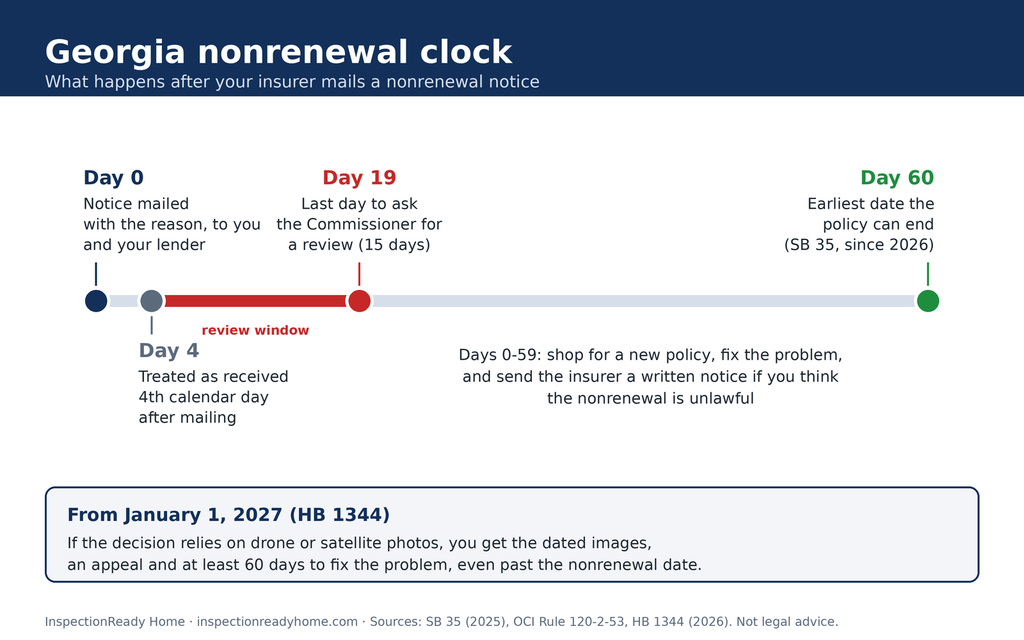
Every homeowners insurance Georgia cancellation or nonrenewal notice must also tell you how to ask the state for a review. Under OCI’s Rule 120-2-53, you have 15 days from receiving the notice to mail or deliver a written request to the Commissioner, explaining why you think it is unlawful and showing that you paid 30 days of premium, pro rata.
Your coverage continues during the review, and if the Commissioner sides with the insurer, it ends no sooner than five days after the decision. If you also want to claim the nonrenewal is unlawful against the company itself, you must send it a written notice before the nonrenewal takes effect.
Worked example: a nonrenewal letter, day by day
Say your insurer mails a nonrenewal notice on Monday, February 1, 2027, because of the condition of your roof. The dates are an example to show how the rules stack up, not legal advice for your case.
| Date | What happens | Rule |
|---|---|---|
| Mon, Feb 1 | Notice mailed, with the reason | Code Section 33-24-46 |
| Fri, Feb 5 | You are treated as having received it, the fourth calendar day after mailing | Rule 120-2-53-.03(2) |
| Sat, Feb 20 | Last day to mail a written review request to the Commissioner, with 30 days of premium | Rule 120-2-53-.03 |
| Feb 1 to Apr 1 | Shop for a new policy, fix the roof, or both. Send the insurer a written notice if you believe the nonrenewal is unlawful | Rule 120-2-53-.03(1)(a) |
| Fri, Apr 2 | Earliest date the policy can end: 60 days after mailing | SB 35 |
The 15-day window closes first and fastest. If the notice sits unopened for two weeks, you lose the cheapest way to challenge it. Put both dates in your calendar the day the letter arrives; our renewal paperwork tracker can create the reminders for you.
What changes on January 1, 2027
Governor Brian Kemp signed House Bill 1344, the Georgia Insurance Affordability and Claims Integrity Act, on May 12, 2026. Its main rules for homeowners insurance Georgia policies apply to those issued or renewed on or after January 1, 2027:
- Drone and satellite photos. If an insurer cancels or nonrenews an owner-occupied home based on aerial or satellite images, the notice must include the date-stamped images (taken within the past 12 months), the steps to reverse the decision and the repair standards. The insurer must name a contact person, offer an appeal and give you at least 60 days to fix the problem, even if that runs past the nonrenewal date. If you prove the fix, it must renew or rescind. The rule also covers the GUA.
- Faster claims after a declared disaster. The Commissioner can order insurers to acknowledge a claim within 15 days, accept or deny within 60 days of a completed proof of loss, pay within 10 days of agreeing on the amount, and decide within 60 days in total. The Commissioner can also extend the time you have to file.
- More time to sue. For property policies issued or renewed on or after July 1, 2027, a policy cannot give you less than two years from the date of loss to file suit.
- Storm mitigation grants. A new Georgia Storm Damage Mitigation Program can pay for roof, roof-to-wall, opening protection and other retrofits on owner-occupied homes, if the legislature funds it. Grants are capped by law (the largest roof award is up to $7,500), and you need a current policy and a wind mitigation inspection.
How and when the grant program opens depends on OCI rules and funding that were not published when we checked. We will update this section when OCI announces it.
Georgia Underwriting Association: the state’s FAIR plan
The Georgia Underwriting Association is Georgia’s residual market, often called the Georgia FAIR plan. It exists so that basic property and liability coverage is available to all Georgians, and it only insures homes kept up to minimum safety standards. Its policyholder page calls itself the insurer of last resort for Georgia homeowners insurance and urges you to shop the private market at least once a year.
The homeowners policy is an HO-8, a named-perils form. The GUA’s comparison of coverages lists ten covered events: fire or lightning, windstorm or hail, explosion, riot, aircraft, vehicles, smoke, vandalism, theft and volcanic eruption. Water damage is an optional add-on. Most limits are fixed by the application rather than chosen by you:
| GUA homeowners policy | What the GUA documents say |
|---|---|
| Who it is for | A single-family, free-standing, owner-occupied primary home that is not eligible in the private market |
| Dwelling coverage | At least $25,000; up to $2,000,000 for building and contents combined |
| Other structures, belongings, loss of use | Fixed at 10%, 50% and 10% of the dwelling limit |
| Liability and medical payments | Fixed at $100,000 and $1,000 |
| Theft | $1,000, with higher limits for an extra premium |
| Settlement | Actual cash value unless you buy replacement cost; wind and hail damage to roofs 10 years old or more is paid at actual cash value |
| Coastal deductible | 2% for wind and hail in the six coastal counties |
| To apply | Through a licensed agent, with front and rear photos and a cost estimate; agents cannot bind coverage, and processing takes 10 to 14 days |
| When coverage starts | 12:01 a.m. the day after the GUA receives payment; a $50 policy and inspection fee applies |
Compared with a typical private policy, that is thin coverage: a short list of perils, low liability and theft limits, and depreciation taken off older roofs. The GUA itself suggests asking about a Difference in Conditions policy from another company to fill some of the gaps. One upside: its FORTIFIED Home page says a home certified Bronze, Silver or Gold by IBHS gets a credit on the wind portion of the premium.
Our FAIR plan insurance guide compares Georgia’s plan with those in other states.
How to compare homeowners insurance Georgia quotes
OCI is clear that you do not have to buy from the company your lender suggests, and that you should shop around. The “best” or “cheapest” homeowners insurance Georgia company is the one that prices your house well for the same coverage, so the only fair test is to line quotes up side by side. Copy this worksheet, or print it:
| Line to compare | Quote A | Quote B | Quote C |
|---|---|---|---|
| Company licensed in Georgia? (OCI license lookup) | |||
| Policy form (HO-3, HO-5, HO-8) | |||
| Dwelling limit and estimated rebuild cost | |||
| Replacement cost or actual cash value, house and roof | |||
| All-peril deductible in dollars | |||
| Wind, hail or hurricane deductible in dollars | |||
| Water backup and other add-ons | |||
| Liability limit | |||
| Discounts applied | |||
| Annual premium |
Check the company and the agent with OCI’s license lookup before you pay. OCI also suggests asking neighbors, relatives and friends about their companies and agents. A homeowners insurance Georgia quote that is hundreds of dollars lower usually differs somewhere in the rows above the price: a percentage deductible, an actual cash value roof or a lower dwelling limit.
Filing a claim and getting help
OCI’s claim tips come down to a short routine:
- Report it fast. Your policy may require notice within a set time.
- Photograph first, then make temporary repairs such as a tarp, and keep the receipts. Do not make permanent repairs before the adjuster inspects, or the claim can be denied.
- Keep a log of every call and visit: date, name, title and what was said.
- Get denials in writing, with the exact policy language the company relies on.
- Do not rush a settlement. Ask for an itemized explanation, and negotiate if the offer is low.
If you cannot settle a homeowners insurance Georgia dispute with the company, OCI’s Consumer Services Division takes complaints about insurers, agents and claim handling, at 800-656-2298 toll-free or 404-656-2070. Send copies, not originals, of your policy, claim number, letters and receipts. For roof claims, our guide to whether homeowners insurance covers roof replacement explains how age and depreciation change the payout.

Frequently asked questions
How much is homeowners insurance in Georgia?
The NAIC’s latest regulator-compiled average for homeowners insurance Georgia policies is $1,828 a year for a standard HO-3 policy (2023 data), about 5% above the national average. Your price depends on your rebuild cost, deductible, location and claims, so compare quotes for your own address.
How much notice does an insurer have to give before dropping me?
For a nonrenewal, at least 60 days for policies issued or renewed on or after January 1, 2026, with the reason in writing. You then have 15 days from receiving the notice to ask the Commissioner for a review.
Does Georgia homeowners insurance cover flooding?
No. OCI says most home policies do not cover floods, so you need a separate flood policy, usually through the federal NFIP. Most new NFIP policies start after a 30-day wait, so do not wait for a storm forecast.
Who is the cheapest or best insurer in Georgia?
We do not rank insurers, and rankings online often compare a sample house, not yours. Ask three or more licensed companies or agents for the same dwelling limit, deductible and roof settlement, fill in the worksheet above, and compare the price line last.
Can I get a GUA policy if a company already offered me coverage?
The GUA says it is a market of last resort and that coverage placed with it should not be eligible in the private market. Ask your agent to try private companies first, and to shop again every year.
When to call a pro
- Licensed insurance agent: you need quotes, a coastal wind policy or a GUA application.
- Roofer or home inspector: your nonrenewal cites roof condition and you need proof of repairs inside the notice period.
- Wind mitigation or FORTIFIED evaluator: you want a wind credit or plan to apply for a state mitigation grant.
- OCI Consumer Services (800-656-2298): you think a company wrongly canceled, nonrenewed or denied you. Remember the 15-day window for a review request.
- Attorney: a large claim dispute is heading toward court.
This site does not sell homeowners insurance Georgia policies or recommend insurers. Confirm coverage details with your agent or OCI.
Sources
- Georgia Office of Commissioner of Insurance and Safety Fire, Home Insurance
- Georgia OCI, Insurance Claim Tips
- Georgia OCI, How do I file a complaint?
- Georgia OCI, Bulletin 24-EX-2: Nonrenewal requirements and prohibitions (January 31, 2024)
- Georgia OCI, news release on rescinded nonrenewal notices (July 21, 2023)
- Rules of the Georgia Commissioner of Insurance, Subject 120-2-53: Cancellation and nonrenewal regulation
- Georgia General Assembly, Senate Bill 35 (2025), as signed
- Georgia General Assembly, House Bill 1344 (2026), Georgia Insurance Affordability and Claims Integrity Act
- Georgia Underwriting Association, mission and policyholder information
- Georgia Underwriting Association, Application for Homeowners Insurance (HO 12/15)
- Georgia Underwriting Association, Quote guide
- Georgia Underwriting Association, Comparison of coverages
- Georgia Underwriting Association, FORTIFIED Home Program
- NAIC, Homeowners insurance report: Data for 2023 (July 2026)
This guide to homeowners insurance Georgia rules is general information, not insurance or legal advice. Daniel Aznar, who writes this site, is not an insurance agent or inspector and does not recommend any insurer. Laws, rates and programs can change: confirm with OCI, the GUA, your agent or your insurer. Read our full disclaimer, and if you spot an error, our corrections page explains how we fix it. Information checked in November 2026.