Oklahoma Homeowners Insurance: Costs by City, the New 60-Day Notice Rule and $10,000 Roof Grants
Quick answer
Oklahoma homeowners insurance averages $2,486 a year for a standard HO-3 policy (NAIC, 2023 data), the 5th highest in the country and $749 above the national average. In the state’s own August 2026 price chart, the same sample house costs up to about five times more with one company than another. Since July 25, 2026, insurers must give 60 days’ notice before most cancellations and nonrenewals, and the state pays up to $10,000 toward a FORTIFIED roof.
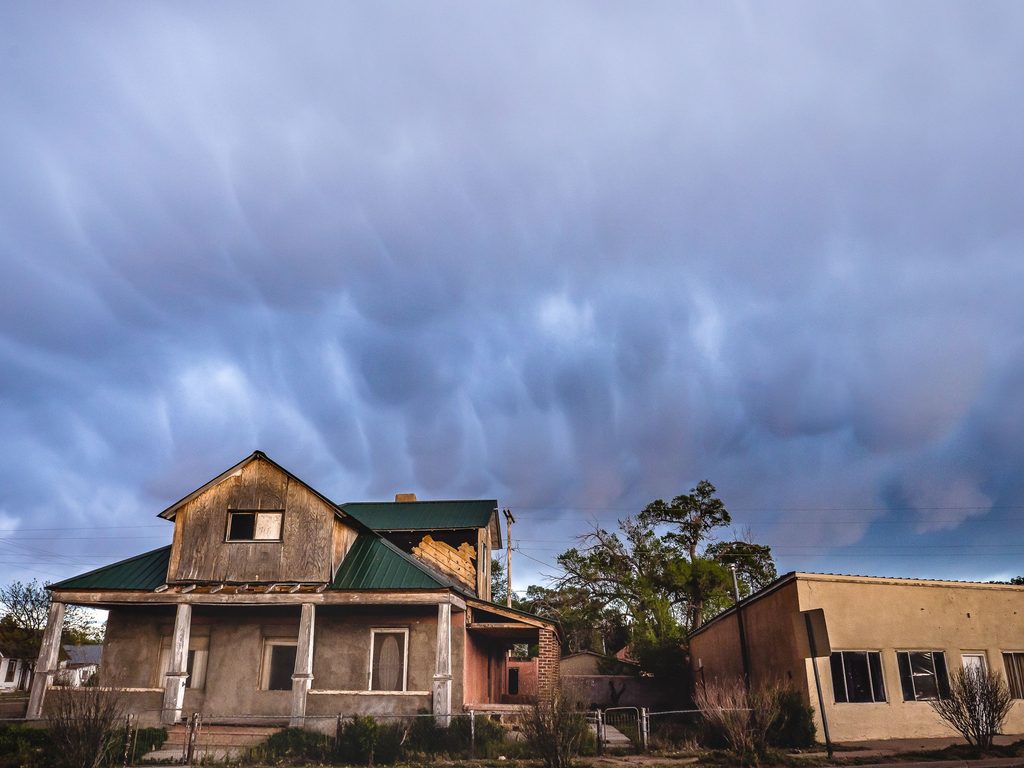
Oklahoma homeowners insurance is expensive for a reason you can see from the porch every spring: hail and wind. The Oklahoma Insurance Department (OID) says hail damage is the most common homeowners claim, and a 2025 Verisk roofing report it cites found that 49.7% of Oklahoma roofs were hit by severe hail over four years, the highest share in the nation.
This guide works from the state’s own numbers on Oklahoma homeowners insurance: the national cost data, the OID’s rate comparison chart for Oklahoma City, Tulsa, Lawton and McAlester, the new 60-day notice rule, the claim protections in the department’s consumer guide, the roofing contractor law and the Strengthen Oklahoma Homes grant. Each rule links to the page we read, as described in how we verify our guides.
Table of Contents
What Oklahoma homeowners insurance costs
The latest regulator-compiled figure comes from the NAIC’s homeowners report with 2023 data, published in July 2026. The average Oklahoma homeowners insurance premium for an HO-3 policy was $2,486 a year, about $207 a month. Only Louisiana ($3,027), Texas ($2,864), Florida ($2,779) and Colorado ($2,492) were higher. The national HO-3 average was $1,737. Across all policy forms, the Oklahoma average was $2,398.
Among its neighbors, only Texas and Colorado cost more on this measure. The NAIC averages are $1,870 in Arkansas, $1,733 in Kansas, $1,589 in Missouri and $1,490 in New Mexico. Our average cost of homeowners insurance ranking lists every state, and our guides to homeowners insurance in Texas and Colorado homeowners insurance cover the two states next door that rank higher.
Quote websites often publish $5,000 or more for Oklahoma homeowners insurance. They usually price one sample house at a fixed, fairly high dwelling limit in the current year, while the NAIC figure is what policyholders actually paid across every size of home. Neither number is your price. The next section shows how wide the range is for the same house.
Oklahoma homeowners insurance prices in the state’s own chart
Each year the OID asks the companies with the largest market share to price five sample policies. The rate comparison chart was last updated in August 2026, and it lists prices for Oklahoma City, Tulsa, Lawton and McAlester. Every company priced the same policy:
- An HO-3 form with no optional coverages, surcharges or credits.
- Dwelling limits of $100,000 to $500,000, with contents at half the dwelling limit, $100,000 of liability and $1,000 of medical payments.
- A 1% deductible.
- A dwelling limit equal to 80% of the replacement value (some companies require 90% to 100%).
- The most favorable fire protection class in the city, and replacement cost that includes composition roof surfacing.
- Separate prices for frame and masonry homes.
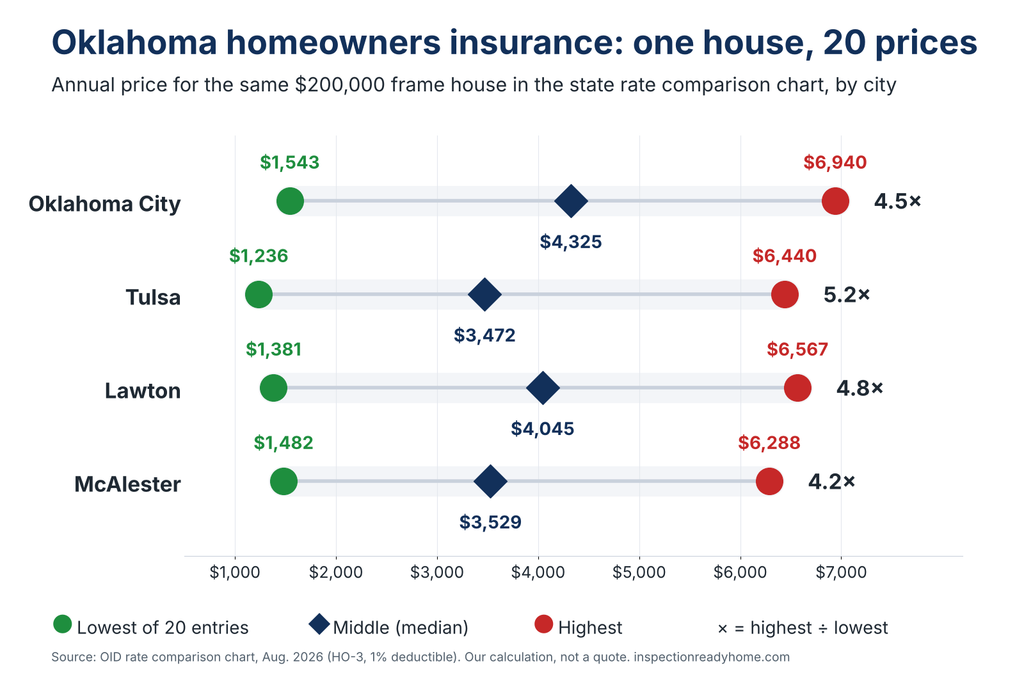
We took the 20 company entries in each city and pulled out the lowest, the middle (median) and the highest annual price for a $200,000 frame house:
| City | Lowest | Middle | Highest | Highest ÷ lowest |
|---|---|---|---|---|
| Oklahoma City | $1,543 | $4,325 | $6,940 | 4.5× |
| Tulsa | $1,236 | $3,472 | $6,440 | 5.2× |
| Lawton | $1,381 | $4,045 | $6,567 | 4.8× |
| McAlester | $1,482 | $3,529 | $6,288 | 4.2× |
Three things stand out. In Oklahoma homeowners insurance, the company you pick matters far more than the city: the middle price moves by about $850 between Tulsa and Oklahoma City, while the gap between the cheapest and dearest entry inside one city is close to $5,000. Oklahoma City has the highest middle price of the four. And masonry is not always cheaper: it beat frame in 13 or 14 of the 20 entries per city, not all of them.
The OID itself warns that these are not the amounts you will be quoted, because your home, claims history, credit and coverage choices change the price. We do not name companies here. The full chart, with names, is on the OID page.
Worked example: one Oklahoma City house, five dwelling limits
Say you own a frame house in Oklahoma City and want to know whether a quote is reasonable. Here is how the 20 entries in the chart spread out at each dwelling limit:
| Dwelling limit | Lowest | Middle | Highest |
|---|---|---|---|
| $100,000 | $1,079 | $2,742 | $5,069 |
| $200,000 | $1,543 | $4,325 | $6,940 |
| $300,000 | $1,749 | $5,727 | $8,156 |
| $400,000 | $1,935 | $6,966 | $10,370 |
| $500,000 | $2,103 | $8,254 | $13,042 |
For a $300,000 house, the middle entry is $5,727 a year. A quote for Oklahoma homeowners insurance well above that is worth questioning: ask whether your roof, claims or credit pushed you into a higher tier. A quote far below it is worth reading line by line. The chart assumes a 1% deductible and a replacement cost roof, so a cheap quote with a 2% wind and hail deductible or a depreciated roof is not the same product.
Hail and wind in Oklahoma homeowners insurance policies
Most standard policies cover hail damage to the roof and the rest of the house, the OID’s wind and hail page says, but it warns that policies can restrict that coverage. It names exclusions for cosmetic damage, which affects only how the house looks, and higher deductibles just for hail. In higher-risk areas, wind or hail may carry a separate deductible or be excluded. These are the clauses to find before the next storm:
| Clause | Where to look | What it does to a hail claim |
|---|---|---|
| Wind and hail deductible | Declarations page | Often a percentage of the dwelling limit. At 2% on a $300,000 home, you pay the first $6,000. |
| Cosmetic damage exclusion | An endorsement | Dents that do not stop the roof, siding or gutters from working may not be paid. |
| Roof paid at actual cash value or by a schedule | Loss settlement section or a roof endorsement | Depreciation comes off, so an older roof gets a smaller check. |
| Wind or hail excluded | Declarations page and endorsements | You need the coverage somewhere else, or the storm is not covered. |
| FORTIFIED roof endorsement | Optional endorsement | Lets the insurer replace a roof damaged in a covered event to the FORTIFIED standard. |
All of these Oklahoma homeowners insurance clauses show up on your declarations page or the endorsements listed on it. If the roof is old, our guide to whether homeowners insurance covers roof replacement explains how depreciation and roof schedules work.
Strengthen Oklahoma Homes: up to $10,000 for a FORTIFIED roof
The Strengthen Oklahoma Homes (SOH) program, also called OKReady, gives grants for wind and hail mitigation, the biggest cost in Oklahoma homeowners insurance, on owner-occupied single-family homes. It is funded by the insurance industry, not the state budget. To get the money, your roof must earn the IBHS FORTIFIED Home Roof High Wind designation with the Hail Supplement. That standard requires an enhanced roof deck attachment, a sealed roof deck, locked-down roof edges, impact-resistant shingles that IBHS has tested against hail up to 2 inches across, and, since January 2025, wind- and rain-resistant attic vents.
How the program grew
| Date | What happened |
|---|---|
| November 1, 2024 | Program takes effect |
| March 3, 2025 | First pilot opens, for 100 homes in selected ZIP codes |
| November 12, 2025 | Final pilot reopens the pilot ZIP codes; statewide launch set for 2026 |
| January 12, 2026 | Applications open statewide, after more than 100 pilot homes were finished |
| March 12, 2026 | First 2026 round full, with 300 applications approved |
| July 13, 2026 | Next statewide round opens; more than 400 roofs certified so far |
| September 1, 2026 | 500th FORTIFIED home completed |
| October 12, 2026 | Fourth-quarter statewide round opens; more than 600 homes completed |
Rounds open several times a year and can fill quickly, so the OID suggests preparing your documents before a round opens. Check the program page for the next date.
Who qualifies
- You own and live in the home as your primary residence, and you have a homestead exemption on file with the county assessor.
- It is a single-family home. Apartments, duplexes, condominiums, manufactured homes and mobile homes are not eligible.
- The home is in good repair, apart from recent storm damage.
- You have an in-force homeowners policy with wind coverage, plus flood insurance if the home is in a FEMA special flood hazard area.
- A program-approved FORTIFIED evaluator finds the home eligible for the designation.
- Age and income do not exclude you. The program uses two income tiers, split at a household income of $62,138.
How a grant works, step by step
- Before you pay anyone, confirm that at least one approved FORTIFIED contractor works in your area.
- When a round opens, register and apply in the program portal. The OID recommends a laptop or desktop.
- Once the application is approved, you choose a program-approved evaluator, who inspects the home to see whether it can be upgraded and what work it needs. You pay the evaluator directly.
- You pick three approved contractors, and each one bids on the work.
- You receive a grant award letter. No work may start before it, or you lose eligibility.
- You sign the contract with your chosen contractor. The evaluator documents the work and sends it to IBHS, which issues the certificate.
- The program pays the contractor up to $10,000. You pay anything above that.
A few limits are easy to miss. The grant does not pay the evaluator or your insurance deductible, but it can be combined with a claim to pay the difference between the claim payment and a FORTIFIED roof. You cannot do the work yourself. If the bids are more than you can pay, you can opt out in writing within 30 days of the award letter, before you sign a contract, but the evaluation fee is not refunded.
The certificate lasts five years and passes to the next owner if you sell. Discounts are set by each insurer, and not every company offers one, so ask your agent and check the list of participating insurers on the OID program page. Alabama and Louisiana run similar grants; our Alabama and Louisiana guides compare them.
Oklahoma homeowners insurance cancellation and nonrenewal: the 60-day rule
OID Bulletin 2026-02, dated July 28, 2026, announced a change to OAC 365:15-1-14 that took effect on July 25, 2026. Insurers must now give at least 60 days’ notice before they cancel or nonrenew a homeowners policy. Shorter notice is allowed only for the reasons listed in 36 O.S. § 3639.1(A). Older OID handouts and many websites still say 30 days for a nonrenewal.
| Reason | Notice before a cancellation | Notice before a nonrenewal |
|---|---|---|
| Unpaid premium; fraud or serious misrepresentation on the application; willful acts that increase a covered hazard; code violations that increase hazards; a change in risk that substantially increases a hazard; continuing the policy would break Oklahoma insurance law; a conviction for a crime that increases a covered hazard | 10 days | 30 days |
| Any other reason | 60 days | 60 days |
If a notice arrives, compare its date with the end of your policy and read the reason. The OID’s homeowners guide says to call the company’s consumer affairs division first if the reason seems unfair, and then the OID at 800-522-0071. Start shopping right away, and do not cancel the old policy until the new one is in effect.
Claims: what an Oklahoma insurer cannot hold against you
The same OID guide sets out four Oklahoma homeowners insurance protections that matter most after a storm:
- Asking is not a claim. A company cannot raise your premium, cancel, or refuse to issue or renew a policy only because you asked about filing a claim.
- First claim. Once a policy has been in effect more than 45 days, the company cannot cancel, nonrenew or raise the premium only because you filed a first claim.
- Weather claims. Insurers may add a surcharge if you file several claims, but they may not surcharge for weather-related claims.
- Who the check goes to. Payment for contents is made out to you; payment for the structure may be made out to you and your mortgage lender.
For the claim itself, the OID’s claim steps are simple: call your agent or insurer, make temporary repairs and keep the receipts, photograph the damage before moving debris, and make no permanent repairs until the insurer has reviewed the loss. A replacement cost policy usually pays actual cash value first and releases the rest after repairs, the OID’s severe storms page explains. For water coming through the roof, see our guide to whether homeowners insurance covers roof leaks.
If you and the insurer cannot agree, OID Consumer Assistance takes complaints at 800-522-0071. The department’s EAGLE mediation program is free and voluntary: both sides must agree, a mediator approved by the Oklahoma Supreme Court runs the session, and you keep the right to go to court if it fails.
Storm roofers and your deductible: Oklahoma’s roofing law
The Roofing Contractor Registration Act in Title 59 of the Oklahoma Statutes protects you when the roof is paid by your Oklahoma homeowners insurance:
- Registration: it is unlawful to work as a roofing contractor without a current, valid registration (§ 1151.3). The Construction Industries Board must verify registration numbers on request and run an online verification system (§ 1151.18).
- Written contract: every registrant must use one (§ 1151.7).
- 72 hours after a denial: if the work is to be paid from insurance and the insurer denies all or part of the claim, you can cancel within 72 hours of receiving the written denial. The contract must give you a boldface notice and a cancellation form, and the contractor must return payments within 10 days, apart from the reasonable value of emergency work you agreed to (§ 1151.21).
- No deductible deals: a roofer paid from insurance may not advertise or promise to pay all or part of your deductible, directly or indirectly. If one does, your insurer does not have to consider that roofer’s estimate, and the roofer must give you written notice of this rule with the first estimate (§ 1151.30, in force since November 1, 2022).
- New exam from 2027: starting January 1, 2027, residential roofers need a residential roofing endorsement, which requires passing an exam (§ 1151.25a).
Before you sign, our roof inspection guide explains which inspection fits, and our roof replacement guide covers costs and the papers to send your insurer afterward.
If no one will insure you: OK-MAP
When homeowners cannot find Oklahoma homeowners insurance, the OID sends them to the Oklahoma Market Assistance Program (OK-MAP), which can connect you with insurance companies that may be willing to cover your home. The number in the OID guide is (405) 842-9883. Before you call, deal with whatever made insurers say no: an old roof, old wiring or past damage. Our free 4-point self-check lists what inspectors look for, and our FAIR plan insurance guide explains how last-resort pools work in other states.
How to compare Oklahoma homeowners insurance quotes
We do not rank insurers. Lists of the cheapest companies price a sample house, and the state chart above shows how much one choice can swing the price. The OID’s advice is to get quotes from several companies, compare equivalent coverage, answer every application question truthfully and never cancel your old policy before the new one is bound. Ask each company or agent the same questions:
Ask your insurer or agent
- Am I in your lowest-priced company or tier? If not, why?
- What is my wind and hail deductible in dollars?
- Does the policy exclude cosmetic hail damage or pay the roof at actual cash value?
- Which perils are excluded or limited, and can I add them back?
- What discount do you give for an impact-resistant or FORTIFIED roof, and what proof do you need?
The first and fourth questions come straight from the OID guide. Our roof age checker shows when insurers start asking about yours, and our free renewal paperwork tracker keeps every quote and renewal date for your Oklahoma homeowners insurance in one place.
Frequently asked questions
Is homeowners insurance required in Oklahoma?
No state law requires it, but most mortgage lenders do. If you let it lapse, the OID warns, the lender will likely insure the home itself, usually at a much higher premium and covering only the structure, and can charge you until you buy your own policy again.
Why is Oklahoma homeowners insurance so expensive?
Hail and wind. The Verisk report cited by the OID found that 64.7% of Oklahoma roofs were hit by severe hail in 2025, the highest share nationally, and that average roof replacement costs reached $17,631 that year. Insurers price that risk into every policy.
How much is homeowners insurance on a $400,000 house in Oklahoma?
In the OID chart, a $400,000 frame house in Oklahoma City ranges from $1,935 to $10,370 a year, with a middle price of $6,966. In Tulsa the middle is $5,784. Those are sample policies with a 1% deductible, not quotes for your home.
Can my insurer drop me after a hail claim?
Not for that reason alone if it is your first claim. Under Oklahoma homeowners insurance rules, a policy in force more than 45 days cannot be canceled or nonrenewed only because of a first claim, and the insurer may not surcharge you for weather claims. It can still nonrenew for other reasons, with at least 60 days’ notice in most cases.
Does the Strengthen Oklahoma Homes grant pay my deductible?
No. It can be combined with a claim to cover the difference between the claim payment and the cost of a FORTIFIED roof, up to $10,000, but your deductible and the evaluator’s fee stay with you.
When to call a pro
- Licensed Oklahoma agent: you need quotes, a different deductible, or every company has said no and you need help through OK-MAP.
- Program-approved FORTIFIED evaluator: you want to know whether your roof can qualify for a Strengthen Oklahoma Homes grant.
- OID Consumer Assistance (800-522-0071): a notice came with too little time, a claim is stuck, or you want EAGLE mediation.
- Licensed public adjuster or attorney: a large wind or hail claim is disputed and talks with the insurer have stalled.
This site does not sell Oklahoma homeowners insurance or recommend insurers. Confirm details with your agent, your insurer or the OID.
Sources
- NAIC, Homeowners insurance report: Data for 2023 (July 2026)
- Oklahoma Insurance Department, Home Insurance Rate Comparison (updated August 2026)
- Oklahoma Insurance Department, Choosing your Homeowners Insurance Policy
- Oklahoma Insurance Department, Wind and Hail
- Oklahoma Insurance Department, Tornadoes and Severe Storms
- Oklahoma Insurance Department, How to File a Claim
- Oklahoma Insurance Department, Bulletin No. 2026-02 (July 28, 2026)
- Oklahoma Insurance Department, Strengthen Oklahoma Homes (OKReady)
- Oklahoma Insurance Department, Strengthen Oklahoma Homes program news
- Oklahoma Insurance Department, 2025 Roofing Report release (June 29, 2026)
- Oklahoma Insurance Department, statewide application period release (September 30, 2026)
- Oklahoma Insurance Department, EAGLE Mediation Program
- Oklahoma Construction Industries Board, Title 59 Roofing Contractor Registration Act
This guide to Oklahoma homeowners insurance is general information, not insurance or legal advice. Daniel Aznar, who writes this site, is not an insurance agent or inspector and does not recommend any insurer. Rules, grant rounds and rates change: confirm with the Oklahoma Insurance Department, your agent or your insurer. Read our full disclaimer, and if you spot an error, our corrections page explains how we fix it. Information checked in November 2026.