My Safe Florida Home: Who Qualifies, How the $10,000 Grant Works and Every Deadline
Quick answer
My Safe Florida Home is a state program run by the Florida Department of Financial Services. It gives a free wind mitigation inspection to owner-occupied, site-built, homesteaded single-family homes. Low- and moderate-income owners of homes built before 2008 and insured for $700,000 or less can then apply for a grant of up to $10,000 for windows, doors and roof upgrades, while state funding lasts.
My Safe Florida Home is the closest thing Florida has to a hurricane-hardening rebate. The inspection costs you nothing, and the grant can pay for most of a window or roof project. But the rules changed again in 2026, the line moves in priority groups, and one wrong step, such as starting work early, can cost you the money.
This guide turns the 2026 law and the program’s own pages into a 9-point eligibility test, a step-by-step timeline with every deadline, and a worked example of the grant math. Each rule links to its source, as explained in how we verify our guides.
Table of Contents
My Safe Florida Home at a glance
| Question | Answer (checked October 2026) |
|---|---|
| Who runs it? | The Florida Department of Financial Services (DFS), under section 215.5586 of the Florida Statutes |
| What is free? | A hurricane mitigation (wind mitigation) inspection with a report of recommended upgrades |
| Largest grant | $10,000 from the state |
| Do you pay a share? | Yes, $1 for every $2 from the state, unless you are low-income |
| Who can get a grant? | Low- and moderate-income homeowners only, under the 2026 statute |
| Which homes? | Built before January 1, 2008, insured for $700,000 or less |
| Time to finish the work | 18 months after the grant is approved |
| Is it open? | The applicant portal has been offline since November 10, 2026 while the program moves to a new system; the program expects the new portal to launch on December 4, 2026 |
| Where to apply | Only through the official portal at mysafeflhome.com |
Do you qualify for My Safe Florida Home? A 9-point test
The program has two doors: the free inspection and the grant. The inspection door is wide. The grant door is narrower and only opens after the inspection. Go down this table and answer yes or no for your home.
| # | Requirement | Free inspection | Grant | How to check |
|---|---|---|---|---|
| 1 | You were granted a homestead exemption on the home | Required | Required | Your county property appraiser’s record |
| 2 | You live in the home (owner-occupied) | Required | Required | Same as your homestead |
| 3 | The home is site-built, not mobile or manufactured | Required | Required | Property appraiser record |
| 4 | Single-family home on its own parcel: detached, or attached up to 3 stories | Required | Required | Your deed and parcel |
| 5 | Not a condo, co-op, duplex, triplex, rental or second home | Excluded | Excluded | Program eligibility page |
| 6 | Built before January 1, 2008 | Not needed | Required | Year built on the property appraiser’s website |
| 7 | Insured value of $700,000 or less | Not needed | Required | Declarations page of your policy |
| 8 | Household income low (80% of county median or less) or moderate (under 120%) | Sets your place in line | Required | County limits, adjusted for household size |
| 9 | Initial inspection through the program in the last 24 months | Not applicable | Required | Your applicant portal |
The split matters. If you answer yes to rows 1 to 5 but your income is above the moderate limit, you can still get the free inspection. You just go last in line, and you cannot get the grant. That report is still useful: you can send it to your insurer to check you already get every wind discount you qualify for.
Condo owners are not part of My Safe Florida Home. Condominium associations have a separate pilot program with its own rules, run by the same department.
Who goes first: the 5 application groups
The statute tells the department to open applications in waves, starting on the day a new budget appropriation takes effect. Each wave opens 15 days after the one before. The program portal places accounts into these groups several times a week, once you finish a short prioritization questionnaire.
| Group | Who | Opens (days after the program starts accepting) | Grant possible? |
|---|---|---|---|
| 1 | Low-income homeowners aged 60 or older | Day 0 | Yes |
| 2 | All other low-income homeowners | Day 15 | Yes |
| 3 | Moderate-income homeowners aged 60 or older | Day 30 | Yes |
| 4 | All other moderate-income homeowners | Day 45 | Yes |
| 5 | Everyone else who qualifies for an inspection | Day 60 | No, inspection only |
Low-income means total household income at or below 80% of the median for your county; moderate-income means below 120%, both adjusted for household size. You can certify your income and age under penalty of perjury instead of sending every document, so be accurate.
How My Safe Florida Home works, step by step
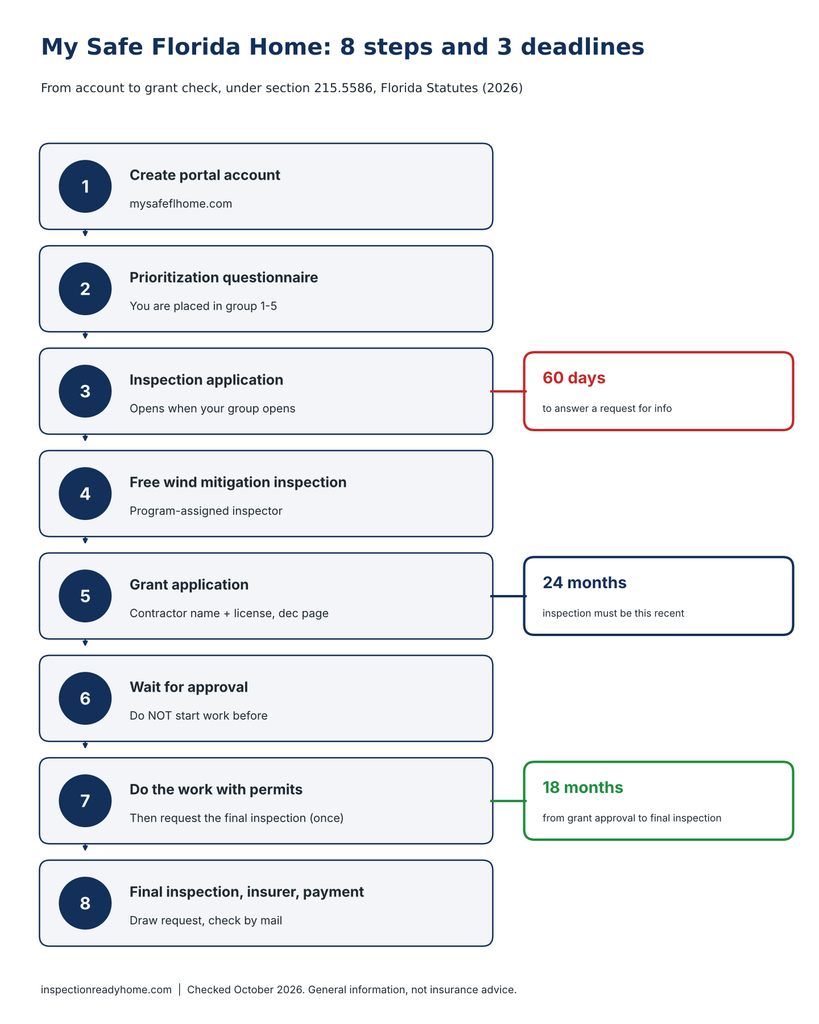
Most homeowners who lose a grant do not fail the eligibility test. They miss a clock. This is the whole process in order, with every deadline the law and the program set.
- Create your portal account. The sign-up runs through the program’s applicant portal at mysafeflhome.com. No deadline, but your place in line starts here. The program suggests using a computer and Chrome.
- Answer the prioritization questionnaire. Your status changes to questionnaire submitted, then to an inspection group from 1 to 5.
- Complete the inspection application when your group opens. Clock: if the department asks for more information, you have 60 days to answer or the application is deemed abandoned. Since 2026, it must warn you at least 5 business days before, and you can show good cause.
- Get the free inspection. A licensed inspector contracted by the program is assigned to you; you cannot use your own. The report lists recommended improvements, a range of cost estimates and estimated premium discounts.
- Apply for the grant. Clock: the inspection must be from the last 24 months. You sign a statement under penalty of perjury, name your contractor and give their state license number, and upload your current declarations page.
- Wait for approval before any work starts. The program’s FAQ is blunt: starting construction before the official approval notice disqualifies you from reimbursement.
- Do the work with permits. Clock: finish and request the final inspection within 18 months of grant approval, or the grant reverts to the state. You get one request for the final inspection.
- Final inspection, insurer, then payment. Send the final report to your insurer, then file the draw request with the invoice, proof of payment (not needed for low-income grants), proof of the premium discount and payment details. The check comes by mail.
Our diagram puts the same 8 steps on one page, with the three clocks marked.
How much My Safe Florida Home pays: the $2-for-$1 match
For most applicants the grant is a match. The state puts in $2 for every $1 you put in, up to $10,000 from the state. In plain terms, the state pays two-thirds of the project cost or $10,000, whichever is smaller. Low-income homeowners can get up to $10,000 with no match at all.
Worked example: four homeowners, four projects
These four Florida homeowners all passed the 9-point test. Only their income and project change. The numbers are invented to show how the published formula works; your real grant depends on your approved project.
| Homeowner | Project | Approved cost | State pays | You pay |
|---|---|---|---|---|
| A. Moderate income | Impact windows | $9,000 | $6,000 | $3,000 |
| B. Moderate income | Windows and a garage door | $15,000 | $10,000 (cap) | $5,000 |
| C. Moderate income | All openings and roof-to-wall clips | $24,000 | $10,000 (cap) | $14,000 |
| D. Low income | Roof-to-wall connections and secondary water resistance | $12,000 | Up to $10,000 | $2,000 |
Homeowner B is the sweet spot for a matching grant: at $15,000 the state’s two-thirds share reaches exactly $10,000. Above that, every extra dollar is yours, as C shows. Homeowner D pays only the part above $10,000, because low-income grants need no match. Paying in full first is also not required for low-income draws.
One more rule can change the size of a project: the department may require that all openings, meaning every exterior door, garage door, window and skylight, be protected as a condition of paying the grant. Ask before you sign a contract for only part of the house.
What the grant can pay for, and what it cannot
Only upgrades that the initial inspection recommends, and that the final inspection then sees, are paid. The 2026 statute groups them in two families. If the categories sound familiar, they are the same features a wind mitigation inspection records for your insurer.
- Opening protection: exterior doors, garage doors, windows and skylights rated for impact.
- Roof-to-wall connections: adding clips or straps that tie the roof to the walls.
- Roof-deck attachment: improving how the roof sheathing is nailed down.
- Secondary water resistance and roof covering: a sealed roof deck, and since 2026 the statute also lists replacing the roof covering.
Each of these maps to a question on Florida’s wind mitigation form: roof deck is question 5, roof-to-wall is question 6, secondary water resistance is question 8 and opening protection is question 9. Our guide to the wind mitigation form explains what each answer means for your credits.
What it will not pay for: work you started before approval, upgrades the initial report did not recommend, general repairs, and anything outside those four families. A new roof funded by the program is a mitigation project, not an insurance claim; if storm damage is the reason you need one, read when homeowners insurance pays for a roof replacement first.
From the grant to a lower insurance premium
The grant is half of the reward. The other half is the wind mitigation credit on your homeowners policy, which can last as long as the upgrade does.
Florida law requires insurers to offer discounts or credits for these hurricane mitigation features, and since October 1, 2023 to post them on their websites under section 627.0629 of the Florida Statutes. The size of the credit depends on your insurer, your home and your other features, so we do not quote figures.
My Safe Florida Home builds the insurer into the process. After the final inspection, you send the report to your insurer to request the discounts, and your draw request must include proof of the premium discount. You also agree, when you apply, to share with the department what your insurer tells you about the discount.
Even if you never get a grant, the free inspection report can help. The program suggests sharing it with your insurance carrier to make sure you already receive all available discounts. If your insurer also asks about the roof’s age and condition, our guide to the roof inspection for insurance explains that separate report.
What changed in 2026
Senate Bill 1452, signed on June 26, 2026, rewrote parts of section 215.5586. Compare the old and new rules before you rely on an older guide or a contractor’s flyer.
| Topic | 2025 statute | 2026 statute |
|---|---|---|
| Townhouses and attached homes | Inspections allowed; grants for opening protection only | Attached homes up to 3 stories qualify; grants can cover the roof as well |
| Roof covering | Not listed as a grant item | Replacing the roof covering listed with secondary water resistance |
| Second inspection | Only after errors or a change in eligibility | Also after 24 months if no grant payment was made |
| Time to finish | 1 year, with a possible 6-month extension | 18 months from grant approval |
| Abandoned applications | Deemed withdrawn after 60 days without an answer | 5-business-day warning and a chance to show good cause |
| Grant must follow the final inspection | Not stated | Improvements must be identified by the final inspection |
One point to confirm in your portal: the 2026 statute sets the $700,000 insured-value cap for every grant applicant, with no low-income exception written in. The program’s grant eligibility page, last changed in 2025, still mentions an exception for low-income homeowners. If your home is insured above $700,000, ask the program which rule it applies today.
A separate state benefit also came back in 2026. The home hardening sales tax refund was extended for impact-rated doors, garage doors and windows bought from July 1, 2026, to June 30, 2029, on homesteaded, site-built homes worth up to $700,000. It is one refund of up to $500, filed with the Department of Revenue, not with My Safe Florida Home.
6 mistakes that cost homeowners their grant
- Starting work before approval. Even a deposit-and-start contract can disqualify the whole project.
- Picking a contractor the program cannot verify. The license must be a general, building, residential, specialty or roofing contractor license registered with the state. The program no longer keeps a list of authorized contractors, so the choice and the checking are yours.
- Adding upgrades the report did not recommend. They will not be paid, and they can make your invoice harder to match to the final report.
- Missing an email. A request for information starts a 60-day clock. The program tells applicants to check their spam folder.
- Letting the 18 months run out. Permits and closing inspections take time. Book the final inspection request early; you only get one.
- Skipping the insurer. The draw request needs proof of the premium discount, so send the final report to your insurer as soon as you have it.
Ask the program and your insurer
- Program: which inspection group am I in, and is my group open now?
- Program: does the $700,000 insured-value cap apply to me if I qualify as low-income?
- Program: will you require protection on all openings, or only those in my report?
- Insurer: which wind mitigation credits do I get today, and which would the recommended upgrades add?
- Insurer: what proof do you need to apply the discount, and how fast will it show on my policy?
Frequently asked questions
Is My Safe Florida Home still available in 2026?
Yes, but with a pause. The support center still says the program is accepting applications, yet the applicant portal has been offline since November 10, 2026 for a system upgrade, and the program expects the new portal to launch on December 4, 2026. Funding depends on yearly appropriations and accepted applications cannot exceed the money available, so check the portal before you plan a project.
Does My Safe Florida Home pay for a new roof?
It can, if the initial inspection recommends it. Since 2026, the statute lists replacing the roof covering together with secondary water resistance, alongside roof-deck and roof-to-wall upgrades. The state’s share is still capped at $10,000.
Can I choose my own inspector or contractor?
Not the inspector: the program assigns a licensed inspector it has contracted. You do choose the contractor, as long as they hold one of the accepted Florida licenses. Get several bids, as the program suggests, and check the license before you enter it in the portal.
Do condos qualify for My Safe Florida Home?
No. Condominiums, co-ops, apartments, duplexes, triplexes, mobile homes, rentals and second homes are excluded. Condo associations can look at the separate My Safe Florida Condominium Pilot Program, which applies to the building, not to single units.
Is My Safe Florida Home legit?
Yes. It is a state program created by section 215.5586 of the Florida Statutes and run by the Florida Department of Financial Services. The official site is mysafeflhome.com. Other websites with similar names are not the program, so apply only through the official portal, and remember the program’s inspection is free.
Is the grant taxable?
The statute says the Legislature intends these grants to be treated as disaster-relief assistance under section 139 of the Internal Revenue Code. That is a statement of intent, not tax advice, so confirm how to report it with a tax professional.
When to call a pro
- Your initial report recommends opening protection or roof work and you need bids from licensed contractors.
- You are not sure whether your household counts as low- or moderate-income for your county.
- Your home is insured above $700,000, or it was built in 2008 or later, and a contractor still says you qualify.
- Your application shows an abandoned or denied status and you want to respond in time.
A licensed Florida contractor can price the work. The program’s support center answers status questions. A licensed insurance agent can tell you which credits your policy gives for each upgrade.
Sources
- My Safe Florida Home, official program home page (portal transition notice, checked November 25, 2026)
- My Safe Florida Home Support Center, MSFH Program Modernization FAQs (updated November 6, 2026)
- My Safe Florida Home, Frequently Asked Questions (updated May 15, 2026)
- My Safe Florida Home, inspection and grant eligibility page (updated May 27, 2025)
- Florida Statutes 2026, section 215.5586, My Safe Florida Home Program (Florida Senate)
- Florida Statutes 2025, section 215.5586 (Florida Senate, prior edition)
- Florida Department of Financial Services, Insurance Consumer Advocate, Property Insurance Changes (SB 1452 and HB 7031E, 2026)
- Florida Statutes 2026, section 627.0629, residential property insurance rate filings and mitigation discounts
This guide to My Safe Florida Home is general information, not insurance, legal or tax advice, and this site is not affiliated with the program or the State of Florida. Daniel Aznar, who writes this site, is not a home inspector, a contractor or an insurance agent. Program rules and funding change: confirm what applies to your home in the official portal, with your insurer or a licensed agent. Read our full disclaimer, and if you spot an error, our corrections page explains how we fix it. Information checked in October 2026; program status updated November 25, 2026.