SC Homeowners Insurance: Costs, the Wind Pool and the 90-Day Hurricane-Season Notice Rule
Quick answer
SC homeowners insurance costs about $1,753 a year for a standard HO-3 policy (NAIC, 2023 data), 19th highest in the country and only $16 above the national average. State law does not require a policy, but lenders do. On the coast, wind may be left out and bought from the state Wind Pool. An insurer that will not renew must warn you at least 60 days ahead, or 90 days if the policy ends between June 1 and October 31.
SC homeowners insurance rules are written around the hurricane calendar. The same insurer that needs to warn you 60 days before dropping a policy in March needs 90 days if the policy ends in August. The state’s wind pool covers only the coast. And the state helps pay to strengthen coastal roofs, with grants, two income tax credits and a tax-free savings account for your deductible.
This guide explains what an SC homeowners insurance policy covers, what it costs by official data, when wind is left out, how hurricane deductibles must be disclosed, the exact notice rules for cancellations and nonrenewals, and the three state programs that help pay for mitigation. Each rule links to the law or agency page we read, as described in how we verify our guides.
Table of Contents
SC homeowners insurance in six numbers
Before the details, these are the figures that shape most decisions about SC homeowners insurance. Every one comes from a South Carolina law, a state agency or the NAIC, and each is explained further down:
- $1,753: the average yearly premium for a standard HO-3 policy in 2023, 19th of the 50 states plus Washington, D.C.
- 60 or 90 days: the minimum written notice before a nonrenewal, depending on the month the policy ends.
- 120 days: how long a new policy can be canceled for almost any reason, with 30 days’ notice.
- $1.3 million: the most the Wind Pool will insure for a personal property owner.
- $7,500: the largest SC Safe Home grant, for a roof built to both SC Safe Home and IBHS FORTIFIED Roof standards.
- $2,500: the most you can claim in one year from the two state income tax credits for hurricane retrofits.
What an SC homeowners insurance policy covers
An SC homeowners insurance policy is built from the same six parts used across the country. The most common form is the HO-3, which covers the house against every cause of loss not excluded and your belongings against a list of named perils. Each part has its own limit, printed on your declarations page:
| Part of the policy | What it pays for | What to check |
|---|---|---|
| Dwelling (Coverage A) | The house and attached structures | The limit should match the cost to rebuild, not the sale price |
| Other structures (B) | Fences, sheds, detached garages | Usually a share of Coverage A |
| Personal property (C) | Furniture, clothes, electronics | Lower sub-limits for jewelry, firearms and cash |
| Loss of use (D) | Hotel, meals and rent while you cannot live at home | Whether it is a dollar cap or a time limit |
| Personal liability (E) | Injuries or damage you cause to others | Compare the limit with your savings and assets |
| Medical payments (F) | Small medical bills for guests, regardless of fault | A small limit, separate from liability |
Three gaps cause most surprises. Flood and storm surge are never part of the policy; they need a separate flood policy from the NFIP or a private company, which usually starts 30 days after you buy it (our flood insurance guide explains the limits). Earthquake is excluded too and needs its own endorsement or policy. And on the coast, wind and hail can be excluded or carry their own percentage deductible, which the next sections cover.
What homeowners insurance in South Carolina costs
The most recent regulator-compiled figure comes from the NAIC’s homeowners report with 2023 data, published in July 2026. It puts the average South Carolina HO-3 premium at $1,753 a year, about $146 a month. That is $16 above the national HO-3 average of $1,737 and 19th highest of 51. Across all policy forms, the state average is $1,728.
South Carolina sits below its neighbors on this measure. The NAIC averages are $1,828 in Georgia, $1,852 in North Carolina and $1,906 in Alabama. Our average cost of homeowners insurance ranking lists every state.
Why do quote websites show $2,000 to $3,000 or more? Most of them price one sample house with a fixed dwelling limit in 2025 or 2026. The NAIC figure is what policyholders actually paid across every coverage amount, from small inland homes to large beach houses. Both are useful; they answer different questions. For SC homeowners insurance prices on a house like yours, get quotes from several companies; the South Carolina Department of Insurance (SCDOI) runs a free Insurance Locator that connects homeowners with local agents and companies writing property coverage.
Why is homeowners insurance so high in SC?
For a typical home it is not much higher than the national average. The bill climbs fast on the coast, and five things move it most:
- Distance from the ocean: wind risk is highest in the coastal counties from Horry to Beaufort.
- Roof age, shape and fastening: the roof drives most wind and hail losses, which is why mitigation earns discounts.
- Rebuild cost: a higher dwelling limit raises the premium and, with a percentage deductible, the deductible too.
- Reinsurance: the Wind Pool told lawmakers in 2025 that its rates are driven by what it pays for reinsurance, bought on world markets.
- Claims history: past claims at the address or by you can raise the price, with one exception explained below.
Coastal wind: when SC homeowners insurance leaves it out
Inland, wind and hail are normally inside SC homeowners insurance. State law limits the exceptions: under Section 38-75-1230, an insurer may not exclude wind and hail from a homeowners policy unless the property is in the area served by the South Carolina Wind and Hail Underwriting Association (SCWHUA, usually called the Wind Pool) or the director of insurance approves the exclusion. On the coast, that exclusion is common.
The Wind Pool was created by the legislature in 1971 and sells wind and hail coverage only. Its territory runs along the seacoast, and the SCDOI extended it in 2007 to the Intracoastal Waterway and other areas of Charleston, Georgetown and Horry counties. The SCDOI’s Wind Pool FAQ points to the association’s maps to check an address. What the association told a legislative committee in July 2025 (SC Wind presentation):
- Limits: up to $1.3 million for personal property owners and $2.5 million for commercial.
- Settlement: 75% of dwellings are insured at actual cash value, which subtracts depreciation from a claim.
- Deductibles: 38% of policies carry a 5% or 10% deductible.
- Flood: 48% of its policyholders also carry flood insurance.
- Size: 15,825 policies in mid-2025, down 67% since 2011; about 92% of the coastal market is now with private insurers.
You cannot apply to the Wind Pool yourself; a South Carolina licensed agent submits the application. Use this order of questions before you sign anything:
- Does the SC homeowners insurance quote include wind and hail? Read the declarations page, not the summary email.
- If not, does a private company sell a separate wind policy for the address? The Wind Pool is meant as the market of last resort, so agents normally try private companies first.
- If no private company will, is the house in the Wind Pool territory? Your agent can check the association’s map.
- Do the two policies line up? Match the dates, the dwelling limits and the deductibles, and keep both declarations pages together.
- Is the house insured at replacement cost or actual cash value for wind? On an older roof, the gap can be thousands of dollars.
Two policies mean two renewal dates, two bills and two sets of paperwork. Our FAIR plan insurance guide compares last-resort pools in other states, and our wind mitigation inspection guide explains what an inspector records when you ask for credits.
Hurricane deductibles: the $100,000 example rule
Many coastal SC homeowners insurance policies carry a separate hurricane, named storm or wind/hail deductible, usually a percentage of the dwelling limit. South Carolina regulates how it is disclosed. Under Regulation 69-56, an insurer offering or renewing a policy with one of these deductibles must:
- include an example showing how the deductible works on a $100,000 policy, with a clear explanation of the event that triggers it;
- print a warning, in capital letters, on the face of the policy and on the declarations page that the deductible may mean high out-of-pocket costs;
- get your signature or initials on a disclosure if it adds this kind of deductible at renewal or raises an existing one.
The regulation also defines what triggers a named storm deductible: a hurricane, tropical storm or tropical depression named or identified by the National Weather Service or the National Hurricane Center. A storm named only by the news media does not count. A wind/hail deductible, by contrast, can apply to any windstorm or hailstorm, including an ordinary summer thunderstorm.
The math is simple, and worth doing before the storm. A 2% deductible on a $300,000 dwelling limit is $6,000; at 5%, it is $15,000. Find the example page the regulation requires in your policy packet, then multiply your own limit by your percentage. If an SC homeowners insurance renewal asks you to initial a new deductible, read that page before you sign.
Cancellation and nonrenewal: the 60-day and 90-day rule
South Carolina splits the rules in two: cancellation ends a policy before its expiration date, and nonrenewal means the insurer will not offer another term. Different sections of the Code govern each one, and both apply to SC homeowners insurance:
- New policies, first 120 days: the insurer can cancel for any reason with at least 30 days’ notice (Section 38-75-730).
- After 120 days: cancellation is limited to reasons such as nonpayment of premium, fraud or material misrepresentation, a breach of the policy’s terms, or a physical change that makes the home uninsurable. The SCDOI says a cancellation for misrepresentation needs 30 days’ notice with the reason stated.
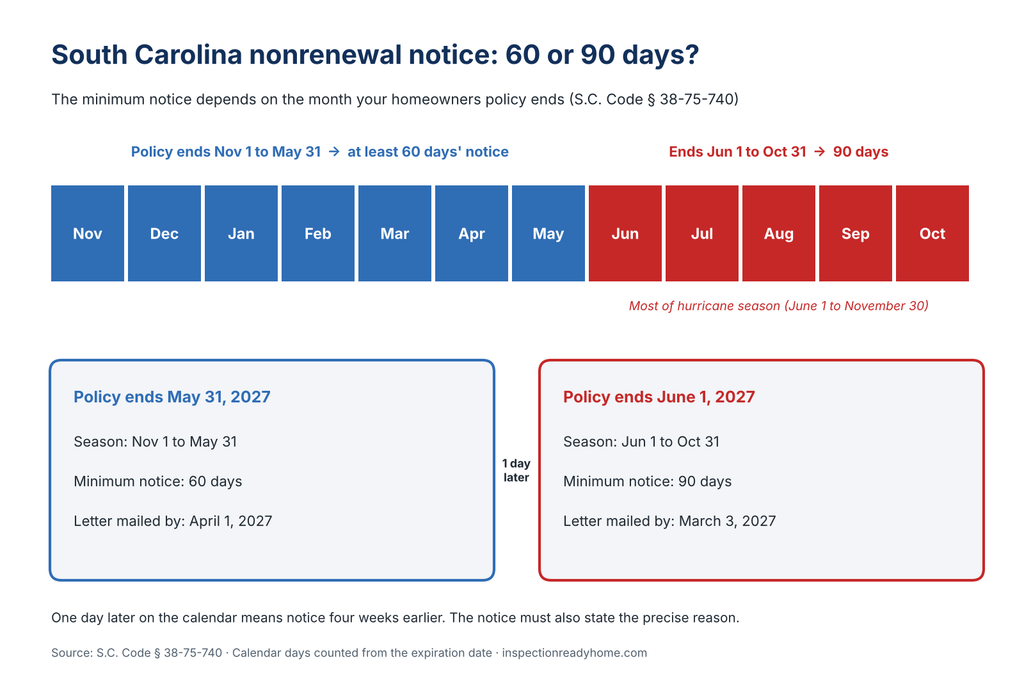
- Nonrenewal (Section 38-75-740): written notice to you and your agent at least 60 days before the policy ends if that date falls between November 1 and May 31, and at least 90 days if it falls between June 1 and October 31. The notice must state the precise reason, and proof of mailing counts as proof of notice.
- Acts of God (Section 38-75-790): an insurer may not refuse to renew a homeowners policy because you filed a claim for damage from an act of God. The SCDOI adds that these claims cannot be counted when an insurer judges how often you claim.
Many summaries, including the SCDOI’s own homeowners FAQ, simply say 60 days. That is correct for most of the year. The longer 90-day rule, added by the 2007 coastal reform law, covers policies that end during most of hurricane season, when finding new wind coverage is hardest.
Worked example: when should the nonrenewal letter arrive?
The notice period depends on the date the policy ends, not the date the letter is written. We counted back from six example expiration dates; the latest notice date is the day the insurer must mail the letter by:
| Policy ends | Season under Section 38-75-740 | Minimum notice | Latest notice date |
|---|---|---|---|
| March 15, 2027 | November 1 to May 31 | 60 days | January 14, 2027 |
| May 31, 2027 | November 1 to May 31 | 60 days | April 1, 2027 |
| June 1, 2027 | June 1 to October 31 | 90 days | March 3, 2027 |
| August 20, 2027 | June 1 to October 31 | 90 days | May 22, 2027 |
| October 31, 2027 | June 1 to October 31 | 90 days | August 2, 2027 |
| November 1, 2027 | November 1 to May 31 | 60 days | September 2, 2027 |
Look at the second and third rows. A policy ending June 1 needs notice four weeks earlier than one ending May 31, a single day before. If a letter for a summer SC homeowners insurance renewal arrives with less than 90 days to go, compare it with this rule and ask your agent or the SCDOI whether the nonrenewal is valid. Section 38-75-740 says a nonrenewal that does not follow it is ineffective.
If the letter does arrive, use the time it buys you:
- Write the expiration date and the notice date in a calendar the day the letter arrives.
- Read the reason. If it is a claim, check whether the claim was weather damage, which Section 38-75-790 protects.
- If the reason is the roof or another condition, get a roofer’s report or run our 4-point self-check and send the evidence to the insurer.
- Start shopping right away; coastal wind coverage can take weeks to place, and the SCDOI’s Insurance Locator can point you to agents and companies that write it.
- Keep the new policy’s dates and inspection reports in our renewal paperwork tracker so the next renewal does not catch you out.
Three state programs that help pay for a stronger home
The 2007 Omnibus Coastal Property Insurance Reform Act created a set of tools that most SC homeowners insurance buyers never hear about. They work differently and some can be combined, with limits explained below:
| Program | What you get | Who can use it | When |
|---|---|---|---|
| SC Safe Home grant | Up to $7,500 toward roof or opening-protection retrofits | Owner-occupants of single-family homes in 11 coastal counties | Application rounds, usually twice a year; approval needed before work starts |
| Tax credits for fortification measures (Schedule TC-43) | 25% of retrofit costs up to $1,000, plus a sales-tax credit up to $1,500 | Any South Carolina taxpayer, for their legal residence | On your state income tax return for the year of the work |
| Catastrophe Savings Account | State tax deduction for deposits, tax-free interest | South Carolina residents who own the home they live in | Any time; withdraw after a declared disaster |
SC Safe Home grants
SC Safe Home, run by the SCDOI, pays part of the cost of retrofits that make a coastal home resist hurricane winds. A finished project can make you eligible for discounts on your SC homeowners insurance, though discounts vary by company. The program’s grant page lists three award types; each has a higher non-matching amount and a lower matching amount, and household income compared with the county or state median decides which you get:
- Resilient Mitigation Award: up to $7,500 (non-matching) or $6,000 (matching), for a roof that meets both SC Safe Home and IBHS FORTIFIED Roof standards.
- Sustainable Mitigation Award: up to $5,000 or $4,000, for a roof that meets SC Safe Home standards only, or for protecting windows and doors.
- Hurricane shutters and protective barrier systems: up to $3,000.
Eligible counties, per a June 2026 state report on the program, are Beaufort, Berkeley, Charleston, Colleton, Dorchester, Florence, Georgetown, Horry, Jasper, Marion and Williamsburg. The home must be a single-family, freestanding house you own and live in as your main residence, with an active homeowners policy and no previous Safe Home grant. Duplexes and multifamily homes do not qualify, and neither do homes with prior storm damage or storm claim payments. The award calculator gives an estimate.
Two rules trip people up. The grant cannot pay for work already done: the program FAQ says you need an inspection and approval first. And it only funds wind retrofits such as roof deck attachment, a secondary water barrier, a high-wind roof covering, braced gable ends, roof-to-wall connections and rated windows and doors, never general repairs or remodeling. Applications open twice a year through an online portal; in 2026 a round opened on February 10, and the page said it was not taking applications when we checked in November 2026.
Income tax credits for fortification measures
South Carolina’s Schedule TC-43 combines two credits for retrofitting your legal residence against hurricane, flood or windstorm damage. The first is 25% of the qualifying costs, capped at $1,000. The second is a credit for the sales or use tax paid on qualifying materials, 6% of their price, capped at $1,500 and at the tax you actually paid. Ordinary repairs or replacements do not count, products need an evaluation report, and you keep receipts and a contractor’s certification or your affidavit. Work paid with a Safe Home grant is excluded unless the grant is counted as income. The credits lower your state tax, not your SC homeowners insurance premium; for that, send the finished work to your insurer and ask about mitigation credits.
Catastrophe Savings Accounts
A Catastrophe Savings Account is a labeled, interest-bearing savings or money market account at a bank, set up to pay hurricane deductibles and other uninsured storm losses. Deposits reduce your South Carolina taxable income, the interest is exempt from state income tax, and withdrawals are tax-free when used for qualified expenses after the governor declares an emergency. The SCDOI FAQ limits it to residents who own the single-family home they live in, including condos and mobile homes. Other withdrawals are taxed, plus a 2.5% additional tax, and contribution limits depend on your deductible, so check them with the SCDOI or a tax professional before you deposit.
Best homeowners insurance South Carolina: how to compare quotes
We do not rank insurers, and most lists of the best or cheapest homeowners insurance South Carolina has to offer price a sample house, not yours. Two quotes with the same premium can hide a five-figure difference in the hurricane deductible, or one can pay your roof at actual cash value. Ask every company or agent the same questions:
Ask your insurer or agent
- Is wind and hail included? If not, who sells it for this address, and do the policies’ dates match?
- What is the hurricane, named storm or wind/hail deductible, in dollars, and where is the required $100,000 example?
- Is the dwelling limit based on a current rebuild estimate? Is the roof paid at replacement cost or actual cash value?
- What mitigation credits apply, and what would change with an SC Safe Home or FORTIFIED Roof certificate?
- Is the company admitted in South Carolina, or a surplus lines insurer outside the state guaranty fund?
The roof question matters more each year in SC homeowners insurance quotes, because some policies now pay older roofs at depreciated value. Our guide to whether homeowners insurance covers roof replacement explains how that works, and our roof age checker shows when insurers start to ask about yours. A cheaper SC homeowners insurance quote that drops wind is not the same product.
Claims and complaints
After a storm, report the claim quickly, make temporary repairs to stop more damage, photograph everything and keep damaged materials until the adjuster sees them. The SCDOI says most people with a claim hear from an adjuster within 48 hours of reporting it. If a dispute about your SC homeowners insurance goes nowhere, the SCDOI’s Office of Consumer Services takes complaints about insurers, agents and adjusters; its homeowners page lists the complaint form, consumers@doi.sc.gov and 1-800-768-3467. Send copies of your policy, claim number and letters, never the originals.
Frequently asked questions
How much is homeowners insurance in South Carolina?
The NAIC’s latest regulator-compiled average is $1,753 a year for a standard HO-3 policy (2023 data), about $146 a month. Coastal homes, and homes that buy wind as a separate policy, usually pay more for SC homeowners insurance.
Is homeowners insurance required in South Carolina?
SC homeowners insurance is not required by state law, but a mortgage lender will require it. If your policy lapses, the lender can buy force-placed coverage and bill you, and that coverage mainly protects the lender.
Can my insurer drop me after a hurricane claim?
Not for that reason alone. Section 38-75-790 bars a nonrenewal because you filed a claim for damage from an act of God. The insurer can still decline to renew for other reasons stated in the notice, such as the condition of the roof, with 60 or 90 days’ notice.
Does SC Safe Home pay for work I already finished?
No. State law requires an inspection and grant approval before the work starts. If you have already finished, check whether the work qualifies for the TC-43 income tax credits instead.
Does SC homeowners insurance cover flooding from a hurricane?
No. Wind damage from a hurricane can be covered, but flood and storm surge need a separate flood policy, which usually starts 30 days after you buy it.
When to call a pro
- Licensed South Carolina agent: you need quotes, a separate wind policy or a Wind Pool application.
- SC Safe Home participating contractor or inspector: you plan to apply for a grant.
- Roofer or certified FORTIFIED evaluator: your roof is due for replacement and you want the mitigation credit.
- SCDOI Office of Consumer Services: you think a nonrenewal notice came late or a claim was underpaid.
- Tax professional: you want to claim TC-43 credits or open a Catastrophe Savings Account.
This site does not sell SC homeowners insurance or recommend insurers. Confirm coverage details with your agent or the SCDOI.
Sources
- NAIC, Homeowners insurance report: Data for 2023 (July 2026)
- South Carolina Department of Insurance, Coastal Insurance and homeowners information
- SCDOI, Homeowners insurance FAQ: cancellation and nonrenewal
- South Carolina Code, Section 38-75-730: restrictions on cancellation
- South Carolina Code, Section 38-75-740: restrictions on nonrenewal
- South Carolina Code, Section 38-75-790: nonrenewal of homeowners insurance
- South Carolina Code, Section 38-75-1230: wind and hail exclusions
- S.C. Code of Regulations 69-56: hurricane, named storm or wind/hail deductible
- SCDOI, South Carolina Wind Pool FAQ
- SC Wind and Hail Underwriting Association, presentation to the Insurance Rate Review Ad Hoc Committee (July 23, 2025)
- SCDOI, SC Safe Home Mitigation Grant Program
- SCDOI, SC Safe Home FAQ
- SC Office of Resilience and SCDOI, Proviso 117.200 report on the SC Safe Home Program (June 2026)
- SC Department of Revenue, Schedule TC-43 Residential Retrofit Credit
- SCDOI, Catastrophe Savings Accounts
- SCDOI, Catastrophe Savings Accounts FAQ
This guide to SC homeowners insurance is general information, not insurance, legal or tax advice. Daniel Aznar, who writes this site, is not an insurance agent or inspector and does not recommend any insurer. Grant rounds, limits and rules change: confirm with the SCDOI, the SC Department of Revenue, the Wind Pool, your agent or your insurer. Read our full disclaimer, and if you spot an error, our corrections page explains how we fix it. Information checked in November 2026.