Colorado Homeowners Insurance: Costs, Hail Deductibles, the 60-Day Notice Rule and the New Roof Grants
Quick answer
Colorado homeowners insurance averages $2,492 a year for a standard HO-3 policy (NAIC, 2023 data), the 4th highest in the country and $755 above the national average. Hail is the main reason: the state Division of Insurance found it makes up 26% to 54% of premiums, depending on the county. Most policies carry a separate wind and hail deductible, insurers must give 60 days’ written notice with reasons before they cancel or nonrenew, and state roof grants are expected from 2027.
Colorado homeowners insurance is priced around a storm most buyers never think about: hail. Wildfire gets the headlines, but the state’s own data shows hail drives far more of the premium in Denver, Colorado Springs and the Eastern Plains. It is also the reason many policies now carry a deductible set as a percentage of your home’s insured value.
This guide shows what Colorado homeowners insurance costs by official data, how much of the bill is hail in five counties, what a 1%, 2% or 5% wind and hail deductible means in dollars, which state laws protect you at renewal and after a claim, and what the new Strengthen Colorado Homes grants will do. Each rule links to the statute or agency page we read, as described in how we verify our guides.
Table of Contents

Colorado homeowners insurance at a glance
The short version, with the source behind each line. The sections below explain each one.
| Question | Answer | Source |
|---|---|---|
| Average premium | $2,492 a year for an HO-3 policy; $2,601 across all policy forms (2023 data) | NAIC, July 2026 |
| National rank | 4th highest of the 50 states plus Washington, D.C. | NAIC |
| Biggest cost driver | Hail: 26% to 54% of premiums, by county | Colorado Division of Insurance, Feb. 2026 |
| Wind and hail deductible | Often a percentage of your coverage, such as 1%, 2% or 5% | Colorado Division of Insurance |
| Notice before a cancellation or nonrenewal | 60 days by first-class mail, with specific reasons; 10 days for nonpayment | C.R.S. 10-4-110.7 |
| Roofers and your deductible | A roofer may not pay, waive or rebate it | C.R.S. 6-22-105 |
| Last resort | Colorado FAIR Plan, after three declinations | Colorado Division of Real Estate advisory |
| Roof grants | Strengthen Colorado Homes, created by SB26-155 | Colorado General Assembly |
What Colorado homeowners insurance costs
The latest regulator-compiled figure is in the NAIC’s homeowners report with 2023 data, published in July 2026. It puts the average Colorado HO-3 premium at $2,492 a year, about $208 a month. Only Louisiana ($3,027), Texas ($2,864) and Florida ($2,779) are higher. The national HO-3 average is $1,737, so the typical Colorado bill is $755 above it. Across all policy forms, the Colorado average is $2,601.
On this measure, Colorado homeowners insurance also costs more than in any neighboring state, though Oklahoma homeowners insurance ($2,486) is only $6 behind. The NAIC averages are $2,142 in Nebraska, $1,853 in Wyoming, $1,733 in Kansas, $1,490 in New Mexico and $1,107 in Utah. Our average cost of homeowners insurance ranking lists every state.
Quote websites often show a higher Colorado number, sometimes $3,800 to $4,600. They usually price one sample house at a fixed dwelling limit in 2025 or 2026, while the NAIC figure is what policyholders actually paid across every home size. Only quotes on your own house tell you what you will pay. The Colorado Division of Insurance (DOI) homeowners page links to its premium cost comparison and to the coverage summaries insurers must give you.
How much of your premium is hail?
In February 2026 the DOI asked 20 insurers, writing about 80% of the market, for premium data in 11 counties. The results released with the Governor show hail accounts for 26% to 54% of the average premium, depending on the county, and about half along the Front Range and the Eastern Plains. Wildfire ranges from 0.9% to 24.6%. Insurers spread the cost of hail across the whole state, but price wildfire mainly in high-risk areas.
| County | Average premium | Hail portion | Hail share | Wildfire portion | Wildfire share |
|---|---|---|---|---|---|
| Denver | $3,040 | $1,547 | 50.9% | $30 | 1.0% |
| Summit | $3,463 | $1,233 | 35.6% | $274 | 7.9% |
| Alamosa | $1,590 | $639 | 40.2% | $78 | 4.9% |
| La Plata | $2,170 | $562 | 25.9% | $533 | 24.6% |
| Mesa | $1,369 | $353 | 25.8% | $138 | 10.1% |
Two things stand out for anyone buying Colorado homeowners insurance. Summit County gets far less hail than Denver, yet hail is still about a third of its premium, because the cost is shared statewide. And in La Plata County, wildfire and hail cost almost the same. The DOI estimates that hail mitigation, such as a FORTIFIED roof, could save an average of $82 to $387 a year across the 11 counties, against $3 to $25 for wildfire mitigation. That is why the state’s new grant program targets roofs.
Wind and hail deductibles in Colorado
After a hailstorm battered metro Denver, the DOI reminded homeowners that many Colorado homeowners insurance policies carry wind and hail deductibles that are a percentage of coverage, for example 1%, 2% or 5% (DOI consumer advisory). The percentage is usually taken from your dwelling limit, not from the size of the claim. It is listed on your declarations page, often next to a flat deductible that applies to every other kind of loss.
Worked example: one spring hailstorm, four deductibles
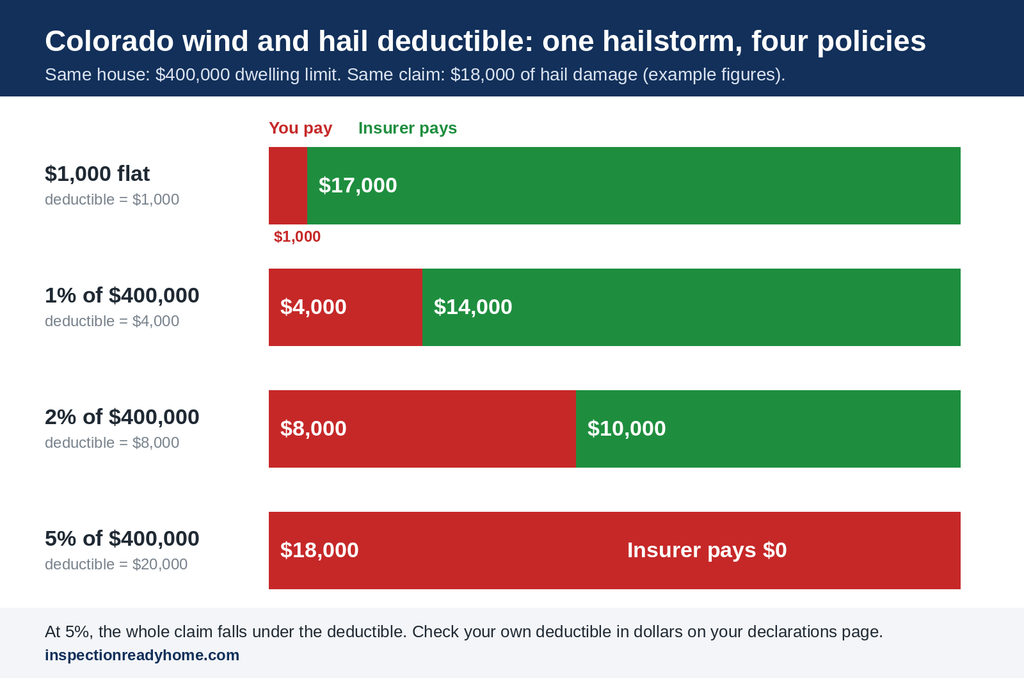
Take a house in Colorado Springs with a $400,000 dwelling limit. A May hailstorm damages the roof, gutters and window screens, and the adjuster’s estimate is $18,000 at replacement cost. Here is the split under four common deductibles (example figures):
| Deductible on the policy | In dollars | You pay | Insurer pays |
|---|---|---|---|
| $1,000 flat | $1,000 | $1,000 | $17,000 |
| 1% of the dwelling limit | $4,000 | $4,000 | $14,000 |
| 2% of the dwelling limit | $8,000 | $8,000 | $10,000 |
| 5% of the dwelling limit | $20,000 | $18,000 | $0 |
At 5%, the whole claim sits under the deductible: hail is covered, yet you pay for the new roof yourself. If the policy pays the roof at actual cash value or on a roof payment schedule, depreciation comes off too, so the check shrinks further. Our guide to whether homeowners insurance covers roof replacement explains how that works.
Before you renew Colorado homeowners insurance, multiply your dwelling limit by your wind and hail percentage and write the result in dollars. A lower percentage costs more premium each year, so compare the extra premium over several years with what you could actually pay after one storm.
Your Colorado homeowners insurance renewal: pass or fail
Hail claims are where Colorado homeowners insurance gets tested, and most surprises are visible on the renewal paperwork months before the storm. Read yours against this table:
| Item | Pass | Red flag |
|---|---|---|
| Wind and hail deductible | You know it in dollars, and you could pay it after a storm | Only a percentage, never converted to dollars |
| How the roof is paid | Replacement cost, or a roof schedule you have read and accepted | Actual cash value or a schedule you never noticed |
| Rebuild estimate | The insurer gave you a reconstruction cost estimate and explained it | Dwelling limit unchanged for years while building costs rose |
| Extended replacement cost and law and ordinance | The declarations page shows in bold whether you bought or rejected each | You cannot tell whether you have them |
| Wildfire risk score | It came with the renewal and reflects the mitigation you have done | Missing, or it ignores work you can document |
| A roofer’s offer after a storm | Written contract with a 72-hour cancellation clause | A promise to cover or waive your deductible |
Colorado homeowners insurance laws that protect you
Colorado has rewritten its homeowners rules several times since the 2012 and 2013 wildfires and again after the Marshall Fire. These are the ones you are most likely to use.
Cancellation and nonrenewal: 60 days and specific reasons
Under C.R.S. 10-4-110.7(3), an insurer may not cancel or refuse to renew a homeowners policy unless it mails a notice by first-class mail to your last known address at least 60 days in advance, stating the specific reasons. For nonpayment of premium, the notice is at least 10 days. The 60-day period came from HB23-1174; older guides, including a 2022 DOI advisory, still say 30 days.
The same section adds two rights at the start of a policy. If the insurer uses your credit score or the claims history of you or the property, it must tell you during the application, and if claims history leads to a refusal or other adverse action, it must disclose the specific claims behind it. A new policy can also be conditional for up to 30 business days while the insurer inspects the home.
What the law does not do: the DOI’s after-a-hail-storm FAQ says no Colorado law stops an insurer from nonrenewing after hail, and an insurer may weigh multiple losses. If a notice arrives, use the 60 days:
- Check the date on the letter against the policy’s end date. Fewer than 60 days, for a reason other than nonpayment, is worth raising with the DOI.
- Read the reasons. If they cite claims history, ask for the specific claims in writing.
- If the reason is the roof or another condition, get a roofer’s report (our roof inspection guide explains the options) or run our free 4-point self-check and send the evidence.
- Ask an agent for new Colorado homeowners insurance quotes at once. Do not wait for the last two weeks.
- If something looks wrong, contact DOI Consumer Services at 303-894-7490 or DORA_Insurance@state.co.us.
After a large or total loss
C.R.S. 10-4-110.8 sets the rules for Colorado homeowners insurance claims. The main ones for a homeowner:
- Living expenses: replacement cost policies must include additional living expense coverage for at least 12 months, with an option to buy 24 months in total.
- Contents without an inventory: after a total loss of a furnished primary home, the insurer must offer at least 30% of the contents limit without a written inventory, or 65% after a governor-declared wildfire.
- Time to finish: you get at least 365 days to submit an inventory, and at least 365 days after living expense coverage ends to replace property and collect the held-back depreciation. After a declared wildfire, it is at least 36 months from the first payment, with possible extensions.
- Your policy: the insurer must send a full copy, including the declarations page and endorsements, within three business days of your request.
- Lawsuits: a policy may not shorten the time to sue below the statute of limitations.
One gap after hail: the DOI says no law requires an insurer to match undamaged siding or replace all of it. It must repair or replace only what the covered storm damaged. For roof leaks after a storm, our guide to whether homeowners insurance covers roof leaks walks through the claim.
Storm roofers and your deductible: Colorado’s roofing law
Contractors flood Colorado neighborhoods after every big hailstorm. Title 6, article 22 of the Colorado statutes gives you specific protections when the roof is paid by your Colorado homeowners insurance:
- Written contract: it must include a clause letting you cancel and get a full refund of any deposit within 72 hours of signing (C.R.S. 6-22-103).
- Denied claim: if the work was to be paid by your insurer and the claim is denied, you can cancel within 72 hours of the insurer’s written notice, by writing to the roofer’s address in the contract (C.R.S. 6-22-104).
- No deductible deals: a roofer may not advertise or promise to pay, waive or rebate any part of your deductible. If one does, your insurer does not have to consider that roofer’s estimate, and you or the insurer can sue for damages (C.R.S. 6-22-105).
- No acting as your adjuster: a roofer may discuss the scope of repairs with your insurer for you under a valid contract, but may not act as a public adjuster. Public adjusters are licensed by the DOI and usually charge a percentage of the claim.
If the roof does need replacing, our roof replacement guide covers costs, permits and the papers to send your insurer afterward.
Strengthen Colorado Homes: roof grants from 2027
SB26-155, signed on June 4, 2026 and in effect since August 12, 2026, creates the Strengthen Colorado Homes Enterprise inside the DOI, run by a seven-member board. Its job is a grant program to help homeowners fit roofs that resist hail and wind, the largest cost inside Colorado homeowners insurance. What the act sets:
- Funding: an annual fee of 0.5% of the homeowners premiums each insurer collected the year before, starting in 2027. Insurers may not pass the fee on to policyholders.
- Grants: at least 85% of the fee revenue goes to grants, mainly for resilient roof systems. Some can fund training for roofing workers.
- Who comes first: primary residences. The board may also weigh income, roof age, home size, the number of applicants, local hail-resistant building codes and past exposure to severe weather.
- What counts as resilient: an IBHS FORTIFIED wind and hail certification or a similar verifiable standard, as the board sets by rule.
- Deductibles: contractors paid with grant money may not waive insurance deductibles.
- Discounts: the act does not set a discount amount. From 2027, after rules are adopted, insurers must report how many insured homes have resilient roofs, the discount they apply and their wind and hail claims with and without those roofs.
There is no application yet. The Colorado Sun reported that the board should be in place by the end of 2026, so the earliest grants would come in 2027. Similar programs pay only for work approved before it starts, as in Alabama and Louisiana, so if your roof can wait, wait for Colorado’s rules before you sign a contract.
Wildfire risk scores and mitigation credit
HB25-1182 gives you new rights when an insurer uses a wildfire model to price or decide your policy. They apply to admitted insurers and the Colorado FAIR Plan, not to surplus lines companies (DOI release, October 2026):
- Your score in writing: since October 1, 2026, insurers must give you your wildfire risk score, how it was calculated, the full range, the features that drove it and how mitigation would change it. New applicants get it within 15 days of a completed application; current customers get it with the renewal offer or the nonrenewal notice.
- Credit for mitigation: insurers must reflect property and community mitigation in their pricing, or discount premiums for verified work such as IBHS designations.
- Appeal: send evidence of your work. The insurer must acknowledge the appeal within 10 calendar days and decide in writing within 30. If the decision comes after the policy expires, coverage continues for at least 10 calendar days after you are told.

When no one will insure you: the Colorado FAIR Plan
The Colorado FAIR Plan has sold home policies since April 2025. To qualify you need three declinations from standard insurers, and you apply through a licensed agent. According to a state Division of Real Estate advisory, the residential limit is $750,000 for the dwelling and contents combined, paid at actual cash value. Analyses of the policy form also note it has no liability or living expense coverage, so many owners add a second policy for those. Our FAIR plan insurance guide compares Colorado’s plan with other states’.
How to compare homeowners insurance Colorado quotes
We do not rank insurers. Lists of the best or cheapest Colorado homeowners insurance companies price a sample house, and a low premium can hide a 2% hail deductible or a depreciated roof. Whether you live in Denver, Colorado Springs, Fort Collins or a mountain town, compare quotes for the same dwelling limit, read each insurer’s required coverage summary, and ask every company or agent the same questions:
Ask your insurer or agent
- What is my wind and hail deductible in dollars, and does it apply to the dwelling limit?
- Is the roof paid at replacement cost, actual cash value or on a roof schedule by age?
- What discount would an impact-resistant or FORTIFIED roof earn, and what proof do you need?
- How did you calculate my reconstruction cost, and what is my wildfire risk score?
- Is the company admitted in Colorado, or a surplus lines insurer outside the state’s protections?
The roof answer matters most in Colorado. Our roof age checker shows when insurers start asking about yours, and our free renewal paperwork tracker keeps every quote, report and renewal date for your Colorado homeowners insurance in one place.
Frequently asked questions
Is homeowners insurance required in Colorado?
No state law requires it, but a mortgage lender almost always does as a condition of the loan. If you own your home outright, the choice is yours, though one hailstorm or fire can cost far more than years of premiums.
Why is Colorado homeowners insurance so expensive?
Mainly hail. The DOI’s 2026 data shows it makes up 26% to 54% of premiums by county, and about half on the Front Range. Wildfire adds a large share in some mountain and southwestern counties, and rising rebuilding costs push every dwelling limit up.
Can my insurer drop me after a hail claim?
It can. The DOI says no Colorado law prevents a nonrenewal after hail, and multiple losses can count against you. The insurer still has to mail notice at least 60 days ahead with specific reasons.
Does homeowners insurance cover hail damage in Colorado?
Hail is normally a covered peril in Colorado homeowners insurance, but you pay the wind and hail deductible first, and an older roof may be paid at actual cash value. On a small claim with a percentage deductible, the insurer may pay nothing.
Does my insurer have to match my siding after hail?
No. The DOI says no Colorado law requires matching undamaged areas or replacing all the siding. The insurer must repair or replace what the covered storm damaged.
When to call a pro
- Licensed Colorado agent: you need quotes, a different deductible, or private insurers have declined you and you need the FAIR Plan.
- Roofer or home inspector: after a hailstorm, or before renewal if your roof is old. Our roof inspection guide explains which inspection fits.
- DOI Consumer Services (303-894-7490): a notice came with fewer than 60 days, the reasons are vague, or a claim is stuck.
- Licensed public adjuster or attorney: a large hail or wildfire claim is disputed and talks with the insurer have stalled.
This site does not sell Colorado homeowners insurance or recommend insurers. Confirm details with your agent, your insurer or the DOI.
Sources
- NAIC, Homeowners insurance report: Data for 2023 (July 2026)
- Colorado Division of Insurance, Homeowners’ and Renters Insurance
- Governor Polis and Division of Insurance, hail premium data (February 11, 2026)
- Colorado Division of Insurance, Hail is the Number One Cost Driver of Insurance in Colorado
- Colorado Division of Insurance, consumer advisory after the metro Denver hailstorm
- Colorado Division of Insurance, After a Hail Storm: Insurance FAQs
- C.R.S. 10-4-110.7: cancellation or nonrenewal of homeowner’s policies
- C.R.S. 10-4-110.8: homeowner’s insurance, prohibited and required practices
- HB23-1174, Homeowner’s Insurance Underinsurance
- C.R.S. 6-22-103: contracts for roofing services
- C.R.S. 6-22-104: rescission after a denied claim
- C.R.S. 6-22-105: waiver of insurance deductible prohibited
- SB26-155, Strengthen Colorado Homes Enterprise
- Colorado Division of Insurance, new rights under HB25-1182 (October 12, 2026)
- Colorado Division of Real Estate, HOA Center advisory on the FAIR Plan
- The Colorado Sun, reporting on the Strengthen Colorado Homes timeline
This guide to Colorado homeowners insurance is general information, not insurance or legal advice. Daniel Aznar, who writes this site, is not an insurance agent or inspector and does not recommend any insurer. Laws, grant rules and rates change: confirm with the Colorado Division of Insurance, your agent or your insurer. Read our full disclaimer, and if you spot an error, our corrections page explains how we fix it. Information checked in November 2026.