Average Cost of Homeowners Insurance: Every State Ranked by Official Data
Quick answer
The average cost of homeowners insurance in the U.S. was $1,737 a year (about $145 a month) for a standard HO-3 policy, according to the latest regulator-compiled data from the NAIC (data for 2023, published July 2026). State averages run from $923 in Wisconsin to $3,027 in Louisiana. Your dwelling coverage amount moves the price almost as much as your state does.
The average cost of homeowners insurance depends on who is counting. Insurers and quote sites publish their own averages built from sample homes, so their numbers rarely match. This guide uses the one national source compiled by state regulators: the National Association of Insurance Commissioners (NAIC) homeowners report. Below you will find every state ranked, what people pay at each coverage amount, a monthly view and a quick test to see whether your own premium is out of line.
Table of Contents
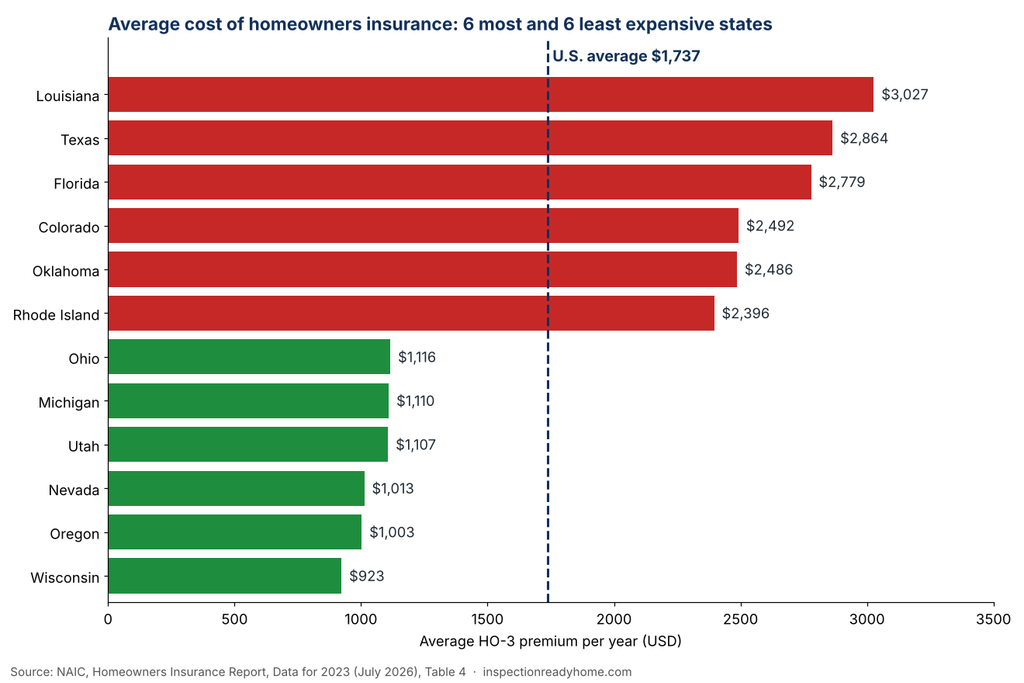
The 6 most expensive and 6 cheapest states
Start here if you only want to know where your state sits on the average cost of homeowners insurance. These are the NAIC averages for the HO-3 form, the standard homeowners policy that covers about 79% of owner-occupied homes in the country.
| Most expensive | HO-3 average | Cheapest | HO-3 average |
|---|---|---|---|
| 1. Louisiana | $3,027 | 1. Wisconsin | $923 |
| 2. Texas | $2,864 | 2. Oregon | $1,003 |
| 3. Florida | $2,779 | 3. Nevada | $1,013 |
| 4. Colorado | $2,492 | 4. Utah | $1,107 |
| 5. Oklahoma | $2,486 | 5. Michigan | $1,110 |
| 6. Rhode Island | $2,396 | 6. Ohio | $1,116 |
The pattern is easy to read. The top of the list is hurricane, hail and tornado country along the Gulf and in the Plains. The bottom is mostly the upper Midwest and the dry West, away from the coast. A homeowner in Louisiana pays more than three times what a homeowner in Wisconsin pays for the same type of policy. If you live in the second-most expensive state, our guide to homeowners insurance Texas rules adds the state regulator’s own, more recent average and the coastal wind rules.
Average cost of homeowners insurance by state: all 50 states and D.C.
The table shows the average cost of homeowners insurance in each state with two numbers. The HO-3 column is the one to compare with your own policy if you have a standard homeowners policy. The “all forms” column mixes in cheaper named-peril and dwelling fire policies and more expensive HO-5 policies, so it can sit above or below the HO-3 figure.
| State | HO-3 average per year | All forms average per year |
|---|---|---|
| United States | $1,737 | $1,731 |
| Alabama | $1,906 | $1,862 |
| Alaska | $1,216 | $1,188 |
| Arizona | $1,194 | $1,272 |
| Arkansas | $1,870 | $1,868 |
| California | $1,655 | $1,675 |
| Colorado | $2,492 | $2,601 |
| Connecticut | $2,036 | $2,063 |
| Delaware | $1,196 | $1,191 |
| District of Columbia | $1,545 | $1,570 |
| Florida | $2,779 | $2,482 |
| Georgia | $1,828 | $1,773 |
| Hawaii | $1,549 | $1,591 |
| Idaho | $1,135 | $1,191 |
| Illinois | $1,480 | $1,544 |
| Indiana | $1,259 | $1,304 |
| Iowa | $1,342 | $1,379 |
| Kansas | $1,733 | $1,801 |
| Kentucky | $1,525 | $1,484 |
| Louisiana | $3,027 | $2,860 |
| Maine | $1,150 | $1,177 |
| Maryland | $1,578 | $1,562 |
| Massachusetts | $2,134 | $2,134 |
| Michigan | $1,110 | $1,157 |
| Minnesota | $1,988 | $2,037 |
| Mississippi | $2,029 | $2,007 |
| Missouri | $1,589 | $1,675 |
| Montana | $1,768 | $1,865 |
| Nebraska | $2,142 | $2,148 |
| Nevada | $1,013 | $1,059 |
| New Hampshire | $1,300 | $1,332 |
| New Jersey | $1,551 | $1,560 |
| New Mexico | $1,490 | $1,540 |
| New York | $1,801 | $1,770 |
| North Carolina | $1,852 | $1,771 |
| North Dakota | $1,414 | $1,441 |
| Ohio | $1,116 | $1,130 |
| Oklahoma | $2,486 | $2,398 |
| Oregon | $1,003 | $1,086 |
| Pennsylvania | $1,217 | $1,179 |
| Rhode Island | $2,396 | $2,318 |
| South Carolina | $1,753 | $1,728 |
| South Dakota | $1,614 | $1,651 |
| Tennessee | $1,649 | $1,644 |
| Texas | $2,864 | $2,762 |
| Utah | $1,107 | $1,167 |
| Vermont | $1,215 | $1,231 |
| Virginia | $1,537 | $1,506 |
| Washington | $1,232 | $1,266 |
| West Virginia | $1,179 | $1,141 |
| Wisconsin | $923 | $968 |
| Wyoming | $1,853 | $1,958 |
Live in Florida? The state regulator publishes a newer and higher figure, plus averages for all 67 counties. See our guide to the average cost of homeowners insurance in Florida for the county table and why the two sources differ.
What you pay depends on your dwelling coverage
People often ask what insurance costs on a $300,000 or $500,000 house. The NAIC answers a close version of that question: it groups policies by the amount of insurance on the dwelling, not by the price you paid for the home. Your dwelling limit is the cost to rebuild, which can be well above or below the market value, so read your declarations page before you compare.
| Dwelling coverage (amount of insurance) | U.S. HO-3 average per year | Per month |
|---|---|---|
| Under $150,000 | $954 | $80 |
| $150,000 – $199,999 | $1,192 | $99 |
| $200,000 – $224,999 | $1,282 | $107 |
| $225,000 – $249,999 | $1,297 | $108 |
| $250,000 – $274,999 | $1,350 | $113 |
| $275,000 – $299,999 | $1,414 | $118 |
| $300,000 – $324,999 | $1,475 | $123 |
| $325,000 – $349,999 | $1,492 | $124 |
| $350,000 – $399,999 | $1,598 | $133 |
| $400,000 – $449,999 | $1,679 | $140 |
| $450,000 – $499,999 | $1,825 | $152 |
| $500,000 – $599,999 | $1,973 | $164 |
| $600,000 – $699,999 | $2,249 | $187 |
| $700,000 – $999,999 | $2,916 | $243 |
| $1,000,000 and over | $4,314 | $360 |
Two things stand out. Premiums rise steadily with coverage, but not in proportion: doubling coverage from about $250,000 to about $500,000 adds roughly 46%, not 100%. And this is a national blend. In a high-cost state, the same coverage band will usually cost more; in a low-cost state, less. That is why the average cost of homeowners insurance by state and by coverage band should be read together.
Average cost of homeowners insurance per month
Most people pay through their mortgage escrow, so a monthly figure is easier to check against a statement. Divide the yearly average cost of homeowners insurance by 12:
- U.S. average (HO-3): about $145 a month.
- Most expensive state, Louisiana: about $252 a month.
- Cheapest state, Wisconsin: about $77 a month.
- Texas and Florida: about $239 and $232 a month on the NAIC numbers.
If your escrow payment for insurance is $200 a month, you pay $2,400 a year. That is about 38% above the national average cost of homeowners insurance for an HO-3 policy. Whether it is “a lot” depends on your state and your coverage, which is exactly what the test below checks.
Why the average cost of homeowners insurance differs from site to site
Search for the average cost of homeowners insurance and you will see several different answers on the first page. None of them has to be wrong. They measure different things:
| Type of figure | What it measures | Why it can be higher or lower |
|---|---|---|
| NAIC report (this page) | Premium actually written by insurers in a year, divided by insured homes, from statistical agents and state regulators | Covers every coverage amount and the whole market, but it is about two years old by the time it is published |
| State regulator data (for example, Florida OIR) | Premium and policy counts reported to one state | Newer and more local; methods vary by state |
| Quote-based averages from insurers and comparison sites | Prices quoted for a sample home with a fixed coverage amount and deductible | Reflect current rates, but only for the profile they chose |
| One company’s own customers | What that company’s policyholders pay | Depends on who that company insures and where |
The NAIC itself warns that an average premium is an imperfect measure of price, because hazards, local economies and home values vary so much from state to state. Use the averages as a reference point, not as the price you should be offered. We explain how we choose and check sources on our How We Verify page.
Why is homeowners insurance so expensive in some states?
The NAIC report lists the forces behind the gap in the average cost of homeowners insurance between states. In plain terms:
- Catastrophe exposure. Hurricanes, hail, tornadoes, wildfire and severe winter storms drive large, sudden losses. States exposed to several of these sit at the top of the ranking.
- Rebuilding costs and home values. The amount of insurance follows the cost to rebuild. Dense areas, fast-growing areas and places with strict building codes tend to need higher limits.
- The building itself. Roof age and type, construction and wind or fire resistance change the expected loss. That is why insurers ask for roof, 4-point and wind mitigation inspections.
- State rules. Each state regulates rates and coverage requirements in its own way, which the NAIC says makes direct comparisons difficult.
You cannot move your house to a cheaper state, but you can change the third item. An older roof is one of the most common reasons for a higher quote or a refusal. Check yours with our free roof age and insurance checker, and read whether homeowners insurance covers roof replacement before you plan the work.
Is your premium out of line? A 3-step test
Compare your premium with the average cost of homeowners insurance twice: once against your state and once against your coverage band.
- Find your numbers. On your declarations page, note the yearly premium, the policy form (HO-3, HO-5 and so on) and the dwelling limit (Coverage A).
- Divide by the two averages. Divide your premium by your state’s HO-3 average, then by the national average for your coverage band in the table above.
- Read the result. Up to about 1.2 on both: you are close to typical. Above 1.5 on both: ask your agent what drives the price and get other quotes. One high and one low: your coverage amount or your state probably explains the gap.
Worked example (assumed numbers)
A homeowner in Michigan has an HO-3 policy with $360,000 of dwelling coverage and a renewal of $2,400 a year.
- Against the state: $2,400 ÷ $1,110 (Michigan HO-3 average) = 2.16.
- Against the coverage band: $2,400 ÷ $1,598 (U.S. average for $350,000-$399,999) = 1.50.
Both ratios are high, so the price is not explained by the state or by the coverage amount alone. This homeowner should ask what changed at renewal (claims, roof age, deductible, added coverage) and compare at least two other quotes for the same coverage.
Ask your insurer or agent
- Which factors raised my premium at this renewal?
- Is my dwelling limit based on rebuilding cost, and when was it last updated?
- Would a roof, 4-point or wind mitigation inspection change my rate?
- What would a higher deductible save, in dollars, on this policy?
In Florida and other coastal states, a wind mitigation inspection is the inspection most closely tied to the wind part of the premium. If regular insurers will not cover your home at any price, your state’s FAIR plan insurance may be the fallback.

Frequently asked questions
What is the average cost of homeowners insurance per year?
The average cost of homeowners insurance per year was $1,737 for a standard HO-3 policy and $1,731 across all owner-occupied and dwelling fire forms, according to the NAIC’s data for 2023. Rates filed since then have changed in many states, so a renewal today can be higher.
How much is homeowners insurance on a $300,000 house?
If the house is insured for $300,000 to $324,999 of dwelling coverage, the national HO-3 average was $1,475 a year, about $123 a month. The figure is for the amount of insurance, not the sale price, and it will be higher in states such as Louisiana, Texas or Florida.
How much is homeowners insurance on a $500,000 house?
For $500,000 to $599,999 of dwelling coverage, the national HO-3 average was $1,973 a year, about $164 a month. Above $1 million of coverage, the average rises to $4,314.
Which state has the cheapest homeowners insurance?
Wisconsin has the lowest average cost of homeowners insurance, with an HO-3 average of $923 a year, followed by Oregon ($1,003) and Nevada ($1,013). Louisiana is the most expensive at $3,027.
Why does my quote not match the average cost of homeowners insurance?
Your quote prices your home: its location, roof, age, construction, claims history, deductible and coverage. The average cost of homeowners insurance blends millions of very different homes. Use the 3-step test above to see whether the gap comes from your state, your coverage or something specific to your home.
When to call a pro
Talk to a licensed insurance agent or broker if your premium is far above both averages, if your renewal jumped without a clear reason or if you have received a non-renewal notice. If the insurer points to the roof or the home’s systems, a licensed home inspector can document their condition. Our free 4-point self-check helps you prepare before the visit.
Sources
- National Association of Insurance Commissioners (NAIC), Dwelling Fire, Homeowners Owner-Occupied, and Homeowners Tenant and Condominium/Cooperative Unit Owner’s Insurance Report: Data for 2023 (July 2026), Figure 1, Table 4 and the sections on limitations and factors affecting cost.
This guide is general information, not insurance advice. Daniel Aznar is not an insurance agent or a home inspector. Ask your insurer, a licensed agent or a licensed inspector about your own home. Read our full disclaimer. Information checked in November 2026.